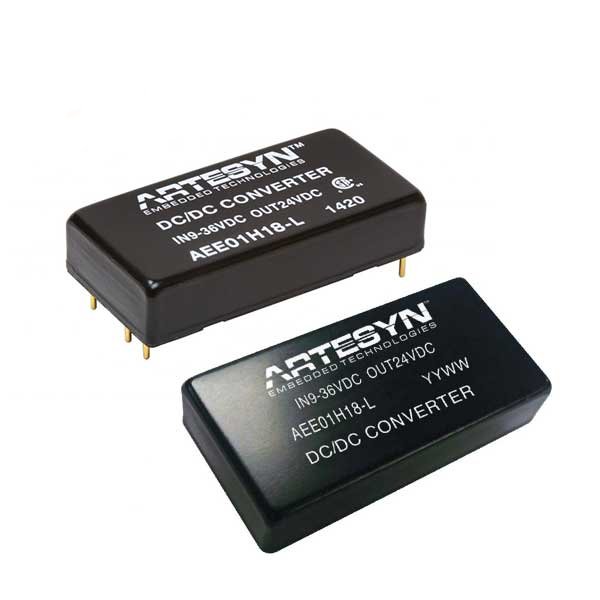
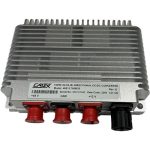
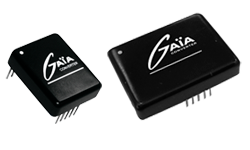
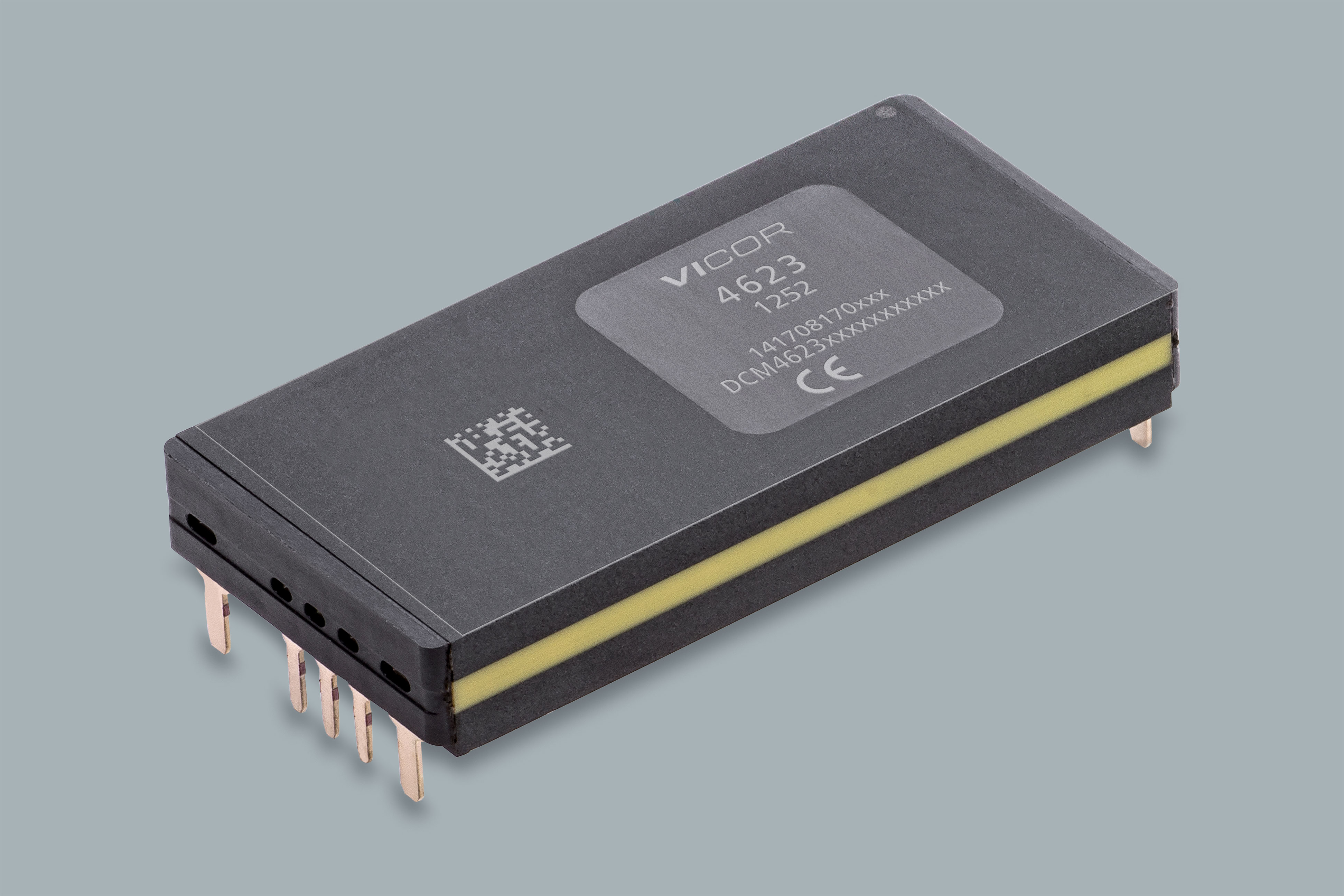
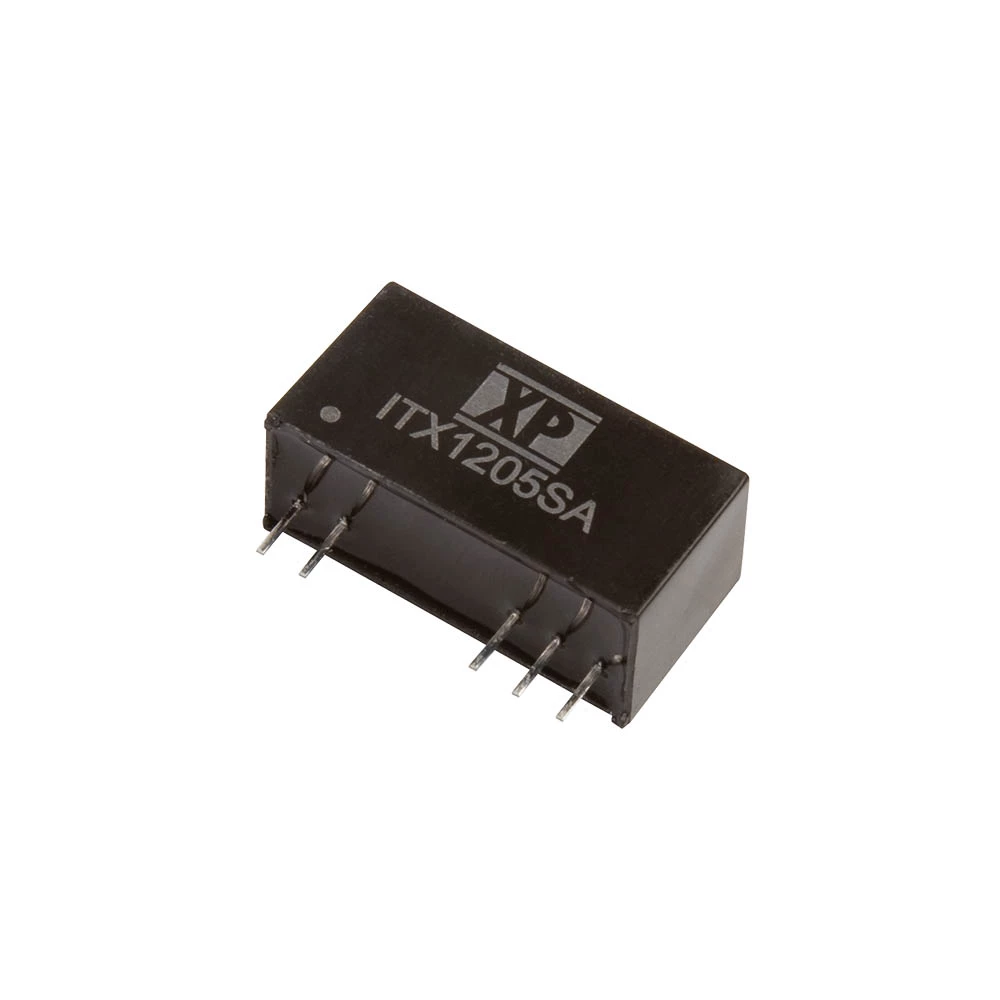
A DC-DC converter transforms one direct-current voltage into another, stepping it down, up, or both, while regulating the output against changes in input voltage and load. Modern converters are switch-mode: a semiconductor switch chops the input at tens to hundreds of kilohertz, an inductor or transformer stores and transfers the energy, and a feedback loop holds the output steady. They are the workhorses that convert a 48 V rack bus, a 24 V industrial rail, or a battery pack into the multiple regulated voltages that processors, sensors, radios, and actuators actually need.
This guide separates the two families that drive every selection decision, non-isolated and isolated, and walks through topologies, brick formats, the safety and railway standards that gate procurement, and the spec-sheet numbers that decide which module survives in your design.
Photo: Matthew Berardi, CC BY-SA 4.0, via Wikimedia Commons
This guide is written for industrial purchasing engineers and design engineers. It covers 6 chapters: what a DC-DC converter is, the non-isolated and isolated families, the working topologies, packaging formats and the standards that gate them, the key specification parameters, and the selection decision sequence, plus 7 selection FAQs and manufacturer comparisons. Parameters and standard designations reference public technical literature and the IEC/EN 62368-1 safety standard, the EN 50155 / EN 61373 / EN 45545-2 railway standards, the CISPR 32 / EN 55032 EMC standard, and the DOSA brick footprint convention.
Chapter 1 / 06
What is a DC-DC Converter
A DC-DC converter is an electronic power-conversion device that accepts a direct-current input at one voltage and produces a direct-current output at a different, regulated voltage. It sits between a power source (a battery, a rectified mains rail, a solar string, a bench programmable DC power supply, or a distribution bus) and the loads that need a specific voltage to operate. Where a linear regulator simply burns the voltage difference as heat, a switch-mode DC-DC converter transfers energy in discrete packets through magnetic storage, so it can step voltage up as well as down and can reach efficiencies above 90 percent that a linear regulator cannot approach.
The defining mechanism is switching. A controller drives a semiconductor switch (a MOSFET, and increasingly a gallium-nitride or silicon-carbide device) on and off at a fixed or variable frequency, commonly in the range of 100 kHz to several megahertz. During the on-time, energy flows into an inductor or transformer; during the off-time, that stored energy flows to the output. The ratio of on-time to total period, the duty cycle, sets the conversion ratio. A feedback loop continuously trims the duty cycle so the output stays on target as the input voltage drifts and the load changes. This is why a switch-mode converter is sometimes called a switch-mode power supply (SMPS) when packaged as a complete unit.
Two architectural distinctions organize the entire field. The first is isolation: whether a transformer galvanically separates the input ground from the output ground. Non-isolated converters (buck, boost, buck-boost) share a common ground and are smaller and cheaper; isolated converters (flyback, forward, push-pull, half-bridge, full-bridge, resonant) insert a transformer and are required wherever grounds must float or safety insulation is mandated. The second is regulation: whether the converter actively holds a fixed output voltage, or delivers a fixed ratio of input to output (a bus converter) and leaves regulation to a downstream stage. These two axes, isolated versus non-isolated and regulated versus fixed-ratio, frame every chapter that follows.
The history runs alongside the rise of power semiconductors. Switch-mode conversion became practical once fast power transistors replaced vacuum tubes and mechanical vibrators in the 1960s and 1970s. Integration followed: the monolithic switching regulator put controller and switch on one die, then the power module put controller, switch, inductor or transformer, and capacitors into one packaged brick. The latest shift is the wide-bandgap transition, where gallium-nitride (GaN) and silicon-carbide (SiC) switches reduce switching loss enough that published 48-to-12 V data-center converters now exceed 99 percent peak efficiency, a level unreachable with silicon a decade earlier.
In application scale, DC-DC converters span from milliwatts to hundreds of kilowatts. A board-mounted point-of-load regulator may deliver a few watts at 1.0 V to a processor core; an isolated brick may deliver tens to hundreds of watts across a safety barrier; a bus converter may move kilowatts down a server rack fed in turn by an upstream industrial UPS. The same physics scales across this range, but the topology, packaging, cooling, and standards change at each tier, which is exactly what makes selection a structured engineering task rather than a single catalog lookup.
Chapter 2 / 06
Non-Isolated vs Isolated Families
The first fork in any DC-DC selection is isolation. Non-isolated converters connect input and output through a shared return path; isolated converters break that path with a transformer so the two sides float independently. The choice is rarely about voltage ratio alone: it is driven by grounding, safety insulation, and noise. The table below summarizes how the two families differ on the parameters that matter at selection time.
Non-isolated converters are the default for on-board power distribution where input and output already share a ground. A buck converter steps a higher rail down to a lower one (for example 12 V to 3.3 V or 1.0 V), a boost converter steps a lower rail up to a higher one (for example a single-cell battery to 5 V), and a buck-boost converter does either, which matters for battery inputs whose voltage crosses the output during discharge. Because there is no transformer, these converters are physically small, inexpensive, and reach the highest efficiencies, since a synchronous buck stage with a low-resistance MOSFET avoids the diode drop entirely. Their limitation is that they provide no galvanic separation and cannot satisfy a safety-insulation requirement.
Isolated converters insert a transformer between primary and secondary, breaking the direct electrical path. This is mandatory in three situations: when a safety standard requires basic or reinforced insulation between a hazardous source and an operator-accessible output; when input and output must reference different grounds (a common need in instrumentation, where a battery-referenced controller drives a separately grounded sensor, often alongside a signal isolator on the measurement path); and when ground loops or common-mode noise must be blocked. The transformer also lets the designer set any turns ratio, so isolated converters handle large step-down ratios gracefully, but they pay for it in size, cost, and a few points of efficiency lost in the magnetics.
A useful intermediate category is the fixed-ratio isolated bus converter, which provides isolation and a fixed step-down ratio but no active regulation. By dropping the regulation loop, these modules reach the highest efficiencies in the field: Vicor BCM bus converters built on a sine-amplitude resonant topology are rated at peak efficiencies up to 98 percent. They are used as the middle stage in intermediate bus architectures, where a downstream non-isolated point-of-load stage supplies the final regulation. This is the architecture that lets a system get isolation, high efficiency, and tight regulation at the same time, by assigning each job to the stage best suited to it.
The practical decision rule is simple. If both sides already share a ground and no standard demands insulation, choose a non-isolated converter for its size, cost, and efficiency. If grounds must float, a safety standard mandates insulation, or you need to block a ground loop, choose isolated, and decide separately whether you need a regulated isolated module or a fixed-ratio bus converter followed by point-of-load regulation.
Chapter 3 / 06
Working Topologies
Within each family, the circuit topology sets the achievable power, isolation, efficiency, and complexity. There is no universal topology: low-power isolated rails favor the flyback for its part count, while multi-kilowatt isolated stages move to bridge and resonant designs. The table below compares the mainstream topologies on the metrics that drive a topology decision.
Topology
Isolated
Typical Power
Notes
Buck (step-down)
No
< 1 W to kW
Highest efficiency step-down, shared ground
Boost (step-up)
No
< 1 W to kW
Step-up, used in PFC and battery boost
Buck-boost / SEPIC / Cuk
No
< 1 W to hundreds W
Output above or below input, battery inputs
Flyback
Yes
< 100 W
Simplest isolated, low part count
Forward
Yes
100 to 300 W
Isolated buck, needs reset winding
Push-pull
Yes
100 W to > 1 kW
Higher efficiency than flyback/forward
Half / full bridge
Yes
500 W to > 10 kW
High power, four switches in full bridge
LLC resonant
Yes
100 W to > 10 kW
Soft switching, very high efficiency
Buck, boost, and buck-boost are the three fundamental non-isolated converters that underpin nearly all power-supply design. The buck converter switches the input into an inductor and freewheels it into the output, producing a voltage below the input. The boost converter charges the inductor from the input then dumps it in series with the source, producing a voltage above the input. The buck-boost produces either, and its modern non-inverting four-switch implementation uses a single inductor with switches replacing diodes so the controller can transition smoothly through the region where input equals output, which is exactly what a battery-powered rail needs as the cell discharges.
Two further non-isolated variants, the SEPIC (single-ended primary-inductor converter) and the Cuk, also allow output voltage above or below input, but with a non-inverting output and a coupled-inductor structure. They suit applications where a wide input range crosses the output and where the cleaner input or output current of these topologies is worth the extra inductor. All of these non-isolated converters operate in either continuous conduction mode, where inductor current never falls to zero, or discontinuous conduction mode at light load, which changes the control behavior and the efficiency profile.
On the isolated side, the flyback is the simplest and most common topology for low power, storing energy in the transformer during the on-time and releasing it during the off-time; at the switching frequencies used here the transformer core is typically ferrite rather than the laminated silicon steel used in line-frequency magnetics. The flyback is economical but does not scale well above roughly 100 W or to high output currents. The forward converter is essentially an isolated buck that transfers energy while the switch is on and needs a transformer reset mechanism; it suits the low-to-mid hundreds of watts. The push-pull drives the transformer in both polarities through two switches, offering higher efficiency than flyback or forward and serving power levels from the hundreds of watts to over a kilowatt.
Half-bridge and full-bridge topologies step down large DC voltages by pulsing a transformer with two or four switches respectively; the full bridge transfers energy in all switching phases, raising power density at the cost of more switches and control complexity, and these designs reach into the multi-kilowatt range. The LLC resonant topology shapes the current into a near-sinusoid so the switches turn on and off at zero voltage or zero current, slashing switching loss and reaching very high efficiency across a wide input range. Its drawbacks are control complexity and poor light-load and standby behavior, because the resonant tank must stay energized. Vicor's proprietary sine-amplitude bus converters are a productized resonant approach that reaches up to 98 percent peak efficiency in fixed-ratio service.
Chapter 4 / 06
Packaging Formats and Standards
A topology becomes a purchasable part only once it is packaged, and packaging in this field follows two largely standardized conventions: chip-scale and module point-of-load packages for non-isolated converters, and the brick footprint family for isolated converters. The brick footprints are standardized by DOSA (the Distributed-power Open Standards Alliance) so that modules from different manufacturers are pin-compatible and second-sourceable, which is a genuine procurement advantage. The table below summarizes the brick family and representative power levels.
Format
Approx. Footprint
Representative Power
Typical Use
Full brick
116.8 × 61.0 mm
up to ~1 kW
High-power isolated rails
Half brick
61.0 × 57.9 mm
100 to 700 W
Telecom, industrial
Quarter brick
58.4 × 36.8 mm
up to ~750 W
Bus converters, IBC
Eighth brick
58.4 × 22.9 mm
up to ~500 W
Board-mount isolated
Sixteenth brick
33.0 × 22.9 mm
up to ~66 W
Space-constrained boards
SIP / DIP module
SIP4 to SIP8
0.25 to ~10 W
Signal isolation, gate-drive rails
The brick formats trade power against density. A Vicor quarter-brick bus converter delivers up to 750 W and a Vicor BCM module reaches power densities up to 3.4 kW per cubic inch in its highest-density variants, while a Murata sixteenth-brick ULS module delivers up to 66 W at up to 89 percent efficiency with full 2250 VDC isolation in a DOSA-compliant package. At the small-signal end, single-in-line packages from RECOM such as the RxxPxx econoline family deliver about 1 W in a SIP7 outline with a high 6.4 kVDC input-to-output isolation tested for one second over a 250 VAC working voltage, reaching typical efficiency in the 70 to 80 percent range and full power from minus 40 to plus 90 degrees Celsius without derating in free-air convection.
Standards are not an afterthought in this category: they gate which module is even eligible for a given system. The current product-safety standard for information and communication equipment is IEC/EN/UL 62368-1, which replaced the legacy IEC 60950-1 for new designs. It works on a hazard-based engineering model, classifying energy sources and setting the creepage, clearance, and insulation that follow. A converter datasheet that claims reinforced insulation commonly specifies 3000 VAC isolation to satisfy it, and the engineer must confirm whether the rating is basic, supplementary, or reinforced, because the permitted working voltage differs by class.
Two application domains add their own standard stacks. Railway converters must meet EN 50155 for rolling-stock electronics, EN 61373 for shock and vibration, and EN 45545-2 for fire, smoke, and toxicity of materials; rail converters also commonly provide high isolation such as 3000 VAC reinforced insulation and reference EN 50121-3-2 for EMC. Automotive components reference AEC-Q100 qualification for the semiconductors and module-level qualification for the converter. Across all domains, electromagnetic compatibility typically references the CISPR 32 / EN 55032 conducted and radiated emission classes, with Class B being stricter than Class A. Confirming these designations against the bill of materials early prevents a late and expensive redesign when a converter fails a compliance test.
One more packaging-linked dimension is thermal interface. Bricks may be open-frame (cooled by airflow), baseplate (conduction-cooled to a chassis), or potted for harsh environments. The cooling method changes the rated current, because the same electrical core derates differently depending on how heat leaves the package, which is why the thermal derating curve in Chapter 5 must be read together with the package choice here.
Chapter 5 / 06
Key Specification Parameters
Reading a DC-DC converter datasheet means separating headline marketing numbers from the parameters that actually constrain a design. A datasheet may list dozens of lines, but a small set drives selection: input voltage range, output voltage and current, efficiency, isolation voltage, ripple and noise, line and load regulation, switching frequency, operating temperature with derating, and reliability. Each is explained below.
Input voltage range is the window over which the converter operates within specification. Wide-input modules (for example 9 to 36 V or 18 to 75 V) tolerate sagging and surging source rails; narrow 2:1 modules are cheaper but demand a well-controlled source. Always match the window to the full excursion of the source, not its nominal value, because an industrial 24 V rail routinely dips and spikes well outside 24 V, which is why a surge protective device is often placed ahead of the converter input. Output voltage and current define the deliverable power; the rated current is a ceiling that itself depends on temperature, as the derating curve shows.
Efficiency is output power divided by input power at a stated input voltage and load, and it is a curve, not a point. Converters peak near 50 to 80 percent load and fall off at light load where fixed switching and bias losses dominate, and at minimum input voltage where currents and conduction losses rise. Synchronous non-isolated buck point-of-load converters typically reach 90 to 96 percent, small isolated bricks 88 to 92 percent, and fixed-ratio resonant bus converters up to 98 percent. The losses behind the curve are conduction loss in the switch on-resistance and inductor and capacitor resistance, the diode forward-voltage drop in non-synchronous designs, and switching loss that rises with frequency, which is precisely why wide-bandgap GaN and SiC switches improve high-frequency efficiency.
Isolation voltage applies only to isolated converters and is the test voltage the input-to-output barrier withstands, quoted as VAC or VDC for a defined time (often one second). Distinguish the test voltage from the continuous working voltage and from the insulation class (basic, supplementary, reinforced); a 3000 VAC reinforced barrier and a 1500 VAC basic barrier serve very different safety roles. Ripple and noise is the peak-to-peak output disturbance: ripple at the switching frequency and harmonics, noise at higher frequencies from switching edges. It is meaningful only with its measurement bandwidth (commonly 20 MHz) and external capacitor stated; small isolated bricks often specify on the order of 150 mV peak-to-peak, while sensitive analog or RF rails may need under 10 mV, achieved with an LC post-filter or a downstream low-dropout regulator.
Line and load regulation quantify how much the output moves when the input voltage or the load current changes, expressed as a percentage; tighter regulation matters for precision rails and is one of the trade-offs given up by unregulated bus converters in exchange for efficiency. Switching frequency (commonly in the hundreds of kilohertz, for example 300 to 500 kHz, and into the megahertz for the smallest modules) sets the size of the magnetics and the EMI spectrum; many converters lower the frequency at light load to recover efficiency.
Operating temperature and derating are inseparable. A converter rated at full current only up to a baseplate or ambient temperature (often 25 to 55 degrees Celsius) delivers less above that, following a linear derating curve to zero at the maximum case temperature. Reliability is expressed as mean time between failures (MTBF), commonly calculated by the MIL-HDBK-217F method at 25 degrees Celsius; board-mount modules frequently quote figures from several hundred thousand to several million hours, but the calculation method and reference temperature must match before two numbers can be compared. The decisive output specifications are summarized below.
Parameter
Typical Range
What It Constrains
Input range
2:1 to 4:1 window
Source rail tolerance
Efficiency (peak)
88 to 98%
Heat and energy cost
Isolation (isolated)
1 to 8 kVDC
Safety insulation class
Ripple and noise
< 10 to 150 mV p-p
Downstream rail cleanliness
Load regulation
± 0.2 to 1%
Precision of regulated rail
Switching frequency
300 kHz to MHz
Magnetics size and EMI
Operating temp.
-40 to +85°C
Current derating ceiling
Chapter 6 / 06
Selection Decision Factors
To turn the preceding five chapters into a specific part number, follow the decision sequence below. Most selection mistakes are not a single wrong number but a premature decision at the wrong level, such as picking a module before confirming whether isolation is required. These steps work as a fixed RFQ template.
Isolation requirement: Decide first whether input and output must be galvanically separated, driven by grounding needs and by any safety standard (IEC/EN 62368-1, railway EN 50155) that mandates basic or reinforced insulation. This single decision splits the entire candidate field into non-isolated and isolated.
Voltage and power envelope: Define the full input voltage window (minimum to maximum, including transients), the required output voltage, and the worst-case output current. Choose a topology family from Chapter 3 that covers the step direction (down, up, or both) and the power level.
Regulation versus fixed ratio: Decide whether you need a regulated output or can use a fixed-ratio bus converter followed by point-of-load regulation. Intermediate bus architecture (a 4:1 bus converter feeding non-isolated POL stages) often wins on total efficiency and is why hyperscale systems distribute 48 V, with the front-end AC-DC stage frequently fed from a mains power transformer upstream.
Packaging and footprint: Fix the format from Chapter 4, chip-scale or module POL for non-isolated, or a DOSA brick size for isolated. The brick footprint sets the mechanical, thermal, and second-source envelope before electrical comparison begins.
Efficiency at the real operating point: Compare efficiency curves at your actual input voltage and load, not the headline peak, and at the minimum-input corner where conduction losses are highest. The few points of difference here drive heatsinking and energy cost over the product's life.
Isolation and EMC compliance: Confirm the isolation class and test voltage (basic, supplementary, reinforced; for example 3000 VAC) and the EMC class (CISPR 32 / EN 55032 Class A or B). Verify any domain standards for railway (EN 50155 / EN 61373 / EN 45545-2) or automotive (AEC-Q100) up front.
Thermal and derating margin: Read the temperature derating curve and confirm the rated current holds at your maximum ambient or baseplate temperature with margin. Decide the cooling method (open-frame airflow, baseplate conduction, or potted) consistent with the package.
Reliability and signal integrity: Check MTBF on a consistent basis (MIL-HDBK-217F at a stated temperature), and verify ripple-and-noise and line and load regulation against the downstream rail's tolerance, adding an LC post-filter or LDO if a sensitive analog or RF load demands it.
One commonly overlooked dimension is serviceability and second-sourcing: whether the footprint is DOSA-standard so a pin-compatible alternate exists, whether the maker holds local inventory and lead times you can live with, and whether long-term availability matches your product lifecycle. For board-mount isolated modules, RECOM, Murata Power Solutions, and TDK-Lambda are mainstream sources; for high-density bricks and bus converters, Vicor and Bel Power Solutions lead; and for non-isolated point-of-load regulators and modules, Texas Instruments, Analog Devices, Infineon, and Monolithic Power Systems supply the silicon and integrated modules. Choosing a DOSA-compliant footprint early preserves the option to second-source years later, which standalone proprietary parts cannot offer.
FAQ
What is the difference between a non-isolated and an isolated DC-DC converter?
A non-isolated converter shares a common ground between input and output: buck, boost, and buck-boost circuits connect the two sides through an inductor, so there is a direct electrical path. An isolated converter inserts a transformer between primary and secondary, breaking the galvanic path so the two grounds float independently. Isolation is required when input and output must not share a return (for example a battery-referenced control side and a grounded sensor side), when safety standards demand basic or reinforced insulation, and when ground loops or common-mode noise must be blocked. Isolation costs efficiency points and board area, so non-isolated point-of-load converters dominate on-board step-down where both rails already share a ground.
How do I read efficiency and what is a realistic figure?
Efficiency is output power divided by input power, quoted at a specific input voltage and load. It is not a single number: read the efficiency-versus-load curve, because converters peak near 50 to 80 percent load and fall off at light load where fixed switching and bias losses dominate. Non-isolated synchronous buck point-of-load converters typically reach 90 to 96 percent. Small isolated brick converters (eighth to sixteenth brick) run 88 to 92 percent. Fixed-ratio bus converters using resonant or sine-amplitude topologies are the efficiency leaders, with Vicor BCM modules rated at peak efficiencies up to 98 percent. Always compare efficiency at your actual operating point, not the headline peak.
What do brick sizes like quarter-brick and eighth-brick mean?
Brick is an industry footprint standard for board-mounted isolated DC-DC converters, standardized by DOSA (Distributed-power Open Standards Alliance) so modules from different makers are pin-compatible. A full brick is roughly 116.8 by 61.0 mm (2.4 by 4.6 inch). A half-brick is half that area, a quarter-brick a quarter, an eighth-brick an eighth, and a sixteenth-brick a sixteenth. Smaller bricks carry less power but raise power density: Murata sixteenth-brick ULS modules deliver up to 66 W at up to 89 percent efficiency, while Vicor quarter-brick bus converters reach up to 750 W. Choosing a brick size fixes the mechanical and thermal envelope before you compare electrical specs.
What is intermediate bus architecture and why is 48 V used?
Intermediate bus architecture (IBA) splits conversion into three stages: a front-end AC-DC or 48 V source, an isolated intermediate bus converter (IBC) that steps the bus down by a fixed ratio (commonly 4:1, giving a nominal 12 V), and non-isolated point-of-load (POL) converters at each chip that provide final regulation. Distributing power at 48 V instead of 12 V cuts distribution current by a factor of four, and because resistive loss scales with current squared, it cuts distribution loss by about sixteen times. Hyperscale data centers adopted 48 V rack power for this reason, and modern 48-to-12 V converters reach above 99 percent efficiency in published designs.
Which standards govern DC-DC converter safety and isolation?
For information and communication equipment, IEC/EN/UL 62368-1 is the current product safety standard, replacing the older IEC 60950-1 for new designs. It classifies energy sources and sets creepage, clearance, and insulation requirements; reinforced-insulation converters commonly specify 3000 VAC isolation to satisfy it. Railway converters add EN 50155 (rolling-stock electronics), EN 61373 (shock and vibration), and EN 45545-2 (fire and smoke). Automotive components reference AEC-Q100 qualification. EMC compliance typically references CISPR 32 / EN 55032 conducted and radiated emission classes. Always confirm whether a datasheet claims basic, supplementary, or reinforced insulation, because the working voltage and test voltage differ.
How do I size input voltage range and output current for a module?
Match the module input window to the full excursion of your source, not just its nominal value: a 24 V industrial rail can sag to 18 V and surge during transients, so a 9-to-36 V or 18-to-75 V wide-input module gives margin. On the output, size for worst-case load current plus a derating margin, then check the thermal derating curve, because rated current usually applies only up to a baseplate or ambient temperature (often 25 to 55 degrees Celsius) and falls linearly above it. For wide-input ratio modules, verify efficiency at both ends of the input range, since efficiency at minimum input often differs by several points from the nominal-input headline.
What causes output ripple and noise, and what is acceptable?
Ripple is the periodic output variation at the switching frequency and its harmonics; noise is the higher-frequency spikes from switching transitions. Both are driven by output capacitor ESR, switching frequency, and layout. Datasheets quote ripple-and-noise as a peak-to-peak voltage measured over a defined bandwidth (commonly 20 MHz) with a specified capacitor: small isolated bricks often specify on the order of 150 mV peak-to-peak or less, while sensitive analog and RF rails may demand under 10 mV, requiring an added LC post-filter or a low-noise LDO downstream. Always check the measurement bandwidth and external capacitor used, because numbers are not comparable without them.
DC-DC Converter Manufacturers
Source-backed product routes. Open a company dossier for procurement scope and cited evidence.