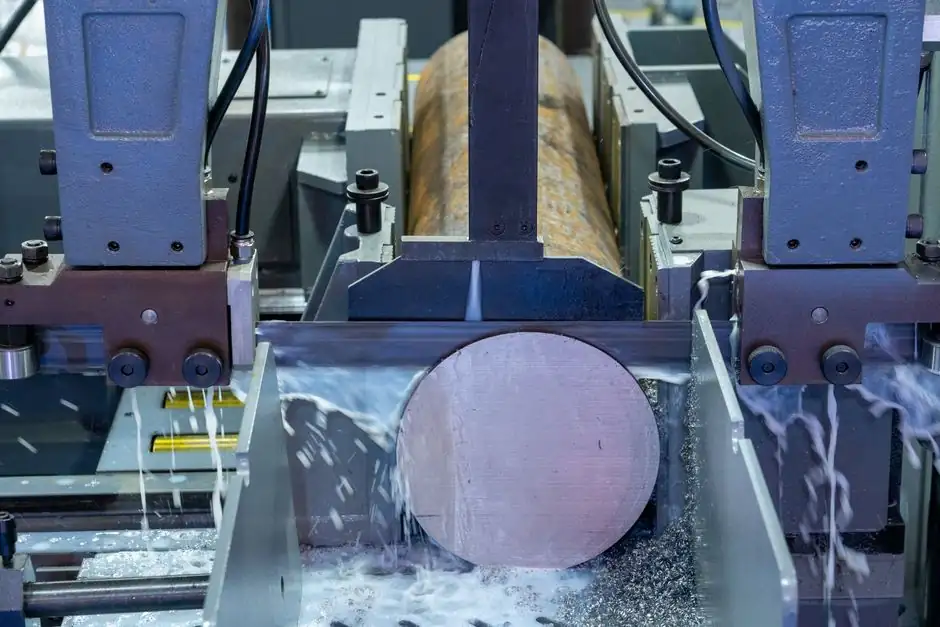
Deburring is the secondary operation that strips raised edges, flash, and slag left by stamping, milling, drilling, turning, laser, plasma, and waterjet cutting [S1][S4]. A deburring machine specification sheet typically locks down four variables: the burr class being removed, the abrasive or media selected, the achievable edge radius, and the throughput model (continuous-belt vs. batch vibratory).
Cost pressure is real: deburring absorbs roughly 30% of total manufacturing expense for precision aerospace parts and 15-20% in automotive production, because burr removal adds no intrinsic part value yet it is functionally non-negotiable [S3]. Specifying the right machine class is therefore a direct lever on unit cost, not a finishing-line afterthought.
Burr Classification and Why It Drives Machine Choice
Burrs fall into three mechanical families: rollover (the most common, curled sliver protruding from the cut edge), Poisson (lateral extrusion at the exit side of a cut), and breakout (upward swelling at the bottom of a pierced or drilled hole) [S1]. A fourth practical class, thermal burrs (slag, dross, resolidified melt), appears after plasma, flame, and laser cutting and bonds metallurgically to the parent material, which forces a different removal strategy than mechanical burrs [S4].
Burr size, shape, and adhesion vary with material ductility, tool wear, and cut parameters, so the spec sheet must name the upstream operation (laser, plasma, stamped, fineblanked, cast) before the abrasive or media can be selected [S3]. Generic "deburring machine" quotes without a named burr source tend to under-spec the contact tool and over-spec the spindle power.
Abrasive and Media Specification: Grit, Contact Tool, Geometry
For belt-driven deburring, the abrasive spec is the controlling number. Common abrasive grains on grinding belts are aluminum oxide (corundum), silicon carbide, and ceramic; grit size runs from P36 (aggressive stock removal) to P180 (fine surface refinement), with the higher P-number meaning smaller grit and lower material-removal rate [S2]. A spec line that only states "abrasive belt" without a P-range is non-conforming for OEM procurement.
For batch processing, vibratory deburring places parts and tumbling media in a polyurethane- or rubber-lined process chamber driven by a vibration motor with offset weights; media flows in a coroidal (corkscrew) pattern, and the chamber sits on a spring-mounted base [S5]. Media selection sets the cutting force: ceramic media handles light to heavy burrs on harder metals, plastic media suits precision parts and anodizing prep, and steel media targets burnishing and compressive surface work [S5].
Edge Rounding, Oxide Removal, and Throughput Geometry
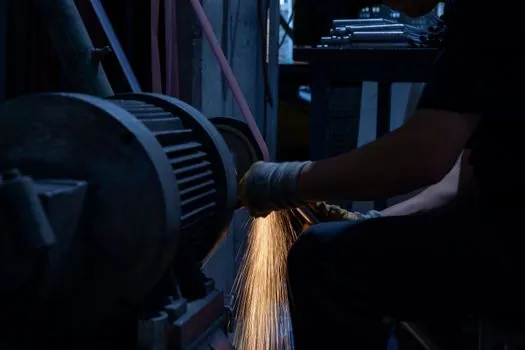
Single-sided belt machines (e.g. the LISSMAC SMD family) can hit edge-rounding radii up to 2 mm in a single pass but require the operator to flip the part for the second side; double-sided machines (e.g. the SBM series) process top and bottom in one pass, which matters for thin-gauge sheet that would deform if handled twice [S2]. For plate and plasma-cut parts with heavy slag, single-sided machines still tend to give the larger achievable radius, while double-sided machines trade radius for handling economy.
Wet and dry vibratory configurations are both offered; the cut is wet for heavier burrs and finishing compounds, dry for parts that must leave the machine dry or where compound residue is unacceptable [S5]. A complete vibratory spec should also pin the chamber volume, motor power, and amplitude, since those three numbers govern batch size and finishing time per load.
Process Comparison: Belt, Vibratory, Thermal, Electrochemical
Four deburring process families dominate the spec sheet, and each lines up differently against four decision criteria: burr accessibility, material hardness, tolerance risk, and unit cost at volume [S1][S3][S5].
Manual deburring is the cheapest entry point and the most common method, but it is labor-bound and inconsistent across shifts [S1]. Mechanical belt or brush deburring is the cost-efficient mid-volume choice and handles the bulk of laser- and plasma-cut steel service center work [S2]. Vibratory mass finishing is the throughput leader for batch production, with the lowest labor content and the gentlest part handling when media is correctly matched [S5]. Thermal deburring (combustive gas) reaches cracks, cross-holes, and internal passages that a contact tool cannot touch, and electrochemical deburring (salt or glycol electrolyte) hits the same hard-to-reach zones on tough alloys while leaving the parent surface intact [S1].
Selection rule of thumb: specify belt machines for flat plate and sheet with defined edge-radius targets, vibratory for high-mix batch parts under 200 mm where contact access is open, thermal for internal passage burrs on machined valve bodies, and electrochemical where the parent material is hardened or exotic and a no-recast layer is mandatory [S1][S5].
Standards, Quality Control, and What Belongs on the Spec Sheet
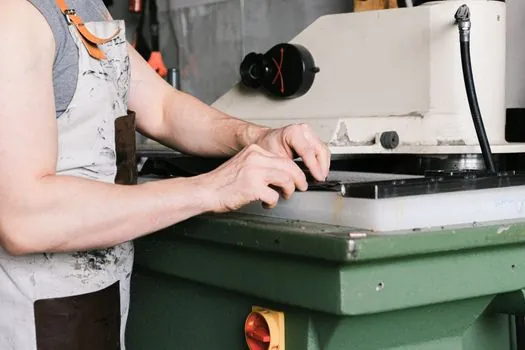
Because burr size, shape, and location are empirical, process development usually includes production trials and QC checks before a machine is locked into a routable work order [S3]. A defensible deburring spec should therefore name the upstream cut process, the target edge radius in mm, the abrasive P-range or media type, the surface finish expectation (Ra if known), and the throughput class (parts per hour for belt, kg per load for vibratory).
Material handling constraints belong on the spec as well: thin-gauge sheet often needs leveling or upward/downward fixturing before deburring, and plate parts are heavy enough that the machine's worktable capacity and hoist interface must be listed, not assumed [S2]. For shops that already run vibratory drives on feeding or conveying lines, vibratory feeder working principles and spring tuning carry over directly into vibratory deburring chamber design, since the offset-weight motor and spring isolation are the same engineering pattern. Likewise, vibratory equipment maintenance and acceptance criteria translate one-to-one to vibratory deburring uptime, and shops that already spec surface-finish equipment such as industrial cutting machine safety can fold deburring into the same guarding review.
Limitations, Failure Modes, and Sourcing Realities
Global deburring methods that treat the whole surface (vibratory, barrel, tumble, abrasive flow) can unintentionally shift dimensions and leave chemical or abrasive residues, so tight-tolerance parts may need a local contact tool, not a batch process [S3]. Burrs also act as fatigue crack initiators and corrosion sites; treating them as cosmetic is a documented root cause of premature field failure, especially in high-stress aerospace and hydraulic components [S3][S5].
Sourcing reality: U.S. steel service centers, laser job shops, stainless processors, and Tier-1 automotive suppliers are the dominant buyer pool for both belt and vibratory deburring equipment, and most OEMs offer tailored fixturing for small parts rather than off-the-shelf frames [S2]. A plant evaluating new deburring capacity should match the machine's work envelope to the heaviest plasma- or laser-cut plate, not the average, because the heavy parts set the table size, spindle power, and abrasive cost-per-part for the whole cell.
Trackable signals for the next planning cycle: published P-range offerings on belt consumables (corundum, SiC, ceramic) for laser-cut stainless at thicknesses above 6 mm; vibratory chamber volumes sized for CNC-batch loads above 50 kg; and OEM disclosures on edge-rounding radius repeatability for thin-gauge sheet under 2 mm. Compare any new vendor's published numbers against the 2 mm single-pass radius benchmark and the P36 to P180 grit window before signing a PO [S2].
Component reference pages worth checking: coding machine, and core machine.