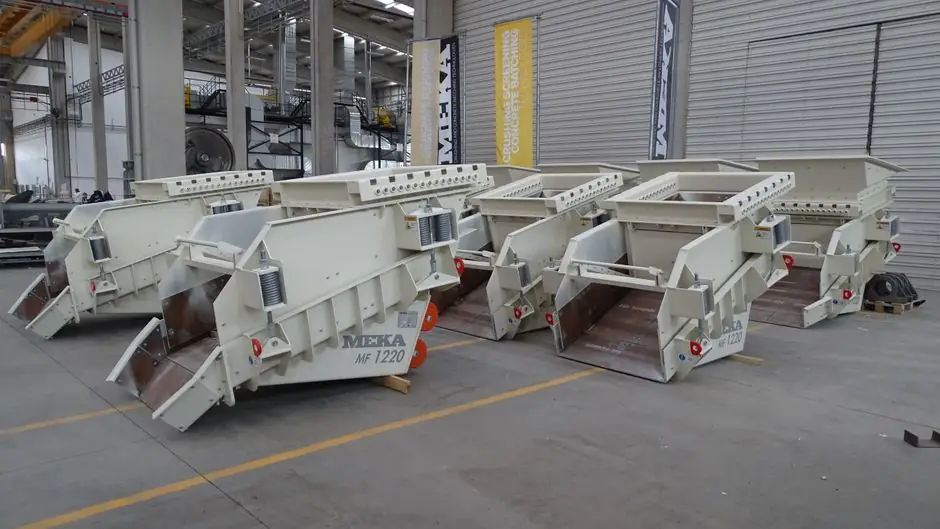
A vibratory feeder running sub-resonant (natural frequency above drive frequency) loses feed rate inside one shift when a single mounting bolt backs out or one spring leaf cracks, with measurable current rise and falling parts per minute as the tell [S1][S2].
Daily visual checks, quarterly spring-pack inspection, and bi-annual drive-coil insulation testing are the working intervals used across OEM service manuals for electromagnetic bowl feeders and pan feeders [S1][S5][S7].
Symptom: Falling Feed Rate With Normal Controller Output
Reduced feed rate at unchanged amplitude setting is the most common complaint and almost always traces to one of three root causes: loose mounting bolts and spring clamps, a cracked or fatigued spring leaf, or a closed electromagnetic air gap [S1][S5]. Loose fasteners dissipate vibrational energy into the support structure instead of into the bowl, producing a measurable current increase at the controller and a drop in parts per minute; re-torque to the OEM specification before any further diagnosis [S1][S2]. The corrective action is verification, not replacement: torque the mounting bolts and spring clamps to spec, then re-measure current draw; the reading should return to the nameplate value within 5 percent [S1][S5]. Acceptance criterion is dual: current draw returns to the nameplate baseline and feed rate returns to rated parts per minute at the same amplitude setting.
Symptom: Dark Dust or Fretting Between Spring Leaves
Spring packs in fiberglass leaf or steel leaf construction fail in two patterns: progressive fatigue cracking at the leaf eye, and fretting wear between adjacent leaves from insufficient clamp preload, both visible as dark oxide or polymer dust at the leaf interface [S1][S7]. OEM guidance is to replace the entire spring pack as a set rather than individual leaves, because mixing old and new leaves shifts the system's natural frequency and breaks the sub-resonant tune [S1]. The corrective action is full pack replacement with matched leaves, followed by a re-tune with a full parts load in the bowl, never while empty; an empty-bowl tune is the most common cause of mid-shift stalling when bulk parts are introduced [S1][S3]. Acceptance criterion is that the natural frequency sits a defined margin above the drive frequency with a full load, verified by stable current draw and constant feed rate across an empty-to-full bowl transition [S1].
Symptom: Controller Current Spike or Coil "Striking" Noise

An electromagnetic coil that audibly strikes the armature, or a controller that trips on overcurrent, indicates the air gap between the coil core and the striker plate has closed below the OEM minimum, usually through mounting sag, bolt migration, or accumulated debris [S1][S5]. The corrective action is to power down, isolate the mains per the OEM lockout-tagout sequence, then measure the gap with feeler gauges and shim back to the OEM-specified clearance; do not adjust the gap under power [S5][S7]. Acceptance criterion is a measured air gap within the OEM tolerance band, no audible contact at full amplitude, and insulation resistance on the drive coil within the value stated in the maintenance instructions, typically checked bi-annually [S1][S5]. When the coil winding shows insulation resistance below the OEM limit or visible charring, replace the coil as a unit rather than re-winding; coil insulation testing sits on a six-month interval in standard service schedules [S1].
Daily, Weekly, Monthly, and Quarterly Cadence
A four-tier cadence is the working pattern across OEM service literature: a daily pre-start checklist (visual inspection of wear parts, abnormal noise, current draw baseline), a weekly fastener-torque check on accessible mounting bolts, a monthly track and bowl-lining inspection in high-wear zones, and a quarterly full spring-pack and air-gap inspection [S2][S4][S7]. Daily and weekly checks cost minutes per shift; the quarterly deep check is the one that prevents unplanned weekend callouts, because spring-leaf cracking and air-gap drift both progress on a 60-90 day cycle under continuous duty [S2][S7]. Cleaning belongs on the daily tier: wipe the bowl track to remove oils and debris, because contaminants change the coefficient of friction and directly slow feed rate, even on a perfectly tuned system [S1][S4]. When inspection shows the bowl lining has thinned below 50 percent of original thickness in the high-wear zone, replace the lining rather than wait for substrate wear; lining replacement is on the monthly interval and is the cheapest wear part on the machine [S1][S4].
Selection Criteria: Which Checks to Prioritise on Mixed Fleets
For plants running a mix of electromagnetic feeders (light-duty, sub-resonant, 120 Hz drive class) and vibratory conveyors with eccentric or vibrating motors (heavy-duty, two-motor counter-rotating), the maintenance programs diverge at the drive end and converge at the spring and mount side [S2][S5]. Electromagnetic units need air-gap and coil-insulation checks on the six-month tier; eccentric-motor units need motor-mount, wiring, and bearing checks on the same tier instead, because the failure mode is mechanical wear rather than electrical insulation breakdown [S2][S5]. Common to both: fastener torque, spring condition, and a full-load re-tune whenever the parts mix or feed rate changes by more than 10 percent from baseline [S1][S2]. A useful acceptance test is the full-to-empty bowl feed-rate ratio: a healthy system maintains within 10-15 percent feed-rate variation as the bowl drains, while a de-tuned system drops more than 25 percent from full to empty [S1].
Limits of Repair: When to Escalate to OEM Service
Three conditions push a feeder from in-house maintenance to OEM service call: visible cracking at the spring-pack mounting eye (not fretting dust, but a propagating crack), drive-coil insulation resistance below the OEM-stated limit, and any persistent current draw more than 15 percent above the nameplate baseline after re-torque, re-gap, and spring inspection have all been completed [S1][S5][S7]. Replacing individual spring leaves instead of the full pack, adjusting the air gap under power, and tuning while the bowl is empty are the three documented practices that shorten service life across multiple OEM service notes [S1][S2][S7]. For deeper specification reference on drive, tray, frequency, and throughput targets, see Vibratory Feeder Specifications Explained; for comparable maintenance cadence on heavy bulk-handling equipment with wear-parts intervals, see Shotcrete Machine Maintenance: Daily Checks, Wear Parts, and Pump Service. Trackable signals for the next service window: spring-pack hours since last replacement (target less than 2,000 operating hours for fiberglass leaf packs), insulation-resistance trend on drive coils, and current-draw deviation from the nameplate baseline at full load.
Spec-level background on the components involved: linear guide, crossed roller guide, and pressure transmitter.