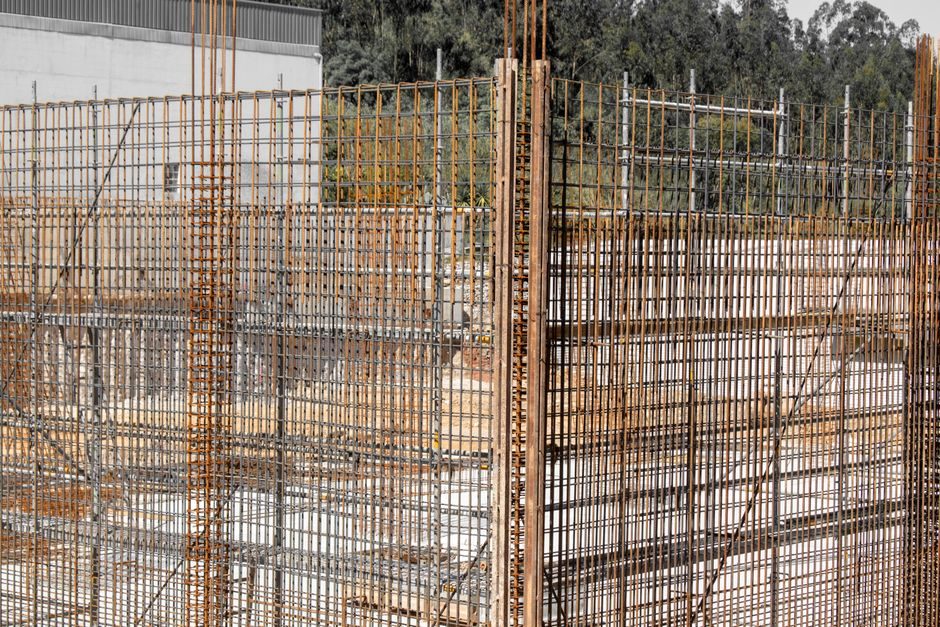
Deformed rebar is classified by three independent axes — material grade (yield strength), section shape (ribbed D, indented I, plain R), and ductility class (L low, N normal) — and the answer to "which deformed rebar" is always read off the designation string printed on the bar, not off a generic product name [S2].
In the United States, ASTM A615 deformed and plain billet-steel bars come in Grade 40 (yield 40,000 psi, tensile 70,000 psi) and Grade 60 (yield 60,000 psi, tensile 90,000 psi), with bar designations #3 through #18 mapping to nominal diameters 3/8 in (0.375 in) through 2-1/4 in (2.257 in) [S3]. In Australia and New Zealand, AS/NZS 4671 uses Grade 500 with a normal-ductility Class N designation, covering metric diameters 12 mm through 36 mm and masses from 0.888 kg/m (D12) to 7.99 kg/m (D36) [S2].
ASTM A615 Grades 40 and 60: Mechanical Property Floor
ASTM A615 deformed billet-steel bars must meet a minimum yield of 40,000 psi for Grade 40 (300 MPa metric) and 60,000 psi for Grade 60 (420 MPa metric), with minimum tensile strengths of 70,000 psi and 90,000 psi respectively, and a 90° cold-bend pin diameter that grows with bar size — 4d for #3 through #5 Grade 40, 5d for #6, scaling up to 10d for #14 and #18 [S3].
Grade 40 carries lower carbon, bends cleanly, and is the default for residential foundation and slab work; Grade 60's higher carbon lifts vertical-load capacity and is the default for dams, nuclear stations, and high-rise columns [S3]. Cold-bend pin diameters in A615 are tighter for Grade 60 (4d under #6, 6d for #7-#8, 8d for #9-#11, 10d for #14-#18) than for Grade 40 at the same bar, so any rebar bender selection must match the pin/roller geometry to the larger of the two bend radii, not the smaller.
Shape, Section, and Ductility Class: AS/NZS 4671 Nomenclature
Under AS/NZS 4671 the designation string "D500N" reads as: D = deformed ribbed section, 500 = 500 MPa yield, N = normal ductility; "I500L" would denote a deformed indented bar at 500 MPa in the low-ductility class [S2]. Round plain bar (R) is excluded from the deformed family and is only used where bond with concrete is provided by other means.
For typical metric D500N stock, cross-sectional area rises from 113 mm² at D12 to 1020 mm² at D36, and mass per metre climbs linearly from 0.888 kg/m to 7.99 kg/m, which fixes the rebar cutter blade rating, the hoist capacity on the yard crane, and the truck payload per bundle [S2]. Low-ductility Class L is generally restricted to non-seismic mesh and ancillary ties; Class N is what seismic and main-reinforcement design codes point to.
Mill Identification and Grade Marks on the Bar
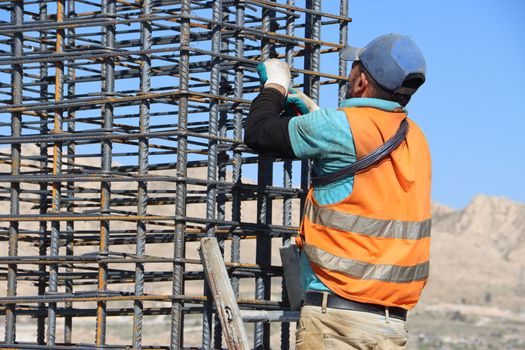
Every mill rolls a unique identification pattern into the deformation: a producing-mill initial, a bar-size number, a type-of-steel letter (N = new billet, A = axle, I = rail, W = low-alloy), and a grade-mark line for Grade 60 (no line = Grade 40) [S3]. The grade-mark line must continue for at least five deformed spaces, which is the on-bar evidence a rebar straightener operator or QC inspector can read in the yard.
Reading the bar correctly matters because A615, A616 (rail), A617 (axle), and A706 (low-alloy weldable) all share the same outside diameter, but only A706 is the weldable grade specified when rebar is joined by rebar threading and rebar coupler mechanical splices in seismic moment frames. Misreading a W (low-alloy) bar as N (new billet) silently drops the weldability check from the submittal.
Selection Comparison: A615 vs A706 vs A955 vs AS/NZS 4671
Four bar standards cover most spec-driven decisions, and the choice is driven by four criteria: yield strength, weldability, corrosion resistance, and seismic ductility. [S1]
A615 Grade 60 gives 60 ksi yield and 90 ksi tensile at the lowest cost and is the workhorse for non-seismic vertical load; A706 matches A615 strength but caps carbon equivalent for weldability and is mandatory where rebar is welded or mechanically spliced in seismic zones [S3]. A955/A955M covers stainless-steel deformed and plain bars in the same imperial sizes and is specified when chloride exposure (coastal, de-icing salt, parking decks) would consume a black bar inside the design life. AS/NZS 4671 Grade 500 Class N delivers 500 MPa yield with a defined ductility class and is the metric-system equivalent of A615 in the Australasian market [S2].
Cut-to-Size, Imperial Sizing Logic, and Field Handling
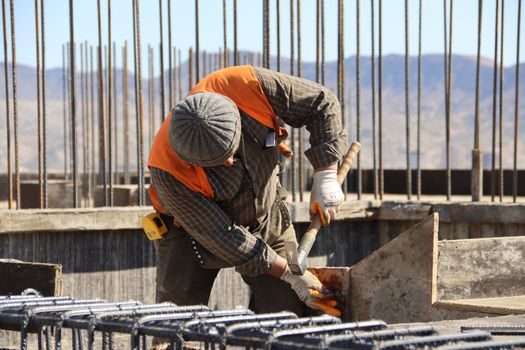
Imperial bar designations step in 1/8-inch increments: #3 = 3/8 in (0.375 in, 0.376 lb/ft), #4 = 1/2 in (0.668 lb/ft), #5 = 5/8 in (1.043 lb/ft), through #18 = 2-1/4 in (13.600 lb/ft), and a 20-ft stock length of #11 weighs 106.26 lb, which is the baseline for crane and rebar cutter cycle-time estimates on site [S3]. Cut-to-size rebar in lengths 12 in, 18 in, 24 in, 48 in, 6 ft, 8 ft, 10 ft is sold in diameters 3/8, 1/2, and 5/8 in for concrete reinforcement, construction stakes, landscaping, and tree stakes [S3].
For No-Grade rebar, the mill skips the yield test on every heat; it is allowed for sidewalks, driveways, and flat pours, but it is not acceptable where the project specification calls for mill-certified ASTM A615 material [S3]. Field practice is to read the bar's grade-mark line, the mill initial, and the type-of-steel letter before sending the bundle to the rebar bender, since these three rolls of steel determine the bend-pin diameter, the splice method, and the cover spacing for the entire pour.
Limitations and Failure Modes by Class
Carbon-steel deformed rebar fails by chloride-induced pitting and by stress-corrosion cracking in tension, which is why epoxy-coated, zinc-coated, stainless (A955), and fibre-reinforced polymer alternatives exist for aggressive environments [S2]. Plain round rebar (R-grade) has no rib interlock, depends on adhesion and end anchorage alone, and is unsuitable as primary tension reinforcement in beams.
Low-ductility Class L stock (AS/NZS 4671) and Grade 40 (A615) lack the uniform elongation and tensile-to-yield ratio demanded by modern seismic codes for longitudinal reinforcement in moment frames; specifying them as the main bar in a seismic lateral system is a common non-conformance. Rebar coupler mechanical splices on A615 (non-weldable) bars must be the swaged or headed-grout type, not the fillet-welded type, unless the bar is actually A706.
Trackable signals for the next design cycle: confirm whether project specifications under ACI 318-25 chapter 25 have tightened the Grade 60 weldability language to point exclusively at A706 for mechanical-splice zones, and verify whether A955 stainless rebar inventory at US service centres has moved off a 6–8 week lead time following the 2025–2026 nickel-price reset.
For related coverage, see Roller Chain Selection: Pitch, Series, Load and Speed Gates.