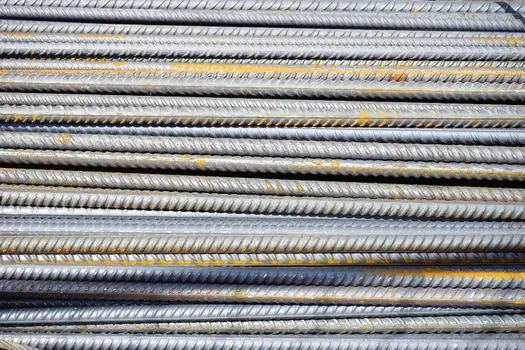
School buildings in seismic zones need hot-rolled deformed rebar conforming to GB 1499.2, HRB400 or HRB500, in diameters 10-25 mm for primary beams, columns, and slabs, while stirrups and confining hoops typically use 8 mm or 10 mm HRB400 at 100-150 mm spacing [S5]. The transverse ribs on each bar are the load-transfer mechanism, not the surface finish, so rib height (typically 0.05-0.10 of nominal diameter) and rib spacing (about 0.7 of the nominal diameter) are the field-checkable specs that actually hold a slab together [S2][S5].
Specifiers working on K-12 campuses and dormitory blocks should treat deformed rebar as a graded commodity, not a generic one, and pin every order to a standard, a grade, and a diameter range before pricing. China-origin supply remains the most cost-competitive route in 2026: one verified manufacturer lists a 200,000 metric-ton monthly supply capability on 50 MT minimum orders with TT or LC payment terms and shipment from a China main port [S4]. That capacity makes deformed rebar a long-lead but reliably sourced line item for school projects in Africa, Southeast Asia, and Latin America.
Standards, Grade Codes, and What They Actually Mean
Three regional standards cover the bulk of deformed rebar procured for school projects: Chinese GB 1499.2 grades HRB335, HRB400, and HRB500; British BS 4449 grades B500A, B500B, and B500C; and US ASTM A615 grades GR40 and GR60 [S5]. HRB400 is the workhorse grade for primary reinforcement in beams, columns, and two-way slabs, with a characteristic yield strength of 400 MPa; HRB500 is reserved for higher-demand members such as transfer beams, long-span gymnasium roofs, and shear walls in zones of high seismic intensity [S5].
For procurement documents, naming the grade alone is not enough. Specify the standard, the diameter, the minimum yield strength, the minimum tensile-to-yield strength ratio (typically 1.25 or higher for seismic applications), and the minimum elongation at fracture. The diameter range most commonly stocked and shipped for school work is 6-32 mm, but a typical bill of materials breaks down into 8-10 mm for stirrups and ties, 12-20 mm for slab and beam bottom bars, and 20-25 mm for column longitudinals and pile caps [S2][S5]. Note that one current Made-in-China product listing shows the same manufacturer offering 6 mm through 32 mm diameters, which simplifies single-source procurement for mixed-grade bills of materials [S5].
Diameter Mapping: Where Each Bar Size Goes in a School
A practical assignment for a reinforced-concrete school frame breaks the diameter set into four bands: 8-10 mm for stirrups, confining hoops, and distribution steel in one-way slabs; 12-16 mm for slab bottom reinforcement in classrooms and corridors; 16-20 mm for beam bottom bars, column ties, and mid-rise shear wall boundary elements; 20-25 mm for column longitudinals, mat foundations, and pile caps [S2][S5]. Spacing of stirrups must be tightened at beam-column joints, typically to 100 mm over a length equal to 1.5-2 times the beam depth, in line with the seismic detailing rules that govern most public-school construction.
Bending equipment must match the bar diameter. Portable benders in the US$1,000-2,000 price band handle 6-32 mm diameters, which covers the full school-building range and matches the sleeve and coupler inventory carried by the same supplier base [S1]. When site bending is impractical, factory-bent shapes (stirrups, ties, column cages) should be ordered to BS 8666 or GB 50204 bending schedules, with leg lengths and hook angles shown on the bar list.
Mechanical Couplers vs. Lap Splices in School Columns

For columns above 12 m storey height, or where bar congestion makes lap splices impractical, mechanical rebar couplers provide a full-tension splice that eliminates the lap-length zone and reduces rebar congestion at beam-column joints. The most common type is the parallel-thread sleeve, sized to the bar diameter (commonly 12 mm, 16 mm, 20 mm, 25 mm, and 32 mm) and rated for grade HRB500 or higher. Sleeve suppliers cluster on the same B2B platforms as the rebar itself, which simplifies logistics for overseas school projects [S1].
Lap splices remain acceptable in beams and slabs where the lap length meets code: typically 40-50 times the bar diameter for HRB400 in tension, depending on concrete grade and splice location. The decision rule is straightforward: use laps in low-stress, low-congestion zones (mid-span of slabs, mid-height of walls) and couplers in high-stress or high-congestion zones (column bases, beam bottom bars at supports, transfer-beam splices). The same deformed rebar tools inventory used for cutting and threading supports both workflows on site.
Cutting, Bending, and Straightening Workflow
On-site fabrication starts with a rebar cutter sized to the largest diameter in the bill, typically rated 6-32 mm for school work. Hardened blades are mandatory because HRB500 wears standard blades roughly twice as fast as HRB335. After cutting, bars are bent on a rebar bender matched to the bar diameter and the bending-angle tolerance, which is usually plus or minus 1 degree for stirrups and plus or minus 2 degrees for hooks. Factory-pre-bent shapes reduce site labour by 30-50 percent on a typical school frame, but require accurate bending schedules and a controlled supply chain. [S1]
Straightening coiled or bent stock is a separate operation. A rebar straightener removes the curvature introduced by coil handling and brings the bar within the straightness tolerance, typically 2 mm per meter, before it is cut and bent. In a quality-controlled school project, straightening happens in a covered lay-down area, not in the open, because surface rust beyond the mill scale is grounds for rejection on most specifications. Reference rebar straightener units sized for site work handle 6-16 mm diameters at throughputs of 10-30 m/min.
Material Inspection, Mill Certificates, and Field Tests
Every shipment of deformed rebar for a school should arrive with a mill test certificate (MTC) naming the heat number, the grade, the diameter, the chemical composition (notably carbon, manganese, and sulfur equivalents), and the mechanical test results from the producing mill. Acceptance sampling on site typically follows a square-root-plus-one rule: for a 50 MT lot, take 6-8 samples and test for yield strength, tensile strength, elongation, and bend performance (typically 180-degree bend over a mandrel of 3-5 bar diameters without cracking) [S4][S5].
Field verification goes beyond the MTC. The engineer of record should confirm the rib pattern, rib height, and rib spacing on a representative sample from each lot, because deformed rebar derives its bond strength from the ribs, not from the chemistry. Bars that fail the visual rib check, or that show surface defects deeper than 5 percent of the nominal diameter, are rejected. Storage on site should keep bars off the ground on timber or concrete dunnage, separated by diameter and grade, with MTCs filed against the bar tag for traceability through to the as-built record.
Procurement, Pricing, and Lead Time for 2026 School Projects
Current supplier listings on Made-in-China and Okorder show deformed rebar from China at a 50 MT minimum order quantity, with monthly supply capability of 200,000 MT and shipment from a China main port under TT or LC payment terms [S4]. Bending equipment to support on-site fabrication of 6-32 mm bars is listed in the US$1,000-2,000 price range, with a 1-piece minimum order quantity and OEM-grade warranty coverage [S1]. Standard 12 m mill lengths remain the default cut, though 6 m and 9 m lengths are available for containerized export to constrained sites [S2].
Lead time for a typical school project breaks down into 4-6 weeks for mill production after order confirmation, 2-4 weeks for ocean freight to African or Southeast Asian ports, and 1-2 weeks for port clearance and inland transport, for a total of 7-12 weeks door-to-site on common trade lanes. Engineers should plan rebar procurement 10-14 weeks ahead of the first concrete pour to avoid schedule slippage. For a campus of two to four three-storey classroom blocks, the rebar order typically runs 150-400 MT depending on slab design and foundation type. The same hot-rolled bar geometry that suits school frames is also the default for adjacent infrastructure, and related concrete curing compound selection for industrial facility slabs is the next downstream spec once the rebar is placed.