
For single-story warehouses with slab-on-grade and conventional column footings, HRB400 (GB 1499.2) and ASTM A615 Grade 40/60 deformed bars in 10–25 mm diameters cover roughly 90% of tonnage in current sourcing catalogs, with diameters of 12 mm and 16 mm dominating footing and slab reinforcement [S2].
Selection in this segment is governed by four gates: required yield strength (400 MPa vs. 500 MPa class), bar diameter vs. member geometry, splice method (lap vs. mechanical coupler), and certification chain (mill test certificate, ISO 9001, CE/IBR marks visible on Made-in-China listings) [S2].
Grade and Standard Mapping for Warehouse Loads
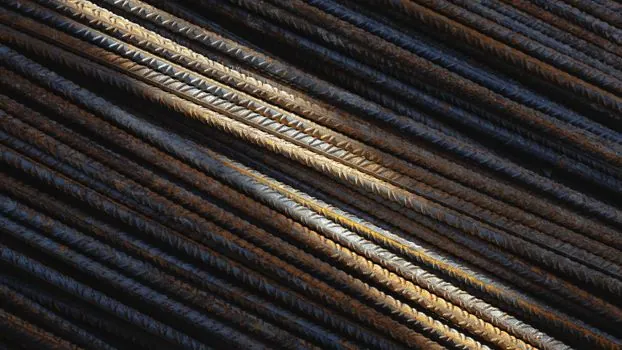
GB 1499.2 HRB400 and HRB500 remain the default Chinese supply grades, with HRB400 specified where design yield of 400 MPa is sufficient and HRB500 reserved for columns, transfer beams, and roof trusses carrying high point loads from racking or mezzanines; both are stocked as hot-rolled deformed bars with transverse ribs [S2].
For export builds to the U.S. and Middle East, the same product category is dual-marked against ASTM A615 Grade 40 (yield 276 MPa) and Grade 60 (yield 414 MPa), and is filtered on Made-in-China under the ASTM standard tag alongside GB, BS, JIS, and EN, with CE and IBR certifications commonly listed [S2]. EN 10080 B500A/B500B is the European parallel and is treated as equivalent for the 500 MPa class.
Diameter Selection by Member Type
Footings and pile caps for warehouse columns typically use 16–25 mm deformed bars as main reinforcement, with 10–12 mm bars as distribution steel; the 10 mm and 12 mm diameters in the catalog match the slab-on-grade mesh and shrinkage-steel use case, while 20 mm bars are listed for heavier primary members [S2].
For slab-on-grade 150–200 mm thick, 10 mm and 12 mm deformed bars at 150–200 mm centers in both directions is a baseline; for suspended slabs carrying racking line loads, designers step up to 12–16 mm bars or add a top layer of 10 mm at 100 mm centers. Lap length in tension follows the governing code (typically 40d–60d for HRB400, longer for HRB500), which is where the splice decision compounds the diameter decision.
Lap Splice vs. Mechanical Coupler

Mechanical couplers sized for deformed rebar DIA14MM–50MM are stocked in the Made-in-China coupling category with MOQ from 1,000 pieces, and they remove lap-length congestion at column-beam joints and slab openings where rebar density blocks concrete flow [S3]. For warehouse builds, the rule of thumb from spec-side practice is: use laps in slabs and walls where congestion is low, switch to couplers in columns, transfer beams, and any member with bar bundles or heavy splice zones.
The same ribbed-bar geometry that gives deformed rebar its bond strength is what makes the press-fit coupler work, so when changing from lap to coupler the bar grade and diameter drive the coupler model rather than the other way around. Stocking the matching rebar coupler family at DIA14, DIA16, DIA20, and DIA25 covers the warehouse range without overstocking.
Source Standards and Certification Filters
Made-in-China's deformed rebar filter exposes the standards actually being supplied, not just declared: GB, ASTM, AISI, JIS, DIN, BS, EN, ANSI, and a National/International toggle, with certifications CE, ISO 9001, ISO 9001:2008, RoHS, IBR, GS, CQC, and CCC available as filterable attributes [S2]. For a warehouse buyer, the practical filter set is: GB 1499.2 or ASTM A615, plus ISO 9001, plus the destination-market mark (CE for EU, IBR for India, CCC for China domestic).
Mill test certificate (MTC) with heat number, chemical composition, and mechanical properties (yield, tensile, elongation, bend) must accompany every shipment, and the rebars should arrive bundled and tagged per heat. For reference on what the base rebar is and how it differs from plain round bar, the encyclopedia entry covers the rib geometry and bond mechanics.
Warehouse-Specific Failure Modes and Constraints

The three rework drivers in warehouse rebar work are: (1) wrong grade delivered against MTC, especially HRB400 swapped for lower-grade Q235 plain bar; (2) diameter mismatch on the column-foundation dowels, where 16 mm specified but 14 mm supplied, breaking the lap-length calc; (3) coupler-rebar diameter mismatch, where a DIA16 coupler is used on DIA18 bar and slips under load. [S1]
Concrete cover in slab-on-grade is typically 40–50 mm top and 75 mm against subgrade, so chair height and spacer selection should be locked at the same time as bar diameter. Storage on site needs dunnage at 1.5–2 m centers to keep bundles off wet ground, otherwise surface rust that exceeds the light-firmly-adherent tolerance can trigger rejection by the QA engineer.
On-Site Processing: Cut and Bend Decisions
For projects where bars arrive long and are cut/bent on site, the rebar cutter selection maps to bar diameter (electric hydraulic cutters handle up to 32 mm; manual cutters top out near 20 mm), and the matching rebar bender must support the same diameter at the bend radii called out in the schedule (typically 4d for HRB400 stirrups and ties, 6d–8d for main bars). [S1]
Where bars are supplied pre-cut and pre-bent from the rolling mill, lead time and the cutting/bending tolerance (±10 mm length, ±2° angle) become a sourcing filter rather than an on-site equipment decision. For tighter tolerances, especially on hooked bars and seismic stirrups, on-site bending is still preferred over mill-bent supply.
Comparison of Warehouse Rebar Spec Options
Three real spec options for a typical single-story warehouse: (1) HRB400 / ASTM A615 Grade 60, 12 mm and 16 mm, lap spliced: lowest cost, slowest to place in congested joints, code-compliant for non-seismic low-rise; (2) HRB500 / ASTM A615 Grade 75, 12–20 mm, mechanical couplers at column-foundation and beam-column joints: higher material cost offset by reduced bar congestion and faster placement, preferred for racking-loaded frames; (3) B500B (EN 10080), 10–16 mm, lap spliced: standard EU spec, no design change vs. HRB400 in most cases, supply lead time longer in non-EU markets. [S3]
lap tying 5–10 min), seismic zone applicability (Option 2 mandatory in zones with SDC C and above), and code match (Option 3 only for EN-jurisdiction builds).
Field-Realistic Sourcing Check
For a warehouse spec package, the most common sourcing failure is not grade but traceability: bars arrive with MTC, but the heat number on the bundle tag does not match the MTC, and the QA engineer rejects the lot. A second tracker is the supply of couplers with the wrong thread system (parallel vs. tapered), which only shows up at the first column-foundation dowel test.
For related product spec context on ribbed-bar mechanics, coupler selection, and on-site processing tools, the rebar coupler and rebar tool encyclopedia pages round out the spec chain. School-building seismic detailing, which shares grade and splice logic with warehouse column-beam joints, is mapped in this rebar spec for educational facilities and is a useful cross-reference when the warehouse site also includes an office block with higher detailing requirements.