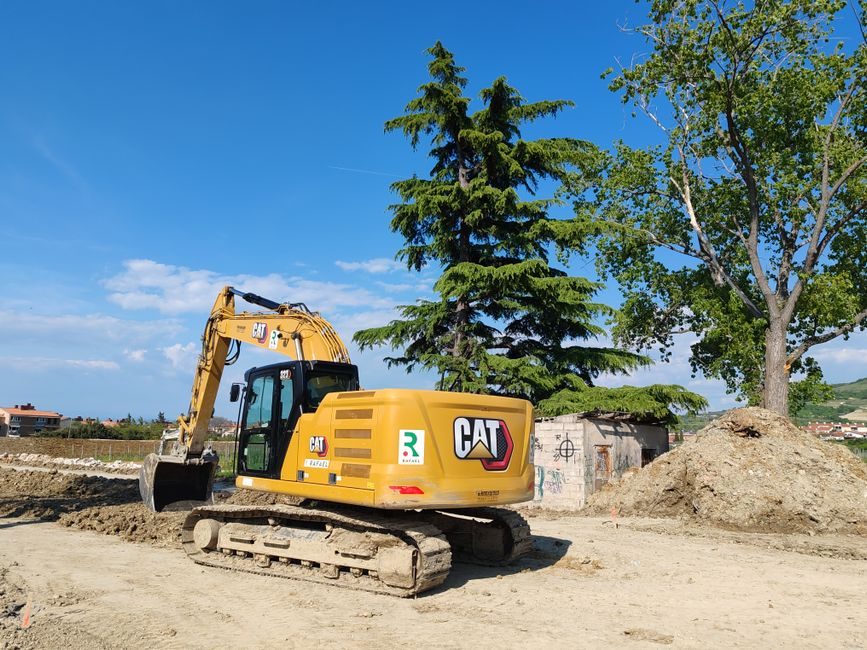
Demolition-class excavators above 20 tonnes operating weight with high-reach booms over 20 m are the workhorses for primary structural demolition, paired with hydraulic shears such as the VTN HP+ series that ship in 7 sizes from compact carriers to long-front machines [S1].
For contractors and rental buyers the decision is not which OEM badge is on the cab, but three measurable parameters: carrier operating weight, tool-tip working height, and attachment cutting force or jaw opening. The wrong pairing wastes fuel and burns through teeth; the right pairing turns a 30-tonne machine into the most versatile asset on a teardown site [S1][S5].
Demolition Scope: What the Carrier Is Expected to Do
Demolition excavators are typically split into three duty bands: secondary processing (sorting, loading) at 8-13 tonnes, structural reduction at 20-35 tonnes, and high-reach primary demolition at 35-130 tonnes with booms over 20 m [S1][S3].
The same machine will be expected to handle selective interior strip-out, concrete and scrap segregation, foundation removal, and bulk loading, exactly the scope listed by South Florida contractor Excavator Man in its service catalogue [S2]. A smaller 8-tonne or 13-tonne digger from fleets such as Online Agri Machinery covers groundwork and small-scale demolition, but cannot safely reach upper-floor slabs without a high-reach boom [S3]. When the job involves reinforced concrete over 6 m vertical, a 30-tonne-plus carrier with a dedicated shear is the floor, not the ceiling [S1][S5].
Selection Criteria: Weight, Reach, Hydraulics, Attachment Interface
Four measurable criteria separate a demolition machine from a general-purpose digger: operating weight class, maximum tool-tip working height, auxiliary hydraulic flow and pressure at the stick tip, and a quick-coupler that supports the demolition tool lineup without manual re-pinning [S1][S5].
For primary structural work the OEM-recommended envelope is a high-reach arm with operative elevation over 20 m, with the shear's centre of gravity placed close to the carrier so that long-reach swings do not overload the slewing ring [S1]. Hydraulic demolition shears sized from HP02 upward deliver ALIEN-class cutting power with a single cylinder and two pivot points, and use fully-protected cylinders plus bolted-access hatches so a fitter can swap seals on site instead of sending the boom to a workshop [S1]. On the lower end, an 8-tonne mini excavator paired with a small shear handles ground-level concrete and masonry, but reach and breakout force limit it to foundation pads and small walls [S3][S5].
Attachment Map: Shears, Crushers, Combi Shears, Grapples
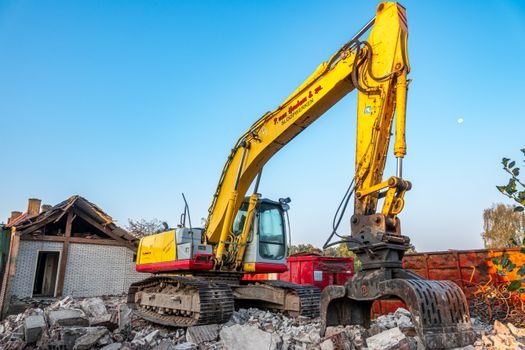
VTN's demolition attachment family alone covers the full duty cycle: HP+ series hydraulic shears for primary concrete and scrap work, CK series crushers for secondary reduction, PD and FP series primary crushers, VF secondary crushers, MT combi shears with 360° hydraulic rotation, plus a separate range of selector grapples for sorting [S1].
For material handling rather than cutting, hydraulic selector grapples like the NTSG series from Northerntrack (designed and built in Leeds, UK for 35 years) handle scrap segregation and recycling feed, and that brand stopped in-house production in August 2024 with the workshop closure, so buyers in 2026 source NTSG units through attachment consultancies rather than direct from the original manufacturer [S4]. Choosing between these options comes down to material: combi shears with rotation suit mixed scrap yards where the operator must re-orient the jaw between cuts; fixed-pivot shears deliver higher closing force for reinforced concrete; selector grapples replace shears entirely when the priority is sorting, not cutting [S1][S4][S5].
Comparison: Primary Shear vs Combi Shear vs Selector Grapple vs Crusher
For an engineer writing a procurement matrix, four attachment types line up against four criteria. Primary hydraulic shears (HP+) score high on cutting force and jaw opening, with bolted access hatches for in-field seal service, but rotate only on HP+ variants and cost more per kilo than a fixed grapple [S1]. Combi shears (MT series) add 360° hydraulic rotation for re-orienting in tight scrap yards, at the expense of some closing force [S1]. Selector grapples (NTSG type) win on speed of sorting and lower purchase cost, but cannot shear rebar cleanly and wear faster in concrete-only debris [S4]. Secondary crushers (VF series) win on throughput of broken concrete into aggregate, but require a primary tool upstream to break the slab free first [S1].
Application Cases: Urban Teardown, Yard Recycling, Site Prep

Urban structural demolition with multi-storey concrete frames pairs a 30-50 tonne carrier with an HP-class shear, where interchangeable rebar cutting blades let the same tool work the slab and the embedded rebar without a tool change [S1][S5]. In scrap and recycling yards, a 20-30 tonne carrier on a combi shear (MT series) re-orients the jaw between cuts and uses 360° rotation to stack cleanly, which is faster than swinging the entire upper structure [S1].
Lower-elevation work such as foundation removal, hurricane debris cleanup and utility trenching falls inside the 8-13 tonne digger envelope offered by hire fleets like JCBDiggers, where the limiting factor is reach rather than cutting force [S2][S3]. Site-development contractors combine excavation, grading and selective demolition under a single machine, exactly the integrated service mix that Excavator Man markets in South Florida, which keeps machine count down on small lots where mobilising a dedicated high-reach rig is uneconomic [S2]. Buyers should cross-reference excavator duty-class definitions before committing to a carrier size, since over-sized machines burn fuel on small jobs and under-sized machines force the operator to drop the boom and work at unsafe angles.
Limits, Failure Modes, and Safety Constraints
Three failure modes dominate demolition-excavator operations: slewing-ring overload from extended high-reach work, hydraulic-cylinder contamination from concrete dust, and tooth wear from rebar-heavy slabs [S1][S5]. VTN's design response is a centre of gravity close to the carrier, fully-protected cylinders, and interchangeable teeth from the HP07 size upward, which directly target those three failure modes [S1].
Operators must respect maximum tool-tip elevation for the boom geometry, keep bystanders clear of the slewing radius, and verify that the carrier's auxiliary flow matches the attachment's specified pressure and lpm before coupling. A shear on a 13-tonne digger that needs 250 bar at 80 lpm will starve the hydraulics and overheat the pump in a few hours; matching the tool to the carrier's published hydraulic curve is non-negotiable [S1][S3]. Procurement specs should reference the demolition hammer operating-envelope principles for breaker-class tools, since breakers and shears share the same hydraulic-power matching logic and the same risk of carrier under-sizing.
Standards, Sourcing, and Trackable Signals

Demolition attachments are not governed by a single global standard, but EU-built machines carry CE marking under the Machinery Directive, and high-reach applications commonly reference EN 13000 for crane-style slewing platforms when the boom is used for lifting rather than purely for tool work [S1]. Buyers should ask for the carrier's load-chart at maximum tool-tip reach, plus the attachment's declared closing force in kN and jaw depth in mm, and treat any spec sheet that omits those three numbers as incomplete [S1][S5].
Trackable signals for the next planning window: VTN Europe is exhibiting the HP+ range at Intermat 2027 in Paris (21-24 April 2027), and Northerntrack continues to supply NTSG-design grapples through its post-2024 consultancy channel rather than as a manufacturer [S1][S4]. Rental pricing and 8-tonne/13-tonne availability for hire fleets remain the leading indicator of small-job demand through the rest of 2026 [S3]. For projects that combine demolition with concrete supply, the ready-mix concrete selection map for commercial builds covers the receiving-side specs, and for on-site cutting of rebar and pipe the cut-off machine selection for concrete work entry is the matching tool reference.
Spec-level background on the components involved: pressure transmitter.