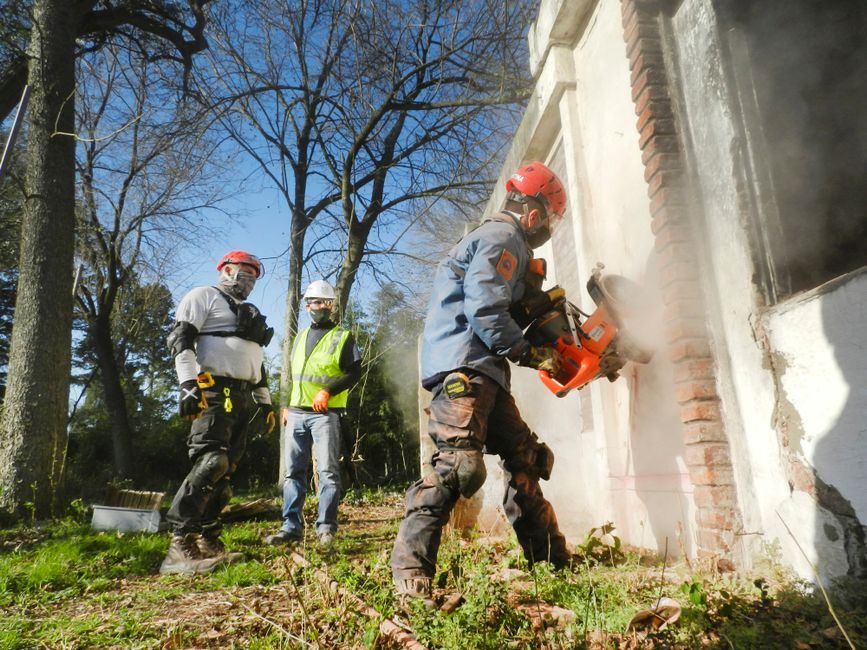
A cut-off machine is matched to the workpiece by blade diameter, motor power, no-load rpm, and duty class — not by brand. The current 2026 OEM line-up clusters around three reference points: 110-125 mm handheld electrics at 1,400 W and 12,000 rpm, 355 mm portable chop saws at 2,200 W and 3,800 rpm, and 762 mm swing-frame foundry cut-offs at 30 HP (22 kW) and 14,200 SFPM (72 m/s) [S1][S3][S4].
Concrete work pulls the spec toward abrasive or diamond blades, water feed on dry-cut handheld units, and either a 355 mm portable saw for rebar and pavers or a rail/wall-saw rig for deeper structural cuts. Smaller 110-125 mm chassis cover tile and masonry trim; they are not a substitute for a 355 mm cut when the section is 50 mm and above [S3][S4].
Three Diameter Classes Set the Selection Tree
The 110-125 mm handheld class runs 1,400 W rated input at 12,000 rpm no-load speed on 220-240 V / 50-60 Hz supply, sized for tile, thin masonry, and rebar trim [S3]. The 355 mm portable class moves to 2,200 W rated input at 3,800 rpm no-load on the same voltage range, taking 50 mm-plus rebar, pavers, and stone slabs [S4]. The 762 mm swing-frame class is crane-suspended, 30 HP (22 kW), with a 30 in x 1/4 in x 1-3/4 in wheel turning at 14,200 SFPM (72 m/s) starting and roughly 12,500 SFPM average as the wheel wears [S1].
Cutting a 50 mm concrete paver or 20 mm rebar belongs on the 355 mm machine; cutting a 5 mm tile back-bead belongs on the 110-125 mm. The 762 mm swing-frame is foundry duty — gates, risers, and runner systems on castings — and its 1,130 lb (513 kg) mass, 110 in (2,794 mm) length, and bridge-crane suspension make it the wrong tool for a slab on grade [S1].
Power, Speed, and Blade Geometry Must Be Matched Together
Surface Feet Per Minute (SFPM) is the figure that ties motor power to wheel diameter — divide SFPM by wheel circumference in feet to get the rpm the wheel actually needs. Fox publishes 14,200 SFPM (72 m/s) starting and approximately 12,500 SFPM average as the wheel wears, with a two-speed pulley that recovers speed without a belt swap because the pulley centers are identical at each step [S1].
For handheld concrete, the equivalent check is no-load rpm against blade diameter: 12,000 rpm at 110-125 mm is the published Minli spec, and 3,800 rpm at 355 mm is the published portable-chop-saw spec [S3][S4]. Under-speed at the same diameter starves the cut and burns the bond; over-speed throws abrasive or diamond segments. The blade rating on the wheel itself is the binding number — never exceed it.
Where Each Class Fits the Concrete Job
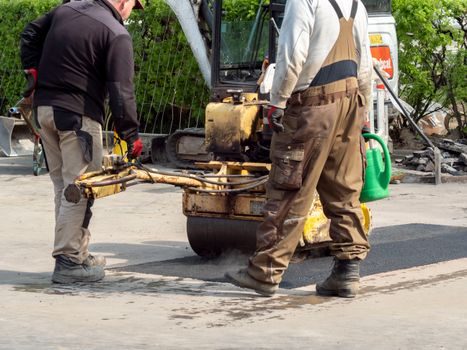
The 110-125 mm handheld covers tile trim, back-beads, and chase cuts in cured concrete when paired with a diamond or abrasive blade rated for masonry. Its 1,400 W input is enough for intermittent cuts under 25 mm depth; sustained production wants the next class up. [S3]
The 355 mm portable chop saw is the workhorse for rebar stock, pavers, pre-cast lintels, and on-site steel trim embedded in concrete — 2,200 W at 3,800 rpm handles 50 mm-plus section in a single pass on most abrasive wheels [S4]. Where the cut runs longer than a few minutes or the abrasive load is heavy, dry-cut is replaced by wet-feed to control dust and segment temperature.
The 762 mm swing-frame is not a concrete tool — it is a foundry cut-off designed for heavy cross-sections in cast iron and steel, with a 90° clockwise / 75° counterclockwise swing and a wheel that rotates up to 90° for horizontal or angled cuts [S1]. Concrete cutting at that scale is rail-saw or wall-saw territory, a different product line entirely.
Limitations, Failure Modes, and Concrete-Specific Constraints
Handheld 110-125 mm machines are limited to about 25-30 mm cut depth per pass on cured concrete; forcing a deeper pass stalls the motor and overheats the armature. Abrasive dust on dry-cut handheld operation is a respiratory hazard and a motor-cooling hazard — many job sites mandate wet-feed or local exhaust, and that requirement is independent of the machine's own rpm rating [S3].
Portable 355 mm saws hit a thermal wall on continuous concrete cutting past roughly 5-10 minutes without water feed, and the published 3,800 rpm no-load speed drops sharply under load on dense aggregate [S4]. Wheel selection matters more than motor power here: a concrete-rated diamond wheel with the correct bond hardness for the aggregate (soft bond for hard aggregate, hard bond for soft aggregate) extends life by multiples over a generic abrasive wheel.
Foundry swing-frame machines are out of scope for concrete, but they illustrate a useful failure mode: the Fox spindle uses acme threads rather than V-threads because acme resists dirt build-up and side-load damage — a design choice that any cut-off exposed to concrete slurry benefits from by analogy [S1]. A cut-off machine that sees concrete dust or slurry should be specified with sealed bearings and a motor enclosure that tolerates wash-down, not just an IP rating on the nameplate.
Selection Criteria Compared Across the Three Classes
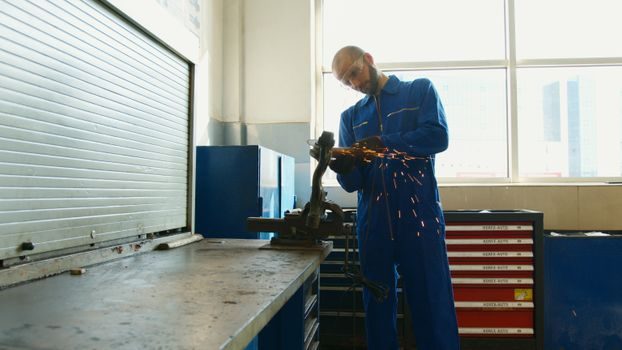
On the four decision criteria that matter for concrete work — diameter, rated power, no-load speed, and duty — the three reference classes line up as follows: 110-125 mm / 1,400 W / 12,000 rpm / handheld tile and trim; 355 mm / 2,200 W / 3,800 rpm / portable rebar, paver, and pre-cast; 762 mm / 22 kW (30 HP) / 14,200 SFPM starting (~12,500 SFPM average) / crane-suspended foundry gate and riser removal [S1][S3][S4].
Cutting depth, water-feed requirement, and suspension method are the next three filters. Tile and trim want a 110-125 mm dry or wet handheld; rebar and paver work wants a 355 mm portable with water feed; gate and riser removal on castings wants a 762 mm swing-frame suspended from a bridge or jib crane, which is not a concrete application at all [S1][S3][S4].
How a Cut-Off Connects to the Rest of the Concrete Job
A cut-off machine is only one node in a concrete placement or demolition chain — adjacent tools are covered in the aerial work platform reference for elevated cuts, the concrete vibrator reference for consolidation around rebar penetrations, and the concrete admixture reference where early saw-cut contraction joints are being timed against set behaviour. On the steel side of the same job, an angle grinder selection map covers the smaller-diameter abrasive work that runs alongside a 355 mm chop saw. [S3]
For jobs that mix rebar cutting with material handling, the belt conveyor spec map covers offcut and slurry handling, and the sandblasting equipment selection reference covers the surface-prep side after the cut. Spec-driven chains in adjacent tooling follow the same diameter / power / rpm logic shown above.
Sourcing, Standards, and What to Verify on the Datasheet

Three data points on the OEM datasheet drive the spec: rated input power in watts, no-load speed in rpm, and blade diameter in millimetres — all three must appear together, and all three are published in the 2026 OEM catalogues cited here (1,400 W at 12,000 rpm for the 110-125 mm class [S3]; 2,200 W at 3,800 rpm for the 355 mm class [S4]; 30 HP at 14,200 SFPM starting for the 762 mm class [S1]).
For handheld electrics on construction sites, verify the voltage range matches the site supply (220-240 V at 50-60 Hz covers most of Europe and Asia, but North American 120 V sites need a different machine, not a different plug), and confirm the wheel speed stamped on the abrasive or diamond wheel is at least equal to the spindle no-load speed — never run a wheel below its rated SFPM, and never run a machine above the wheel's rated SFPM. For crane-suspended foundry machines, the Fox 2-C datasheet at 30 HP, 1,130 lb (513 kg), and 110 in (2,794 mm) length is the line on floor loading and crane capacity that the buyer has to clear before delivery [S1].
Trackable signals for the next six months: (1) whether the 355 mm portable chop-saw class adds a higher-amperage 110-120 V variant for North-American 15 A circuits, since the 2,200 W / 220 V published spec does not run cleanly on 120 V [S4]; (2) whether handheld 110-125 mm makers move to brushless motors in the 1,400 W class to handle the dust load of dry-cut masonry [S3]; (3) whether the 762 mm swing-frame design spreads to concrete-masonry-unit (CMU) saw lines — a logical extension of the Fox 2-C geometry but currently out of scope [S1].