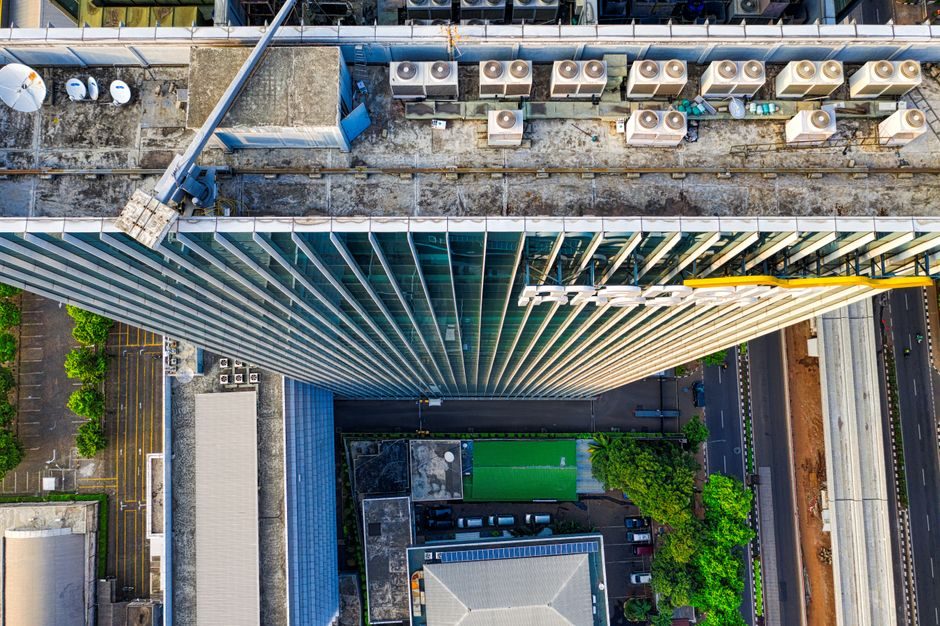
Commercial-building ready-mix orders in 2026 are typically specified by compressive strength class (4,000–10,000 psi / 28–69 MPa), maximum aggregate size, slump or slump-flow target, and air content, then sourced from suppliers whose plants hold state DOT and ACI certifications [S1][S3].
Regional batch-plant networks — for example, 24 concrete plants across central and eastern Kansas plus western Missouri serving the Kansas City metro — are now the structural backbone for high-volume commercial pours, with 100+ truck fleets and mostly automatic mixer units handling stadium, airport, highway, and warehouse jobs [S3].
Compressive Strength Classes and Where They Apply
ASTM C94 ready-mix for commercial structural work most commonly ships in 4,000 psi (27.6 MPa), 5,000 psi (34.5 MPa), and 6,000 psi (41.4 MPa) 28-day classes; high-rise columns and post-tensioned slabs frequently specify 8,000–10,000 psi (55–69 MPa) with silica fume or slag cement replacement [S1][S3].
For ground-floor slabs on grade in retail and warehouse builds, 4,000 psi with a 4–6 in. slump and 5–7% air entrainment is the standard ticket, while elevated decks in hospitals and universities typically require 5,000 psi at 3–5 in. slump with mid-range water reducers to control pump pressure and finishability [S1][S3].
The supplier's quality program is the contractually important half of the equation: RMCAO member plants in Ontario, for instance, must run daily field tests and report results during yearly audits, with third-party labs running cylinder compressive strength checks to eliminate conflicts of interest [S1].
Mix Types Compared for Commercial Applications
Self-consolidating concrete (SCC) is widely specified where rebar congestion, thin walls, or architectural finish requirements rule out vibration, with typical spread targets of 18–28 in. (450–700 mm) per the EFNARC and ACI 237R family of practices [S1].
Shotcrete (wet-mix, per ACI 506) and specialty fibre-reinforced mixes round out the commercial toolkit for retaining walls, pool shells, and slab joints — Penny's Concrete and similar multi-plant operators stock these alongside standard mix designs and dispatch from yards that also supply aggregates, sand, and gravel [S1][S3].
Performance decision matrix for commercial ready-mix selection:
- 4,000 psi standard: lowest cost, default for slab-on-grade and footings in retail/warehouse; slump 4–6 in., air 5–7% if exposed [S1][S3]
- 5,000 psi pumped: elevated decks, parking garages, hospital floors; requires mid-range water reducer, slump 5–7 in. for line pump [S3]
- 6,000–8,000 psi high-strength: columns in mid-rise commercial, post-tensioned slabs; silica fume or slag replacement 25–50% by mass of cement [S1][S3]
- SCC 5,000–6,000 psi: heavily reinforced beam-column joints, architectural walls; spread 22–26 in., no vibration, viscosity-modifying admixture (VMA) for segregation resistance [S1]
Standards, Certifications, and Audit Trail
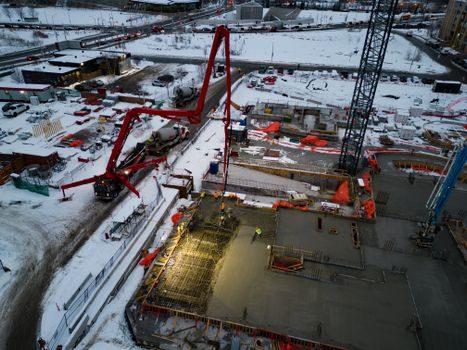
ASTM C94/C94M governs ready-mix production and delivery in the United States; Canadian suppliers follow CSA A23.1/A23.2 with provincial OPSS specifications layered on top, and Ontario operations additionally certify to the Ready-Mix Concrete Association of Ontario (RMCAO) scheme plus Concrete Ontario ECO Gold environmental requirements [S1].
U.S. commercial projects crossing state lines — such as the Kansas City metro's KDOT-, MoDOT-, and ACI-certified supplier network — depend on dual-jurisdiction acceptance so that the same mix design can be placed on both sides of the state line without re-qualification [S3].
Field verification still rests on the cylinder break: third-party laboratories compress 4 × 8 in. cylinders at 7 and 28 days, and a documented f'c result at or above the specified class is the trigger for form stripping and post-tensioning release [S1].
Plant Capacity, Fleet, and Logistics for Commercial Pours
Commercial buildings, particularly stadiums and distribution centres, routinely require 300–1,000 yd³ continuous pours with 50–100 truck trips per day; the only way to hit that cadence is multiple batch plants and a fleet of 100+ mostly automatic mixers operating inside a 60-mile radius [S3].
24 strategically located plants give a regional supplier roughly 30 minutes of headway between any two adjacent yards, which is the practical lever for hot-weather pours where ASTM C94's 90-minute discharge limit and the 300-rpm mixing drum constraint would otherwise strand half the fleet in queue [S3].
For on-site production flexibility, volumetric mixers are an alternative to barrel-truck delivery on smaller commercial renovations, though most new-build work above 50 yd³ still runs through central-mix drum trucks for batch accuracy and ticket traceability [S3].
Admixtures, Fibres, and Placement-Method Pairing

Mid-range water reducers (ASTM C494 Type A/F) at 3–6 fl oz / 100 lb cement are the default for pumped commercial concrete because they let the plant hold a 5–7 in. slump target without bleeding at the form face [S1].
Macro-synthetic and steel fibres (ASTM C1116) are increasingly substituted for traditional WWF in 5,000–6,000 psi warehouse slabs on grade, with typical dosages of 3–5 lb/yd³ for poly fibres and 25–40 lb/yd³ for hooked-end steel — both delivered as a concrete admixture plus fibre system rather than separate tickets [S1][S3].
For slab surfaces that will see forklift or hospital-wheel traffic, a concrete fibre reinforcement combined with a penetrating concrete curing-compound (ASTM C309 Type 1, Class B at 200 ft²/gal) is the spec combination that closes the plastic-shrinkage crack window in the first 24 hours [S1].
For Residential vs Commercial: Where the Specs Diverge
Residential work typically stops at 3,000–3,500 psi with a 4-in. slump and a 1-day pour of 20–80 yd³, so plant selection skews toward local single-yard suppliers; commercial work climbs to 4,000–10,000 psi and needs the multi-plant, multi-state footprint [S3].
For comparison, the residential spec map covers footings, driveways, and house pads where finishability and small-batch turnaround matter more than compressive margin; commercial selection, by contrast, weights f'c margin, pumpability, and audit-grade QC documentation [S1][S3].
Sourcing Decisions for Specifiers and GCs

Shortlist suppliers by three filters: state DOT and ACI certifications, plant count within a 60-mile haul radius, and demonstrated third-party QC. Penny's Concrete's 24-plant, 100-truck, KDOT/MoDOT/ACI-certified footprint is the benchmark for high-volume regional work, while family-run operations like Kay Concrete (subsidiary of Monarch Cement, 50+ years in southwest Missouri) and Tex-Mix Concrete (Austin/San Antonio/central Texas) cover the small-to-mid commercial segment with personalized dispatch [S2][S3][S5].
Canadian specifiers in the greater Toronto area can lean on RMCAO member plants such as PLP Redimix for self-consolidating, shotcrete, and value-added mix designs that meet CSA, OPSS, and ASTM specifications concurrently — a one-plant dual-jurisdiction advantage when projects straddle provincial or federal procurement [S1].
On commercial job sites where the structural pour is followed by mechanical, electrical, and finish trades, the final selection is usually a four-way tie-break between strength class, slump retention, fibre/air strategy, and plant logistics — and the supplier who can show a 7-day break in writing, every time, wins the next pour [S1][S3].