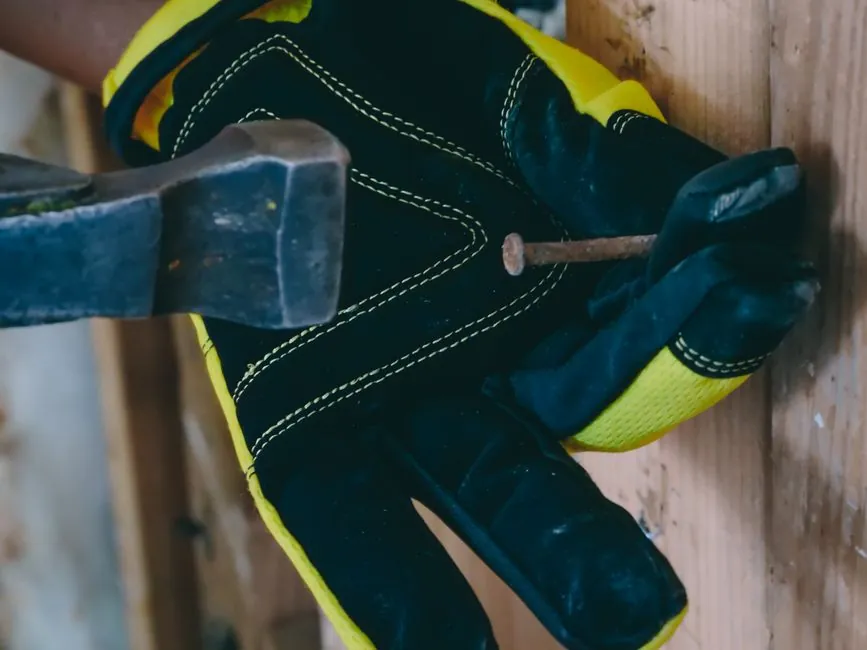
A demolition hammer rated at 8.8 ft-lb impact energy can still impose substantial hand-arm vibration, so performance and vibration control must be assessed separately [S4].
ISO 10819 introduced a 25–200 Hz range for evaluating the effectiveness of vibration-damping gloves [S5].
What a demolition hammer vibration rating actually measures
A useful vibration assessment separates the tool output from the vibration reaching the operator. Demolition hammers deliberately generate high-frequency impact forces, but those forces can transmit through the housing, handles, grip materials and the operator’s hands [S1][S2]. A label such as “anti-vibration” therefore describes a control feature, not a standardized exposure limit.
The evaluation must identify the frequency band, measurement location, weighting system and operating condition. ISO 10819 introduced frequency ranges for evaluating vibration-damping gloves, including 25–200 Hz, which makes frequency relevant when comparing hand-arm vibration transmitted by an electrical demolition hammer [S5]. The same study does not establish that every damping glove reduces vibration from every demolition hammer, because tool mass, impact rate, handle geometry and duty cycle remain part of the exposure.
Impact energy is a separate selection value. Milwaukee offers an SDS-Max demolition hammer [S4]. That number describes breaking capability, not vibration reduction. A high-energy hammer can require stronger vibration controls when its duty cycle, contact time and operator coupling are unfavorable.
Passive and active vibration reduction systems
Passive control reduces vibration transmission through springs, elastomer isolators, tuned masses, compliant handles or damping grips. These components introduce stiffness and damping into the tool-to-hand path, but their performance changes with frequency, load and mounting condition. A vibration-absorbing rear handle is a concrete implementation, as used on Makita demolition hammers equipped with Anti-Vibration Technology, or AVT [S7].
Active control senses machine or handle motion and applies a corrective force. Siemens documented Hilti’s use of Simcenter to evaluate active vibration reduction in demolition-hammer design, with the engineering problem framed around controlling excessive vibration while preserving the tool’s intended impact function [S2]. Active control is more complex than adding a soft grip because it requires sensing, control logic, power and verification across operating states.
The practical comparison is straightforward: passive isolation adds compliant elements and has fewer control dependencies; active isolation can compensate for changing tool motion but introduces electronic and durability questions; both still require measured verification rather than an AVT-style feature name [S2][S7].
Compare the main vibration-control options

Four criteria matter when lining up the main systems: measured attenuation, frequency dependence, durability and cost of ownership.
Passive handle isolation adds springs or elastomers without sensing electronics. Its advantages are mechanical simplicity and generally fewer control components, while the weaknesses are sensitivity to resonance, mounting stiffness and material aging. Active isolation uses controlled counter-motion to reduce transmitted vibration. It can offer greater adaptability across changing conditions, but its effectiveness depends on sensor range, actuator authority, power availability and stable tuning [S2].
Vibration-absorbing grips and gloves improve hand coupling through damping and compliant materials. ISO 10819’s 25–200 Hz range is relevant to transmitted-vibration evaluation, but glove selection must be tied to the tool’s measured output rather than treated as a fixed percentage reduction [S5]. A tool-level rating supported by frequency-weighted acceleration or velocity is more defensible because it includes the complete housing and handle system.
For procurement, demand the measurement method, frequency band, test condition and uncertainty in addition to the label. Compare tools using impact energy, operating mass, rated impact rate, control type and measured hand-arm vibration under the same or explicitly equivalent duty cycle.
Match the rating to concrete work and exposure time
Short, intermittent point-breaking and prolonged slab demolition create different vibration exposures. Impact energy defines the work capability, while operating mass, tool balance, handle position and the operator’s grip determine how much of that energy reaches the hand. The 8.8 ft-lb value published for one SDS-Max demolition hammer can guide a power-class comparison, but it cannot be converted directly into a vibration score without test data [S4].
Concrete professionals evaluating demolition equipment also have to account for vibration-reduction technology, dust extraction and machine weight together. Dust control does not qualify a vibration rating, but it can affect operator positioning and duration of work around the point of impact.
Extended operation requires rotating the control task among trained workers, reducing unnecessary trigger time and selecting the lowest effective breaking capacity. These controls matter because a measured tool value cannot describe cumulative exposure from repeated impacts, awkward posture, slippery conditions and fatigue. The 25–200 Hz assessment band remains a useful engineering reference for transmitted vibration rather than a substitute for an exposure assessment [S5].
Who needs a detailed vibration rating?
Buyers operating multiple demolition hammers, rental fleets, concrete contractors and occupational-hygiene teams need a documented hand-arm vibration profile. A model-level rating makes it easier to establish training controls, tool allocation and maintenance priorities. It is also more useful than a generic “anti-vibration” label when several machines with different operating masses are used across one site [S1][S6].
Occasional users do not need laboratory-grade analysis for every single task, but they still need to avoid confusing impact energy with vibration performance. An 8.8 ft-lb breaker is not automatically less vibrating than a lower-energy model, and a reinforced housing is not evidence of a compliant handle [S4][S6]. For a tool fleet, vibration-reduction capability, noise level, weight and application coverage belong in one specification [S1].
Electric demolition hammers are suitable for controlled indoor work where exhaust is a concern, and cordless models can remove cable handling from the work zone. Neither architecture eliminates impact vibration, and cordless operation does not justify ignoring operating mass, contact time or frequency-weighted exposure.
Limits, failure modes and verification
Vibration performance can degrade when isolators are crushed, cracked, displaced or contaminated, when active sensors are obstructed, or when handles and fasteners develop looseness. Replacement grips and service procedures matter because damping components are wear items in some designs. The supplied research establishes the existence of damping and active-control approaches, but it does not provide a universal service interval or a guaranteed attenuation percentage [S2][S7].
Frequency weighting also prevents a misleading comparison. A system that performs well within one band may not provide equivalent control across the 25–200 Hz range used in vibration-damping glove evaluation [S5]. Tests should also identify whether values represent peak, RMS or another statistic and whether the result covers the tool alone or includes handles, accessories and mounting.
For acceptance testing, require an identified model configuration, calibrated measurement equipment, raw frequency data or a stated weighted result, test duration and operating load. Keep impact energy separate in the record, for example 8.8 ft-lb for the referenced SDS-Max model [S4], and document any anti-vibration system and handle arrangement separately [S2][S7].
Build a rating that supports procurement decisions

A defensible demolition hammer vibration rating combines 25–200 Hz relevance, measured hand-arm output, impact energy, operating mass, duty cycle and control architecture [S4][S5]. AVT or active isolation may improve comfort and handling, but neither label substitutes for comparable test data [S2][S7].
The next trackable signal for buyers is model-level documentation that states the vibration metric, frequency range, test condition and whether the result includes the specified handle and accessories. Specification details for the demolition hammer grip materials used in vibration control can then be compared with the measured system rating rather than treated as standalone proof.