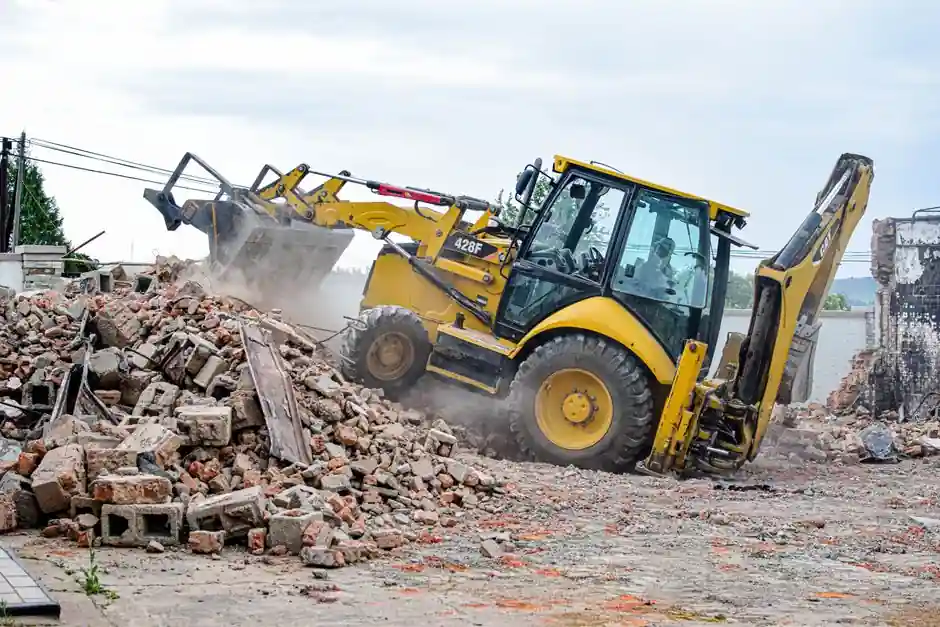
A demolition hammer is a breaker tool for breaking concrete, asphalt, rock, and pavement, with performance governed by impact energy and tool mass rather than the label alone [S1][S4][S5].
Jackhammer, demolition hammer, breaker, and road hammer may describe the same operating concept, while catalogs, rental desks, and users often apply the labels inconsistently [S1][S4].
Terminology: Where the Names Overlap
A jackhammer combines a hammer mechanism directly with a chisel and can be pneumatic or electromechanical, while larger rig-mounted breakers are generally hydraulic [S4]. The internal hammer drives downward into the chisel and returns for another stroke, so the working principle is percussion, not rotary drilling [S4].
The same reference identifies jackhammer, pneumatic drill, breaker, demolition hammer, and road hammer as overlapping names [S4]. This means a request for one tool does not establish a precise size class unless the specification includes weight, impact energy, power source, and tool-holder format.
One selection guide distinguishes demolition hammers as more compact tools for horizontal or controlled removal, while jackhammers are described as better suited to larger-scale breaking [S2][S6]. That distinction is useful as working shorthand, but it is not a universal technical boundary because manufacturer naming is not consistent across the category [S1][S4].
Size Classes: Weight Is Only the Starting Point
Used-equipment examples establish practical size points at approximately 28, 35, and 68 lb, with the 68 lb breaker using a 1-1/8 in chuck and the 28 lb example described as SDS-Max [S3].
The same practical comparison shows why weight alone is insufficient. A 68 lb breaker was bigger to store and considered overkill for the immediate project, while an approximately 28 lb SDS-Max demolition hammer was considered a good size for that project but potentially more difficult to use on future projects [S3]. Operator capability, working height, access, transport, and the material being broken can therefore outweigh the nominal mass difference.
Impact energy provides a more useful capability measure, although the supplied research does not provide a universal weight-to-joule conversion. Demolition hammers are characterized by high impact energy for controlled destruction, while rotary hammers deliver lower impact energy combined with bit rotation for drilling concrete, stone, and masonry [S5]. Do not estimate performance by pounds alone without the model specification.
Decision Matrix: Power, Control, Access, and Service
For a controlled slab edge or localized concrete removal, a compact demolition or breaker hammer gives better access and lower handling burden than a large jackhammer; the research specifically describes demolition hammers as often more compact and designed for controlled removal [S2]. For larger breaking areas, a heavier jackhammer or breaker class may reduce the need for repeated passes, but the tool must still be controllable at the work face [S2][S6].
For drilling rather than demolition, use a rotary hammer, because it combines rotation and hammering and is intended for holes in concrete, masonry, and stone [S5]. For heavy overhead breaking where a complete demolition hammer cannot be positioned safely, a SDS-plus rotary hammer may offer a more controllable alternative for suitable work, but it is not a direct substitute for the high-impact energy of a breaker [S5].
Compare candidates across four criteria before purchase: impact energy for concrete or asphalt, mass for operator handling, working orientation for horizontal or overhead access, and available service support. Tool-holder compatibility must also match the selected chisel, because SDS and 1-1/8 in hardware are not interchangeable [S3]. The research provides 28, 35, and 68 lb size examples but no controlled cross-model impact-energy values, so a purchase based on weight alone remains incomplete [S3].
Application Fit and Tool Selection
A flat point or pointed chisel is appropriate for concentrating force on a defined concrete area, whereas a broad chisel distributes the blow across more material [S5]. Demolition hammers are specifically used for concrete, asphalt, and other hard materials, and their pounding-only mechanism differs from the rotating action of a rotary hammer [S5].
A 35 lb-class breaker is a reasonable intermediate choice when a 28 lb-class machine is undersized but a 68 or 70 lb tool would be difficult to handle or store [S3]. That decision is based on the documented handling examples, not a universal capacity threshold, because no comparable output ratings for those weights appear in the research [S3].
For tile removal and delicate concrete chipping, a full-size breaker may be too aggressive. The practical rule is to select the lowest class that completes the required fracture, then use a smaller tool for trimming and finish work [S3].
Power Source, Accessories, and Operating Limits

Pneumatic breakers require a suitable compressed-air supply, while electromechanical hand tools use an electric motor; larger rig-mounted jackhammers are usually hydraulic [S4]. These are different power architectures, so the complete specification must identify the power source rather than relying on the words jackhammer or demolition hammer.
A demolition hammer transfers energy through a chisel, and accessories such as the pusher leg and lubricator are part of the operating system [S4]. Tool holders are a second critical interface: the research identifies a 1-1/8 in chuck on a 68 lb breaker and an SDS-Max connection on a 28 lb machine [S3].
Tool-holder format does not, by itself, establish impact energy or operating limits. The research gives no model-specific joule ratings, blow rates, stroke rates, duty cycles, or minimum hose or generator requirements. Obtain the manufacturer data sheet for the exact model before comparing impact energy or confirming that a breaker is suitable for repeated production work.
Purchase and Inspection Controls
A 28 lb SDS-Max demolition hammer and a 68 lb 1-1/8 in breaker represent materially different purchases, storage arrangements, and accessory systems [S3]. The 68 lb example was listed at $400 with a cart, while used SDS-Max examples were discussed around $200–$400; these dated market examples do not establish fair value or present pricing [S3].
Inspect the complete tool, retaining chisel, retaining system, power connection, and transport case or cart. The 68 lb example included a cart, which addresses storage and movement, while the same field discussion questioned whether a 70 lb machine is too aggressive for tile and difficult to handle [S3].
Serviceability matters because a breaker creates high shock loads. Track model, serial number, operating hours, chisel condition, and repair history, and verify impact energy and weight from the exact manufacturer model rather than the seller’s category label.
What Terminology Does Not Resolve

The strongest factual distinction available here is functional: a breaker pounds without rotating, while a rotary hammer rotates and hammers for drilling [S5]. By contrast, the demolition hammer versus jackhammer distinction is inconsistent, with both terms covering the same broad family and some guides using size and work style as the practical divider [S1][S2][S4].
Specify the purchase by model, operating weight, impact energy, power source, holder format, required chisel, work orientation, and expected duty. For noise and vibration planning, the separate demolition hammer blow rate guide provides the next trackable specification set, while the original manufacturer data sheet remains the controlling source for model limits.