
For horizontal wall work, choose a demolition hammer when the objective is concentrated breaking and a chipping hammer when controlled material removal matters more than maximum impact.
A demolition hammer produces impact-only blows for concrete and masonry, while a chipping hammer prioritizes faster, more controllable chipping on vertical and overhead surfaces [S2].
Horizontal wall work starts with orientation and material depth
Horizontal concrete work calls for a tool that can be held level against the wall face. Pneumatic tool families are separated by working direction: paving breakers point straight down, rivet busters handle horizontal structural work, and chipping hammers suit vertical surfaces, overhead work, and finish removal [S1].
The cited selection guide says the appropriate tool family depends on the orientation of the work and the thickness of the concrete [S1]. These are selection rules, not guarantees of penetration rate.
A horizontal wall is not a paving-breaker application merely because the tool delivers an impact. If the work surface is the side of a wall, beam, tank, or deck, control and the ability to keep the chisel square matter more than vertical slab-breaking momentum [S1].
Demolition hammer versus chipping hammer by decision criterion
Demolition hammers deliver hammering action without rotation, while chipping hammers provide a more controlled chipping action for vertical and overhead surfaces [S2]. Electric chipping hammers commonly weigh 5–30 lb and operate at roughly 900–3,000 blows per minute, while the pneumatic lineup in the cited comparison spans 680–3,200 BPM overall [S1][S2].
Chipping hammers provide controlled chipping action for precisely breaking vertical and overhead surfaces, demolition hammers deliver impact-only blows for breaking concrete, and rotary hammers combine rotation with hammering for drilling [S2][S4].
For this decision, a heavy demolition hammer is the better choice for removing a thick wall, opening a major chase, or breaking substantial masonry mass. A chipping hammer is the better choice for removing coatings, scale, spalled concrete, limited patches, and finish around openings where surrounding material must remain intact [S1]. A rotary hammer is the correct alternative when electrical boxes, anchors, conduit, or core holes are the main deliverable.
Use cases that favor each tool
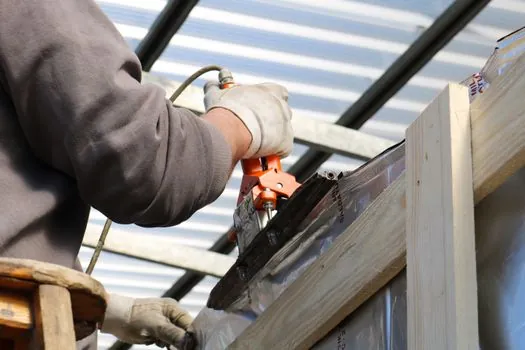
Chipping hammers are used for precise removal at vertical and overhead surfaces because the operator grips the rear handle with one hand and the shaft with the other, allowing the chisel to be directed at different angles [S2]. That geometry is useful for trimming a wall face, cleaning a ledge, and working near a corner where a large breaker would be difficult to control.
Demolition hammers are suited to concentrated impact, including removal of mortar joints, tile, stone, and sections of concrete or masonry [S4]. They accept chisels rather than drill bits, so the application must be removal by percussion rather than production of a measured hole [S2][S4].
Field experience reinforces the split by task frequency rather than brand. A contractor using a corded SDS-Max rotary hammer in hammer-only mode reported using rotation first to remove material and then switching to hammer-only to shape a hole; the same discussion identifies a dedicated demolition hammer as the stronger choice when making holes in solid block walls becomes the dominant task [S3].
Horizontal mounting, control, and operator fatigue
A breaker spline-drive demolition hammer can perform horizontal breaking, but a pneumatic chipping gun was identified as the better horizontal-work option in contractor discussion [S5]. The distinction matters because a side-mounted impact tool transfers reaction force into the operator’s hands and arms, so mass, balance, handle isolation, and serviceability are selection criteria rather than comfort details.
The pneumatic lineup across paving breakers, rivet busters, and chipping hammers draws 20–85 CFM at 90 PSI overall [S1]. Compressor capacity, hose diameter, service-unit maintenance, and continuous-duty rating must therefore be checked before selecting a pneumatic tool for wall work.
A field discussion describes a preferred SDS-Max demolition hammer as light but powerful enough due to substantial horizontal breaking [S5]. A model-specific weight and impact-energy comparison is covered in Demolition Hammer Cost: Impact Energy and Weight, but bit compatibility still has to be confirmed before purchase.
Limits, failure modes, and unsafe assumptions

Neither impact-only tool guarantees fast removal of reinforced concrete. Encountering rebar can stall a small breaker or rotary drill, and forcing the chisel against steel consumes energy and damages tooling rather than removing concrete efficiently [S3]. Reinforced sections may require cutting the reinforcement separately, using a larger breaker class, or changing to a sawing method.
Tool weight and blow rate do not alone establish service life. The power, stroke, shank system, retainer condition, lubrication, and matching compressor determine whether sustained impact reaches the chisel [S1][S2]. Chisels, points, retainers, springs, and hoses are consumable or service parts, and the selected tool must use the correct retention system: the cited pneumatic ranges include .580 hex or .680 round chipping shanks, 11X Jumbo rivet-buster retention, and 7/8 to 1-1/4 in hex paving-breaker shanks [S1].
Do not confuse high blow rate with high breaking energy. Long-stroke tools generally favor heavy removal, while shorter, faster strokes favor controlled chipping [S1]. Operators should also follow the manufacturer’s site-specific instructions for dust, noise, vibration, hidden utilities, and overhead work rather than treating tool selection as the complete safety plan.
Recommended specification by wall task
Specify a demolition hammer for a full-thickness wall where rapid gross removal is the objective, impact-only operation is acceptable, and the operator can control the tool squarely against the surface. Select the lowest practical weight class that can sustain the required impact, then verify model-specific impact energy, stroke rate, shank retention, and accessory availability [S1][S4].
Specify a chipping hammer for a thin or access-constrained wall face, controlled reduction of projections, or surface preparation. The 5–30 lb electric range and 900–3,000 BPM range establish the broad chipping-hammer class, while pneumatic chipping systems in the comparison run at 1,500–3,200 BPM and consume 20–36 CFM at 90 psi [S1][S2].
Choose a rotary hammer when drilling accuracy, anchor holes, conduit penetrations, core holes, or repeated hole production outweigh pure demolition performance. If the job includes both drilling and chipping, the practical arrangement is often one rotary hammer for holes and one chipping or demolition hammer for removal, rather than forcing a single architecture to perform both functions [S3].
Before purchase, record wall thickness, approximate removal volume, reinforcement condition, access height, required direction, power source, and the exact bit retention system. If the application is dominated by horizontal structural removal, test a side-capable breaker or pneumatic chipping gun; if precision surface work dominates, use a lighter chipping hammer [S1][S5].