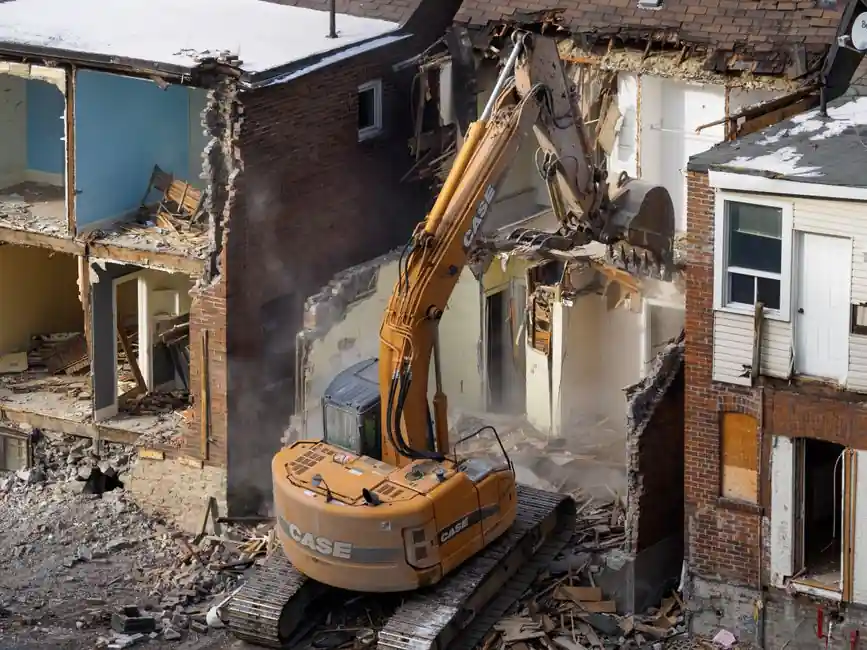
A demolition hammer can produce 100–120 dB at the operator’s ear, while a jackhammer typically registers about 110 dB at 3 feet [S5].
Urban demolition must separate worker exposure from neighborhood noise: operator sound pressure and exposure duration govern hearing protection, while property-line limits require calibrated measurement at the regulated distance [S1][S5].
Separate Tool Output from Site Noise Limits
A manufacturer noise rating and a municipal compliance measurement are different quantities. The tool rating normally characterizes the machine at a defined operating condition, whereas the Los Angeles construction threshold is 75 dBA measured at 50 feet when equipment operates within 500 feet of the regulated receptor [S1].
Los Angeles also permits daytime and nighttime assessments designed for an urban setting and human-health protection, including absolute maximum construction noise levels [S1]. Those thresholds should not be converted into an assumed tool rating: source level, distance, duration, intervening barriers, and meter location can change the result substantially [S1][S5].
For procurement, ask for the declared sound power in dB(A), the measurement basis, rated operating condition, and whether the figure is for the complete tool, hammer mechanism, or fitted chisel and accessory system. A bare “110 dB” label does not provide enough information for an urban noise plan.
Use Distance Data as a Screening Method
At the operator’s position, a jackhammer produces 100–120 dB, and a typical jackhammer registers around 110 dB at 3 feet away [S5].
These figures provide an initial screening range, not a compliance prediction. An impact source has a changing acoustic signature, and directivity, reflections, barriers, operating cycle, concrete condition, and nearby surfaces can shift field levels [S1][S5]. Calibrated measurements at the property line and at the operator position remain the defensible route for acceptance testing.
The distance table also shows why barriers may be necessary. A barrier that interrupts the direct sound path can reduce received level at adjacent properties, while an enclosure may reduce radiation from the hammer housing and work face. Acoustic screens, curtains, panels, and shrouds are available specifically for demolition environments [S3].
Set Worker Controls from Exposure Duration
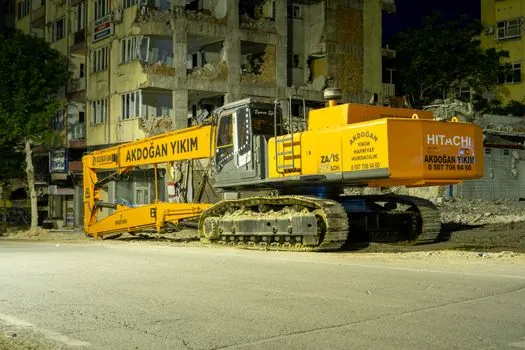
OSHA requires hearing protection for all jackhammer operators [S5].
A city equipment threshold of 75 dBA at 50 feet does not prove that the operator is safe [S1][S5]. The operator can remain inside the machine’s high-noise zone even when the attenuated exterior reading complies with the neighborhood limit. A compliant site therefore needs two controls: hearing conservation for personnel and acoustic controls for nearby receptors.
Actual attenuation must come from the hearing-protection fit testing and manufacturer data, not from adding nominal protection ratings.
Compare Electric, Pneumatic, and Hydraulic Approaches
The comparison cannot rest on noise alone. Electric and pneumatic demolition hammers both generate impact noise and vibration, while hydraulic systems add power-unit noise and line losses [S5][S9]. Electric operation can avoid a separate compressor, but site power availability, duty cycle, battery or cable logistics, and machine control still affect the complete noise profile.
Pneumatic tools require a compressor and air transmission, adding two noise paths beyond the hammer itself [S5]. Hydraulic tools require a power pack and hoses, so the measured boundary level must include those support sources where they contribute [S5]. Electric, pneumatic, and hydraulic systems are therefore comparable only at the system boundary, with the same distance, duration, chisel, material, and operating state recorded.
For a sharper operating comparison, vibration magnitude measurements are available for demolition tools: one field study reports a rotary-hammer value of 5.18 m/s², while vibratory power demolishing tools showed diverse readings [S4]. Noise control cannot be treated as a proxy for vibration control, and tools with similar dB ratings may transmit materially different handle vibration.
Match the Hammer to the Demolition Task
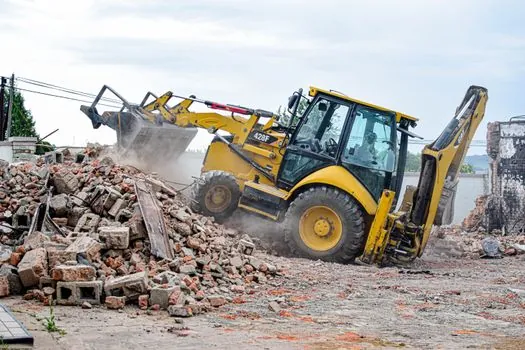
A light demolition hammer may suit localized concrete removal, while heavier machines require more impact energy, a larger working envelope, and a greater capacity to produce harmful airborne noise. The governing urban decision is not simply “quietest available.” It is whether the tool can complete the breaking task within restricted hours and at the lowest defensible boundary level. [S5]
The primary source of jackhammer noise is the rapid impact of the chisel point striking concrete or asphalt, with a jackhammer delivering 25–45 blows per second [S5]. Chisel selection also changes work rates and contact behavior; the relationship between chisel geometry and demolition duty is covered in Demolition Hammer Chisel Types: Flat vs Point vs Spade.
A rotary hammer is generally a drilling and chiseling tool rather than a substitute for high-energy concrete demolition. Both classes produce high noise and strong vibration, but matching the machine to the required breaking capacity is more defensible than specifying by sound level alone [S9].
Specify Urban Work Controls Before Mobilization
The preconstruction plan should record the manufacturer sound-power value, operator-position exposure, 50-foot or applicable property-line prediction, work hours, chisel and material, and backup-control method. Los Angeles thresholds include environmental-protection measures, thresholds, and assessment methodology, so equipment procurement should align with the approved project conditions rather than rely on a generic urban limit [S1].
Noise-control hardware should be selected for the work face and line of sight between the hammer and sensitive receptor. Hushtec lists acoustic barriers, enclosures, shrouds, curtains, and panels for demolition, with systems described as impact-resistant, fire-rated, UV-stable, and available with IPX6 or IPX9 weather-protection ratings [S3]. These product attributes do not establish a guaranteed dB reduction; the assembly installation, gaps, absorptive lining, and maintained contact area determine field performance.
New York’s nighttime construction rule discussed in 2014 imposed a 95 dB jackhammer limit at roughly 3 feet outdoors [S8]. Los Angeles uses a different framework, including a 75 dBA construction-equipment threshold at 50 feet and absolute maximum levels for health protection [S1]. Municipal rules are location-specific, so a contractor must use the applicable ordinance rather than transfer one city’s number to another site.
Verify Noise and Vibration with Measurements

Acoustic acceptance should use a calibrated sound level meter with A-weighting, a documented microphone height, measurement distance, operating cycle, and the worst representative work condition. For a demolition hammer, a single spot reading taken while the chisel is off the material is not an operating noise test [S1][S5].
Measure at the operator position to assess hearing risk and at the receptor or property line to assess community impact [S1][S5]. Record the chisel, impact setting, support equipment, barrier condition, and elapsed work time. A sound level meter also supports compliance evidence through a documented survey rather than an estimate based only on the nameplate.
Track vibration separately with field-capable monitoring, because a demolition hammer combines airborne impact noise with transmitted handle and structural vibration [S4][S9]. Review worker rotation, tool service condition, handles, hoses, and material support alongside noise controls. The practical acceptance threshold is therefore a documented compliance result at the receptor plus a verified exposure plan for personnel, not a single catalog dB value.
Track two signals before urban work starts: the manufacturer’s declared sound-power data and a measured boundary noise baseline. If either exposes a gap at the approved distance or workday condition, revise the shroud, enclosure, work hours, tool, or monitoring plan before the hammer enters the occupied work zone.