
A demolition hammer and an angle grinder are not interchangeable tool classes — the former converts electrical input into percussive impact energy measured in joules for breaking masonry, while the latter converts watts into rotational speed measured in rpm for cutting and abrasive material removal [S1][S2].
Both tool families are stocked in overlapping industrial supply catalogues such as KPT's 2026 line — which lists the KPT16DHN demolition hammer alongside the KPT KAG10-45 115 mm, KAG20-9 230 mm and KAG24-9 230 mm angle grinder models on the same product page [S1]. Jiangsu Delika's 2026 supplier profile groups the same two categories under one manufacturer banner with a stated 500,000-piece annual capacity [S3].
Core Mechanism: Impact Energy vs Rotational Speed
A demolition hammer is sized by single-stroke impact energy in joules and by blow frequency, not by rpm, because the working stroke is a linear hammer blow into the chisel or point — not a rotating abrasive disc [S2][S3]. KPT's 2026 industrial line lists the KPT16DHN as a dedicated demolition-hammer SKU separate from the three angle grinder SKUs (115 mm and 230 mm disc diameters) on the same catalogue page [S1].
An angle grinder is sized by disc diameter in mm or inches, by no-load rpm, and by motor amperage or wattage. The DEWALT DWE402 listed in 2026 third-party reseller copy specifies a 4.5-inch (115 mm) disc, 11 amp motor, 11,000 rpm no-load speed, and a paddle switch with one-touch guard [S4]. The AVID Power variant on the same comparison page is a 7.5-amp, 4-1/2-inch (115 mm) configuration aimed at lighter DIY duty [S4].
Power Input, Disc Size and Typical Operating Bands
Demolition hammers in the 2026 KPT line are listed as 16 kg-class hex-chuck machines aimed at vertical chipping and floor-breaking; comparable industrial breakers on Chinese B2B portals are quoted at EXW price floors around CNY 385 with MOQ-tiered supply [S2]. Cordless 18 V/20 V platforms have not displaced corded 1,500 W-class demolition hammers on heavy construction sites as of mid-2026 [S1][S2].
Angle grinders cluster in two disc-size bands: the 115 mm (4-1/2 in) DIY/light-trade band typified by the DEWALT DWE402 at 11 amp / 11,000 rpm [S4] and the 230 mm (9 in) heavy-trade band typified by the KPT KAG20-9 and KAG24-9 in the 2026 KPT catalogue [S1]. Jiangsu Delika's 2026 supplier profile lists both angle grinders and demolition hammers among its "Main Products" with a 100-piece MOQ and 500,000-piece annual output [S3].
Selection Criteria: When Each Tool Is the Right Answer

Specify a demolition hammer when the workpiece is concrete, brick, asphalt, or frozen ground and the operation is breaking, chipping, or chiselling — i.e. when material must be fractured in bulk [S2]. A rotary-hammer drill (KPT KPTRH26 26 mm) is a closer cousin than an angle grinder for masonry drilling, because it combines rotation with limited impact, while a demolition hammer is purpose-built for breaking only [S1].
Specify an angle grinder when the operation is cutting metal or stone, deburring weld seams, or surface grinding with a disc or flap wheel — i.e. when material must be removed by abrasion or slicing, not fractured [S4]. Using an angle grinder with a demolition-rated chisel is unsafe; using a demolition hammer to cut rebar is impractical. The two are complementary, not substitutable [S1][S2].
Comparison Table: Demolition Hammer vs Angle Grinder on Decision Criteria
The table below lines the two tool classes up against four buyer decision criteria drawn from the 2026 supplier and catalogue evidence [S1][S2][S3][S4].
Criterion 1 — Primary working parameter: demolition hammer = impact energy (J) and blow rate (bpm); angle grinder = disc diameter (mm) and no-load rpm. Criterion 2 — Typical motor input: demolition hammer in the KPT16DHN corded industrial class runs roughly 1,500 W; angle grinders split into 7.5 A / 11 A (115 mm) and 2,000+ W (230 mm) [S1][S4]. Criterion 3 — Consumable wear part: demolition hammer uses hex or SDS chisels and points; angle grinder uses abrasive discs, cutting discs, and flap wheels sized to the spindle [S2][S4]. Criterion 4 — Primary failure/safety mode: demolition hammer risk is vibration-related HAVs (hand-arm vibration syndrome) and dust; angle grinder risk is disc shatter, kickback, and unguarded contact [S1][S4].
Standards, Accessories and Cross-Compatibility

Demolition hammers in KPT's 2026 industrial range use a hex chuck matched to a defined point/chisel shank family, and accessories such as the Bosch OEM fastening-clamp 1601302019 (ERP19499852) are catalogued as cross-compatible with multiple Bosch demolition-hammer and hammer-drill SKUs at US$7.36 list [S6]. This kind of part-level cross-reference is normal in the demolition-hammer ecosystem, but it does not extend to angle-grinder spindles or discs [S6].
Angle-grinder accessories are governed by disc-diameter and arbor size, not by hammer class — the 115 mm DEWALT DWE402 and 230 mm KPT KAG20-9/KAG24-9 each use a different guard, flange set, and side-handle family, and discs are not interchangeable across sizes [S1][S4]. For deeper spec guidance on demolition-hammer joules, chuck type, and vibration, see the Demolition Hammer 2026 Buying Guide: Joules, Chuck, Vibration reference.
Who Each Tool Is For — and Who It Is Not For
A demolition hammer is for the concrete-prep crew, the bricklayer doing window-door openings, the road-repair gang breaking asphalt, and the utility contractor trenching in frozen ground — anyone whose day is mostly about fracturing material and who can absorb the weight (typically 10–17 kg for the corded industrial class) [S1][S2]. It is not for the metalworker, the welder doing slag grinding, the tile fitter, or the homeowner doing weekend repairs — for those users, an angle grinder is the correct primary tool [S4].
An angle grinder is for the metalworker cutting and bevelling rebar, the welder dressing seams, the stonemason shaping paving, and the MRO technician removing rust and paint — anyone whose work is dominated by surface or cut-off operations on metal, stone, or masonry [S4]. It is not for the operator who needs to break a 150 mm concrete slab, demolish a brick wall, or drive a ground rod; those tasks require a demolition hammer or, for combined rotation plus impact, a rotary hammer such as the KPT KPTRH26 26 mm listed in the 2026 catalogue [S1].
Limitations, Failure Modes and Trackable 2026 Signals
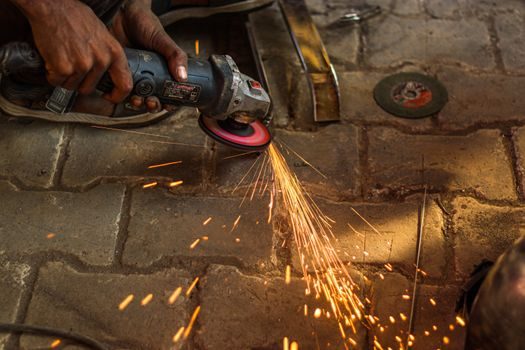
Demolition hammers' main operating constraint is operator fatigue and HAV exposure on long shifts — the corded industrial 16 kg-class machines in the KPT 2026 line are not single-handed tools, and vibration damping is the dominant ergonomic differentiator between premium and budget SKUs [S1][S2]. Angle grinders' main operating constraint is disc-speed discipline: exceeding the rated rpm on a fitted disc, or using a 115 mm disc on a 230 mm machine, can shatter the disc [S4]. Guard removal is the single most common safety failure documented in grinder incident reports, which is why the DEWALT DWE402 ships with a one-touch guard in 2026 reseller copy [S4].
Trackable 2026 signals: corded industrial demolition hammers still dominate heavy-site tender specs in mid-2026, with KPT16DHN-class SKUs and Chinese EXW floors near CNY 385 quoted on Yiwugo [S1][S2]; angle grinders in the 115 mm/230 mm bands continue to be the two top-selling disc sizes, with 11 A/11,000 rpm corded models such as the DEWALT DWE402 as the reference spec [S4]; and Chinese OEM/ODM suppliers such as Jiangsu Delika continue to bundle demolition hammers, angle grinders, polishers, and electric drills under one factory banner at 100-piece MOQ and 500,000-piece annual capacity [S3][S5]. For cost-side benchmarking, see the Cut-Off Machine 2026 Price & Cost Guide: Blade, Power, Automation Levers reference for adjacent abrasive-tool spend data.