Cut-off machine price bands in 2026 run from about US$35 for a portable 355 mm chop saw up to roughly US$50,000 for a foundry swing-frame cut-off, with the four main cost levers being blade diameter, motor power, automation level and the workpiece class the machine is built to handle [S1][S3][S7].
This guide covers abrasive-wheel cut-off saws, swing-frame foundry machines, high-frequency induction cut-offs and the portable 355 mm class — the segments that dominate the 2026 B2B catalog on DirectIndustry, ECVV and Made-in-China [S1][S3][S5]. Engineering buyers should treat any price quote under 90 days old as the only valid reference, since steel coil, abrasive grain and copper-motor costs moved noticeably through H1 2026 [S3].
Four Machine Classes and Their 2026 Price Bands
Portable 355 mm chop saws in the 1800–2400 W bracket list at US$35–US$120 FOB China for OEM-branded units, with a confirmed spec of Ø355 mm blade, 3800 r/min no-load speed, 2200 W rated input, and 110/220 V 50/60 Hz operation — the standard parameter sheet published by Chuanben on Made-in-China [S6].
Automatic carbide cut-off saws such as the ROTY ET FILS Caral series for steel sit in the mid-tier and are specified with up-feed blade geometry for production lines, listed on DirectIndustry as the Caral-series automatic cut-off for steel stock [S1].
High-frequency induction cut-off systems cluster around the US$1.00 MOQ listing tier on Made-in-China because the matched induction-heating supply is the bill of materials, not the cut-off head alone — AWC's catalog entry shows L/C and T/T terms, with the headline price reflecting the welder/power-supply bundle rather than a stand-alone cut-off [S5].
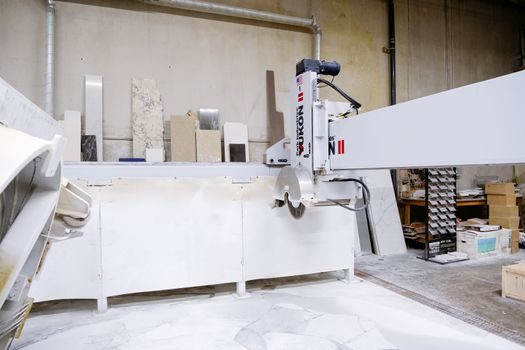
Foundry swing-frame cut-offs are the heavy end: the Vulcan Engineering Fox 2-C Swing Frame Cut-Off Machine is built for heavy cross-sections and fast gate/riser removal on castings, with a swing-frame design that lets the operator feed the wheel into the part without traversing the workpiece [S7]. Quoted project prices for swing-frame units typically land between US$15,000 and US$50,000 depending on wheel diameter, hydraulic feed and enclosure options [S7].
The Five Spec Levers That Move the Quote
Blade diameter is the single largest cost driver on portable machines: jumping from a 250 mm to a 355 mm abrasive wheel typically adds 30–60% to the bare tool price because the wheel, guard and motor all scale together [S6].
Motor power and no-load speed are quoted as a pair, and the 2200 W / 3800 r/min combination on the 355 mm class is now the de-facto reference spec for steel-cutting chop saws at the entry level [S6].
Automation tier separates a US$50 chop saw from a US$5,000 automatic cut-off: an up-feed blade, servo material handling and a parts counter on a Caral-class machine move the build into a guarded, repeatable cell rather than a hand-fed station [S1].
Supply capacity and brand positioning matter on B2B platforms: XLIKE publishes 480,000 sets/year of cut-off and chop-saw output on ECVV, which translates into aggressive FOB pricing on Makita 2414NB and LG355 reference builds, with L/C as the standard payment instrument [S3].
Workpiece class and duty cycle push the buyer into either an abrasive-wheel machine, a cold saw or a swing-frame foundry unit — a portable chop saw will not survive a steel-mill gate-and-riser workload, and a swing-frame machine is overkill for a 50 mm tube cut [S7]. For buyers comparing abrasive-wheel machines against oxy-fuel and plasma alternatives, the Plasma Cutter vs Oxy-Fuel Torch: 2026 Spec & Selection Cut comparison lays out the cut-quality and operating-cost trade-offs side by side.
Manufacturer Type and What It Means for the Quote
Chinese OEM/ODM factories dominate the portable 355 mm segment, with Moyi Tools (founded 1995) and XLIKE as the two most-listed names on Made-in-China and ECVV in 2026 [S2][S3]. XLIKE's published 480,000 sets/year capacity and L/C payment terms are the benchmark for tier-1 Chinese chop-saw supply, and they underpin the US$35–US$120 entry-level FOB band [S3].
European specialty builders focus on the automatic production-line cut-off: ROTY ET FILS positions the Caral series as a steel-cutting automatic with up-feed blade geometry, and the DirectIndustry listing format itself — compare-this-product, add-to-favorites — reflects a higher integration tier than a hand-held chop saw [S1].
North American foundry OEMs like Vulcan Engineering Co. own the swing-frame and heavy-section segment, with the Fox 2-C swing-frame cut-off pitched squarely at casting gate/riser removal in iron and steel foundries [S7]. The swing-frame niche has a much smaller addressable market than portable chop saws, which is why list prices sit in the US$15k–US$50k band even with modest annual volumes [S7].
Standards, Safety and Specification Discipline
Portable 355 mm cut-off machines on the 2026 B2B market are uniformly rated at 110/220 V 50/60 Hz with double-insulated or grounded housings, and the published standard parameter sheet for the 2200 W class is treated as the reference for engineering comparisons [S6].
Foundry swing-frame cut-offs such as the Fox 2-C are guarded machines with mechanical or hydraulic feed, and engineering buyers should request the OEM's CE/UL declaration and wheel-RPM certification with any quote — a foundry cell that runs an under-rated abrasive wheel is a documented failure mode, and the guard/feed package is what justifies the swing-frame price premium [S7].
Buyers sourcing from Chinese suppliers should pin down the payment-instrument mix in writing: L/C and T/T dominate Made-in-China listings, with XLIKE specifying L/C as the primary instrument for cut-off machine orders at 480,000 sets/year capacity [S3][S5]. A 30% T/T deposit plus 70% balance against B/L copy is the typical 2026 split for first-time OEM buyers on this category [S3].
Selection Criteria: Matching the Machine to the Cut
For tubing, rebar and small-section steel under 50 mm, a portable 355 mm / 2200 W chop saw at US$35–US$120 is the cost-effective choice, with the Chuanben-published spec sheet as the engineering baseline [S6].
For production-line steel cutting with repeat-length stops and minimal operator input, an automatic up-feed blade machine such as the Caral series is the right step up — the buyer is paying for the feed system and guarding, not for raw cutting power [S1].
For cast-iron and cast-steel gates, risers and heavy cross-sections, a swing-frame cut-off such as the Vulcan Fox 2-C is the only practical option, with the swing-frame geometry letting the wheel feed into the casting while the operator stays clear of the cut zone [S7].
For buyers cross-shopping cutting processes, the Oxy-Fuel Cutting Torch vs Arc Welding Machine: 2026 Spec & Selection Cut reference lays out the operating-cost and cut-quality trade-offs between thermal cutting and mechanical cut-off on the same workpiece.
Limitations and Failure Modes Buyers Should Price In
Abrasive-wheel cut-off machines consume wheels continuously, and a US$50 chop saw will typically chew through a US$3–US$8 wheel per shift on steel, so consumable cost dominates operating spend within the first 12 months [S6].
Portable 355 mm chop saws are not designed for foundry gate/riser work, and any attempt to run one inside a steel-mill cutting cell is a documented failure path — the swing-frame class exists precisely because the wheel, feed and guarding are scaled for that duty [S7].
Entry-level Chinese OEM units at the US$35 price point typically ship without a CE/UL declaration and may not meet European or North American end-user safety audits; engineering buyers who need CE marking for resale should add 15–25% to the bare FOB price and request a separate conformity document from the supplier [S3][S6].
For adjacent capital-equipment budgeting, the Wheel Loader 2026 Buying Guide: Tier, Bucket, Powertrain, Total Cost reference and the Excavator 2026 Price & Cost Guide: Class, Tonnage and Emission Tier document both lay out the same 2026 supplier-band and total-cost methodology for the heavy-equipment side of the same procurement cycle.
For a 2026 portable 355 mm chop saw quote in the US$35–US$120 FOB band, the verifiable next node is the supplier's 30/70 T/T-vs-L/C payment split, the CE/UL declaration status and the abrasive-wheel SKU on the packing list — three items that decide whether the headline price is a real landed cost or a teaser.
For component-level specifications, see linear guide, crossed roller guide, and coding machine.