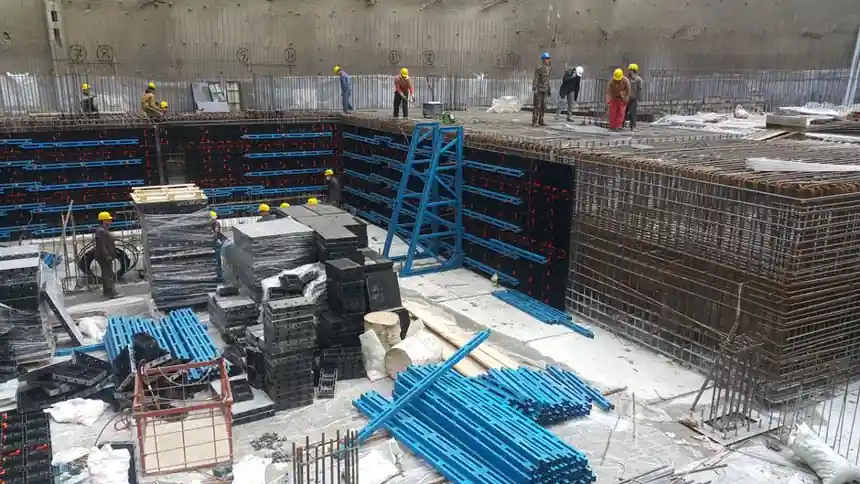
Grab-excavated diaphragm wall construction costs Rs 10,000–15,000 per m² in India [S2]. A hydraulic diaphragm wall grab removes soil in cycles while support slurry stabilizes the open trench [S3].
The rate covers a completed wall area rather than the operating cost of one machine, and it includes the grab-based construction sequence: slurry-supported excavation, reinforcement installation, tremie concreting and panel joints [S2][S5]. Equipment selection depends on soil conditions and trench depth, while grabs remain appropriate where obstruction removal and panel-by-panel excavation are practical [S3][S6].
Cost Per Square Meter and Its Basis
The documented benchmark for grabbed diaphragm wall construction is Rs 10,000–15,000/m² [S2]. This rate applies to vertical reinforced-concrete panels excavated with mechanical or hydraulic clamshell grabs beneath stabilizing slurry, followed by cage placement and underwater concreting [S2].
At the benchmark midpoint, Rs 12,500/m², a 1,000 m² wall area corresponds to Rs 12,500,000 before adding scope outside the published construction rate. The published source identifies wall size, excavation depth and project complexity as cost determinants, but it does not provide a separate labor, plant, energy, slurry, or maintenance breakdown [S2].
A procurement comparison should therefore separate the unit rate for wall construction from the operating cost of the diaphragm wall grab. The cited market report was inaccessible because its page displayed a security-verification notice, while the Indian construction source discusses diaphragm-wall construction types and costs without the stated rate in the supplied excerpt. These figures measure different scopes and must not be divided or compared as if they had equivalent meaning.
What Drives the Area-Based Cost
Excavation depth is a primary cost driver because deeper panels require longer trench support, greater excavation effort, more slurry and concrete volume, and longer lifting cycles [S2][S3]. The selection between a trench cutter and a diaphragm-wall grab primarily depends on soil conditions and trench depth.
Ground conditions determine whether a grab or cutter is suitable. BAUER states that trench cutters are preferred in hard or very hard soil and at large trench depths, while grab selection primarily depends on soil conditions and trench depth [S3]. A grab must therefore be compared with a cutter on excavation productivity, obstruction handling and slurry performance rather than on acquisition price alone.
Water and slurry control add cost because support fluid must prevent groundwater entry and trench collapse until reinforcement and concrete placement are complete [S3][S5]. The slurry circuit includes a desanding plant, with separated solids removed and support slurry returned for reuse [S3]. Wall quality also depends on verticality, position, concrete cover, joint watertightness and structural continuity [S5].
Grab Versus Other Construction Methods
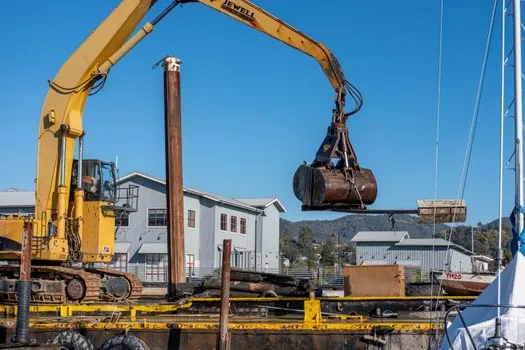
On the published Indian rates, grabbed construction at Rs 10,000–15,000/m² is less expensive than hydromill construction at Rs 15,000–20,000/m², precast concrete panels at Rs 20,000–25,000/m², and steel-reinforced construction at Rs 25,000–30,000/m² [S2].
The comparison changes when geology or geometry favors another excavation route. A hydromill is designed to cut hard soil and rock, whereas a grab loosens soil and removes it in repeated insertion cycles [S2][S3]. Trench cutters are specified for hard or very hard ground and greater depths, and BAUER cutters have achieved trench depths exceeding 250 m [S3].
Precast panels and steel-reinforced sections alter procurement and installation rather than excavation productivity. Precast units are inserted and interconnected after trench excavation, while steel tubes or beams are inserted and concreted to form a composite wall [S2]. The method with the lowest published area rate is not automatically the lowest total cost once access, obstructions, depth, groundwater and schedule risk are included.
Equipment and Operating-Cost Economics
A hydraulic grab completes excavation through repeated insertion, soil loosening and removal cycles, with stabilizing slurry maintained throughout [S3]. The related diaphragm wall grab capacity and panel production reference therefore provides the relevant production lens, because machine cost per hour matters less when converted into usable wall area.
If a project has insufficient wall area or a short operating window, the fixed equipment investment can dominate the effective operating cost.
The published cost evidence does not support a defensible grab-only figure in dollars per operating hour or per m². The supplied evidence supports retaining the Indian benchmark that diaphragm-wall construction costs vary with project size, depth, and complexity, but it does not provide the stated per-square-metre rate in the available excerpt. Any more precise operating-cost allocation requires local rental, fuel, labor, slurry-plant and maintenance quotations.
Total Cost of Ownership Beyond the Unit Rate
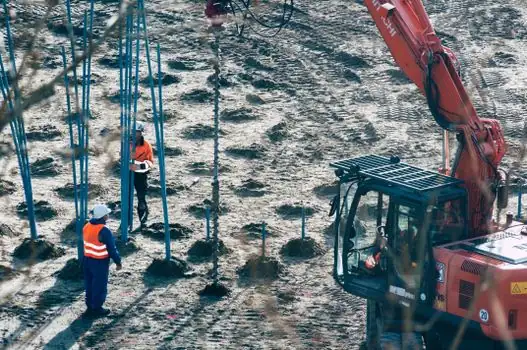
The area rate must be tested against production and support-system requirements. Grab excavation, slurry stabilization, desanding, cage insertion, tremie concreting, joint formation and wall-head trimming are separate work fronts that can constrain one another [S3][S5]. A cheap excavation rate cannot compensate for a stalled slurry plant or a panel cycle that prevents concrete placement.
Total ownership cost therefore includes the grab acquisition or rental, crane or carrier support, hydraulic power, operator labor, preventive maintenance, wear parts, slurry mixing and desanding, slurry disposal, excavation energy, and the cost of maintaining progress through reinforcement and tremie placement [S2][S3][S5]. The research provides no numeric operating-cost allocation for these items, so they should be tendered separately rather than hidden inside an unsupported rate.
Schedule risk also affects cost. Diaphragm walls are used for excavation support, groundwater cut-off and permanent retaining applications, and can be constructed to depths of 90 m and beyond [S4][S6]. A delayed grab can postpone excavation support and subsequent structural work, making utilization and standby time more important than the lowest headline equipment price.
Applicable Projects and Selection Limits
Grabbed diaphragm walls suit deep basements, dams, tunnel approaches, deep excavation enclosures and similar reinforced-concrete retaining or cut-off works [S2][S4]. A mechanical or hydraulic clamshell grab is particularly relevant where the excavation sequence must remove obstructions and build individual panels under stabilizing slurry [S2][S6].
The method is less suitable when hard or very hard soil dominates the profile or when trench depth exceeds the practical operating range of the selected grab, because BAUER identifies those conditions as typical trench-cutter applications [S3]. The hydromill comparison is also relevant where the project face includes rock or other material that reduces grab productivity [S2].
Diaphragm-wall project design also requires panel lengths compatible with the grab, with a minimum panel length generally in the order of 3.0 m [S7]. Trench dimensions, verticality, panel joints, slurry properties, reinforcement-cage fit and tremie execution must be coordinated before claiming that the Rs 10,000–15,000/m² benchmark will hold [S3][S5].
Procurement Basis for a Cost Estimate
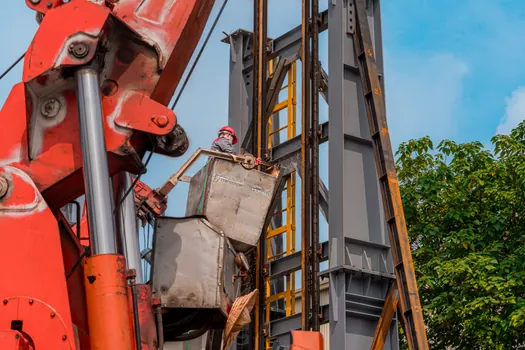
A defensible estimate starts with Rs 10,000–15,000/m² for grabbed diaphragm wall construction in India, then tests that rate against excavation depth, panel dimensions, geology, groundwater, obstructions and slurry requirements [S2][S3]. The estimate should state whether it includes guide walls, slurry plant, reinforcement, concrete, joints, wall-head trimming, dewatering interfaces and working space.
For equipment evaluation, obtain a separate operating-cost model based on planned wall area, panel geometry, expected cycle time, operating days, mobilization, utilization and maintenance exposure. The USD 500,000–1.5 million hydraulic grab benchmark [S1] is an acquisition indicator, not an operating rate, while Rs 10,000–15,000/m² is a construction-cost indicator, not a machine-performance guarantee [S1][S2].
Track two commercial signals before award: written local quotations reconciled to the same wall-area scope, and a production schedule demonstrating that the selected grab, crane or carrier, slurry plant and concrete placement can sustain the planned panel sequence [S3][S5]. This closes the gap between the published area rate and the project’s real installed cost.