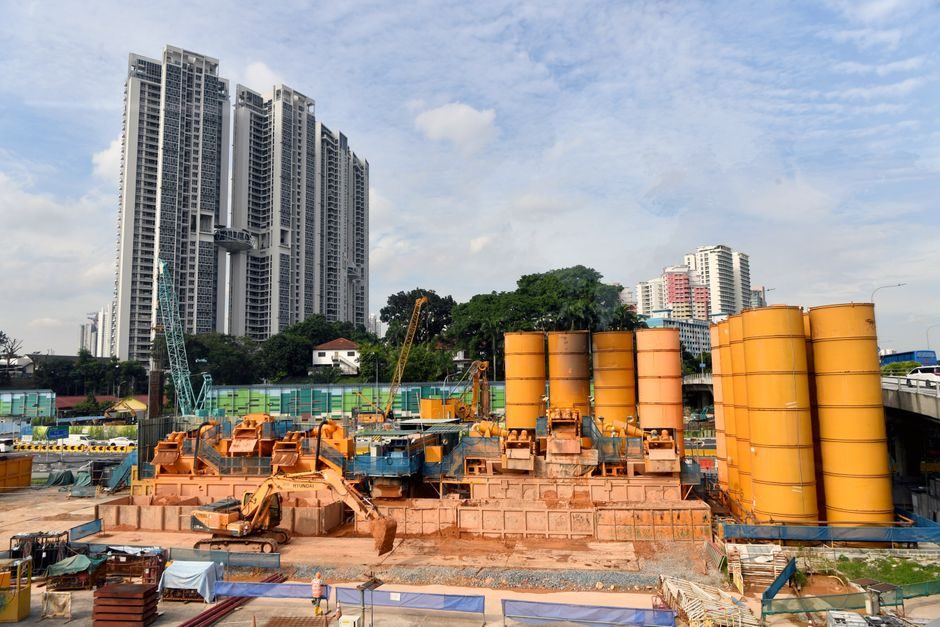
A hydraulic diaphragm wall grab cuts vertical slurry-supported trenches typically 600–1500 mm wide and 30–100 m deep for cast-in-place retaining walls, while a dynamic compactor consolidates loose or fill soils by dropping 6–20 t tamping weights from 10–25 m onto the ground surface, with the two machines addressing sequential foundation phases rather than competing tasks [S1][S4].
Foundation engineers specify the two for entirely different site objectives: the grab is a trench-excavation tool used ahead of tremie-concrete placement and rebar cage lowering, and the compactor is a soil-improvement tool applied to loose granular or fill ground before shallow-footing or floor-slab construction. Specifying one where the other is required is a common procurement error on mixed-use sites with both deep basement walls and thick fills.
Working Principle and Excavation Mechanics
Diaphragm wall grabs excavate under bentonite or polymer slurry that stabilises the trench face during digging; the grab bucket bites into the soil at the trench bottom, is hoisted clear of the slurry, and discharged into a spoil bin, with cycle times driven by grab weight, trench depth, and soil strength [S2]. Underground diaphragm wall hydraulic grab control systems use power-bond-graph modelling to correct deviation of the bucket from the design wall plane, a control problem that becomes critical below 40 m where cumulative drift otherwise pushes the wall out of tolerance [S2].
Dynamic compactors do not excavate; they densify soils by repeated high-energy impacts that generate stress waves propagating to depths of roughly 3–6 m in loose sands and granular fills, and to shallower depths in cohesive soils. The mechanism is impact-loading, not removal, and ground heave between tamping points is normally re-graded by bulldozers before a second pass. Thin-wall grab variants of the diaphragm wall family share the same slurry-trench principle but use narrower buckets for thinner wall panels, typically 300–500 mm [S3].
Typical Operating Envelope and Key Specs
Standard hydraulic diaphragm wall grabs cover panel widths of 600–1500 mm and depths to 60–80 m, with heavy-class units such as the SG60 reaching 100 m at higher unit cost [S4]. The SG60 reference FOB price sits at US$770,000 for 1–9 pieces and US$710,000 at 10+ pieces, with an online-support warranty of one year, illustrating the per-machine capital step between mass-produced mid-depth grabs and 100 m-class deep units [S4].
Dynamic compactors are specified by tamping weight (commonly 6, 10, 15, or 20 t), drop height (10–25 m), and resulting impact energy in kJ or kN·m; common cycle metrics are 4–8 drops per point on a grid pattern of 5–10 m spacing. Manufacturers catalogue grabs by chassis class, jaw-opening width, and allowable trench depth rather than by impact energy, and the two spec sheets share no common variable, which is itself a useful red flag that the machines are not interchangeable.
Selection Criteria: When Each Tool Fits
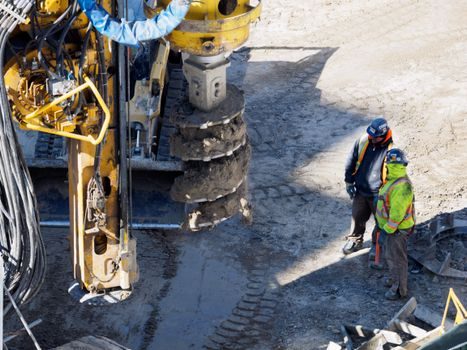
Specify a hydraulic diaphragm wall grab when the design calls for a vertical reinforced-concrete retaining wall deeper than roughly 12 m, where secant-pile walls or sheet-pile walls become uneconomical or water-tightness becomes critical, and where adjacent structures cannot tolerate vibration-driven sheet piling. Common applications include metro station boxes, deep pump-station shafts, and cut-and-cover tunnel sidewalls [S1].
Specify a dynamic compactor where the subsoil is loose sand, hydraulic fill, mine backfill, or uncontrolled demolition fill, with a treatment depth of 3–6 m, ahead of ground-bearing floor slabs, shallow footings, or tank pads. The method is unsuitable for cohesive soils, near existing vibration-sensitive structures, or where buried utilities or shallow basements exist within the stress-wave footprint, since impact loading can damage services inside the influence zone.
Comparison Matrix: Grab vs Compactor on Four Decision Criteria
On the four criteria a foundation engineer actually uses to pick equipment — application phase, depth of influence, output metric, and primary risk — the two machines diverge cleanly. Application phase: trench excavation vs ground improvement. Depth of influence: 30–100 m vertical trench vs 3–6 m soil-improvement depth. Output metric: linear metres of completed wall panel (m/day) vs post-tamping SPT N-value or CPT tip resistance. Primary risk: trench collapse under slurry loss or bucket deviation from design plane vs overstressing of adjacent structures and buried services. [S1]
A grab without slurry support is a safety incident waiting to happen; a compactor without a pre-survey of buried utilities is a service-damage claim. The procurement error on mixed-use sites is treating the compactor as a substitute for the grab on deep-wall sections, which it cannot be, or specifying a grab where a much cheaper vibratory compactor or roller would have densified a shallow fill to the same SPT target.
Site Coordination and Production Realities
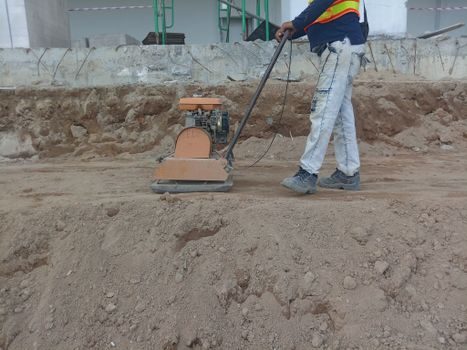
On a typical deep-basement project the sequence is: dynamic compaction of any surface fill first, then diaphragm wall grab excavation along the wall alignment, then bulk excavation inside the wall, and finally base-slab construction. Reordering the two operations is rarely possible: dynamic compaction after wall installation risks impact-loading the newly cast wall panels before they reach design strength, and grab excavation first leaves loose fill inside the future basement footprint that the compactor must still treat separately. [S2]
Production rates diverge by an order of magnitude. A heavy hydraulic grab on a 60 m trench typically advances 2–4 m of wall length per 12-hour shift in stiff clays and softer ground; a dynamic compactor completes 200–400 tamping drops per shift on a 6–8 m grid, each drop delivering roughly 1–5 MJ of impact energy. The compactor's higher drop count reflects its grid-pattern coverage; the grab's lower metres-per-shift figure reflects continuous trench advance.
Limitations, Failure Modes and Boundary Conditions
Diaphragm wall grabs fail operationally when boulder content exceeds bucket jaw opening, when groundwater flow exceeds slurry recirculation capacity, or when trench verticality drifts beyond roughly 1:200 over the wall depth [S2]. Thin-wall grab variants reduce concrete volume but raise the risk of panel deflection in soft clays [S3]. Micro-diaphragm structures at the opposite end of the size spectrum — micron-scale plates used in microtransducers — share the same plane-stress mechanical description as their macro counterparts, a useful reminder that deflection control is a fundamental design constraint across the size range [S6].
Dynamic compactors lose effectiveness rapidly below the water table in saturated sands, where impact loading liquefies rather than densifies the soil, and on cohesive soils where the stress wave decays before achieving meaningful consolidation. The two failure modes are different in nature, and engineers specifying either tool should request a pre-construction trial pad to verify the design assumptions, particularly on brownfield sites with heterogeneous fill.
Procurement Signals and Standards Anchors
Buyers comparing a 100 m-class SG60 grab at US$710,000–770,000 per unit should benchmark that figure against the per-linear-metre wall cost it delivers, not against the day-rate of a compactor, since the two tools are funded from different budget lines and serve different phases [S4]. Foundation engineers reviewing both pieces of equipment for the same project can cross-check trench-excavation methods against the adjacent spec cut for pile driving alternatives and the broader rig-selection logic in pile driver vs rotary drilling rig.
For the broader equipment context on this site, the AAC block cost model in AAC block 2026 price and cost guide tracks wall-finish economics downstream of both operations. The category pages for dynamic compactor and diaphragm wall grab carry the full spec vocabulary an engineer needs to draft a tender.
For component-level specifications, see dynamic balancing machine.