Choose a rope-suspended diaphragm wall grab when the job is a continuous deep rectangular trench (typical panel widths 350–1,500 mm, groove depth up to 100 m per the SINOMADA Sg60 published spec) and choose a hydraulic pile driver when the job is driving discrete piles or sheet sections to a target set. Treating them as substitutes wastes money and overruns the programme [S1][S3].
Diaphragm wall grabs are sold as carrier-mounted attachments (carrier weight 9–35 t for the DHG series, CE-marked, rope-suspended with crowd-rod closing) or as dedicated rigs such as the SINOMADA Sg60 at 92 t operating weight, 298 kW rated power, 33 MPa working pressure, with reference FOB pricing of US$770,000 for 1–9 units and US$710,000 at 10+ units [S1][S3]. XCMG / XG-series piling rigs from Jiangsu manufacturers carry a US$500,000–800,000 FOB price band and 200-unit annual capacity, with ISO 9001 management certification [S2].
Working principle: trench excavation vs impact driving
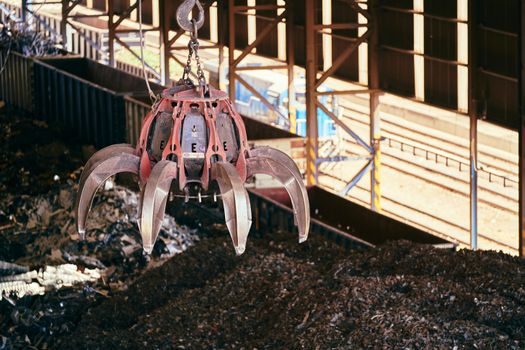
A diaphragm wall grab excavates a slurry-supported vertical panel using either a rope-suspended clamshell bucket or a hydraulic rig with a vertically mounted cylinder driving crowd rods to close the jaws; closing force is what bites the soil, not impact energy [S1].
A pile driver transfers vertical or combined axial+rotary energy into a precast concrete pile, steel H-pile, or steel sheet pile; the Sg60’s 33 MPa hydraulic working pressure and 298 kW powerpack feed a rotary head or drop hammer rather than crowd rods [S3]. Different kinematics, different wear parts, different crews.
Output and dimensional envelope
Diaphragm wall grabs are defined by groove width and depth: the Sg60 spec sheet lists groove width 350–1,500 mm, groove depth 100,000 mm, and a 2,460 × 3,250 × 1,413 mm shipping envelope in LCL transport configuration at 92 t [S3]. DHG-series attachments are limited by their carrier’s 9–35 t class and are commonly used for shallower panels [S1].
Pile drivers are defined by pile length, hammer energy or torque, and rig mass. A 92 t, 298 kW rig in the XG family drives bored or driven piles to typical building-foundation depths; for the trench geometries a grab cuts, a pile driver is the wrong tool [S2].
Decision criteria: when the grab wins, when the driver wins
Specify a diaphragm wall grab when: (a) the wall must be a continuous reinforced-concrete panel (cut-off wall, metro station, deep basement, cofferdam); (b) depth exceeds 30–40 m, where driven piles are uneconomical; (c) ground conditions include soft alluvium or weathered rock that a clamshell can bite cleanly [S1][S3].
Specify a pile driver when: (a) the structure is point-supported by discrete bearing piles; (b) sheets or H-piles must be driven into a defined refusal criterion; (c) programme requires 200+ piles per month from a single rig. The XG-series manufacturer publishes a 200-unit annual production capacity for its piling rig line, sized for high-volume pile campaigns [S2].
Spec-gate comparison: grab vs driver against 4 criteria
Cost: grab systems at the SINOMADA Sg60 spec point sit at US$710,000–770,000 FOB, while XG piling rigs span US$500,000–800,000 FOB — price alone is not a discriminator [S2][S3].
Power & pressure: 298 kW rated, 33 MPa working pressure for the Sg60 grab rig; piling rigs of similar mass draw comparable hydraulic power, but route it to a rotary head or hammer, not crowd cylinders [S2][S3].
Carrier class: DHG grabs mount on 9–35 t carriers (excavator-based) and reuse a contractor’s existing fleet; Sg60-style grab rigs are dedicated 92 t carriers, so the capital model differs [S1][S3].
Geometric limit: a grab’s max groove depth is 100 m and width 350–1,500 mm on the Sg60; a piling rig’s effective depth is bounded by pile length supply, hammer stroke, and soil refusal, not by a 100 m panel geometry [S3].
Standards, certification and sourcing
Manufacturer certifications seen on these product listings are ISO 9001 (production-side quality system) and CE marking for the DHG attachment [S1][S2]. On-site execution standards for diaphragm walls (concrete tremie placement, panel tolerance, slurry support) are project-specific and supplied by the design engineer, not by the equipment OEM.
Procurement channels are predominantly Chinese factory-direct: made-in-china.com listings for SINOMADA (Sg60, 1-year warranty, online after-sales support) and the XG-series Xuzhou-based manufacturer (Lianyungang port, L/C and T/T terms, ISO 9001) [S2][S3]. Lead time is typically 60–90 days for a new rig build.
Who it is FOR vs who it is NOT for
It is FOR foundation subcontractors tendering metro, deep-basement, cut-off-wall or cofferdam packages who already operate slurry plants and tremie crews. It is NOT for light civil contractors who only need to drive precast piles for a warehouse slab — that is a pile driver’s job, and a grab rig at 92 t is the wrong cost model. [S1]
For engineering buyers selecting a grab, the Diaphragm Wall Grab Selection: 4 Spec Gates That Decide the Build walkthrough covers the four spec gates (carrier class, panel geometry, closing force, slurry compatibility) that decide the build. For buyers benchmarking piling-rig budgets, the Pile Driver Price and Cost Guide: Static, Hydraulic and Electric Cost Bands breaks out the cost bands by drive principle.
Failure modes and field constraints
Grabs fail in two predictable ways: jaw wear when closing force is set against gravel or stiff clay without re-grabbing, and crowd-rod fatigue when the rated 33 MPa working pressure is repeatedly exceeded — the Sg60 spec sheet calls 33 MPa the rated working pressure, not a transient limit [S3].
Pile drivers fail via hammer-cushion burnout, spliced-pile joint damage in cohesive soils, and refusal misreads in heterogeneous fills. Neither equipment family tolerates dry excavation; slurry support is mandatory for grabs below the water table, and pre-boring is mandatory for pile drivers in dense granular layers.
Limitations and what the spec sheets do not show
Published FOB prices exclude shipping, commissioning, slurry-plant, tremie pipe, desander, and the steel reinforcement cage — typically 30–50% above the bare rig price for a fully mobilised grab spread [S2][S3]. Carrier weight of 9–35 t for DHG attachments assumes a matched hydraulic supply; mismatched carriers lose closing force linearly with pressure drop [S1].
Cycle-time data (m³/hr, panels/day, piles/day) is not published on these listing pages and must come from the contractor’s own ground-condition log; the manufacturer’s 1-year warranty and online after-sales support cover the hardware, not the production rate [S3].
Trackable signals: monitor SINOMADA and XCMG / XG-series catalogue updates on made-in-china.com for the next 6 months — any new model below US$500,000 FOB with a published groove-depth spec will reset the entry-level benchmark; the current Sg60 at US$710,000–770,000 FOB is the published reference point as of 2026-05-20 [S2][S3].