Die casting cells release more than 1,000 kg per year of sticky, oily aerosol per medium machine, generated from release-agent spray, piston lubrication, and the thermal decomposition of die lubricants during metal injection [S3].
Capturing that cloud at source with a properly designed hood, then separating it through multi-stage filtration (demister, electrostatic precipitator, or media), is the baseline duty that any die casting machine cell's air-handling package must meet before throughput becomes a meaningful talking point [S1][S5].
Source profile: why die casting fumes are harder to filter than welding fumes
Die casting fume is a hot, sticky aerosol of mineral oils, graphite, petroleum, natural waxes from release agent, plus combustion products from molten aluminum, zinc, or magnesium. The release agent is sprayed into the cavity for separation and surface finish; the piston is lubricated in the shot sleeve [S3]. The two streams combine into an aerosol that fouls standard mechanical filters fast, and fire risk rises as oil cake builds [S2].
By contrast, welding fume is mostly dry metallic oxide; the engineering problem is collection velocity and HEPA-grade media, not cake-combustion control [S5]. That is why every serious die casting cell specifies either a Clean-In-Place wash system on the filter or a non-washable electrostatic stage that the oil does not load beyond its saturation limit.
Hood and capture: match the hood geometry to tonnage, not to the cell floor
Standard OEM hoods on the market cover a 200 to 3,500 ton clamping-force range, with movable hoods for die change, and a tall enough throat to clear a reciprocator or spray robot [S4]. For low-ceiling cells or cells with gantry extractors, custom hoods are routine, not exceptional [S4].
The required extraction airflow is governed by machine size and by cold-chamber versus hot-chamber design, since hot-chamber magnesium cells add burn-off risk and a different explosibility class [S5]. For aluminum die casting machine cells, the hood should sit directly over the parting line and the shot-sleeve area; for magnesium die casting machine cells, the design must follow DGUV Regel 109-011 (formerly BGR 204) on magnesium processing, with extraction sized for hydrogen suppression as well as oil capture [S5].
Filtration train: three architectural choices, all commercially available
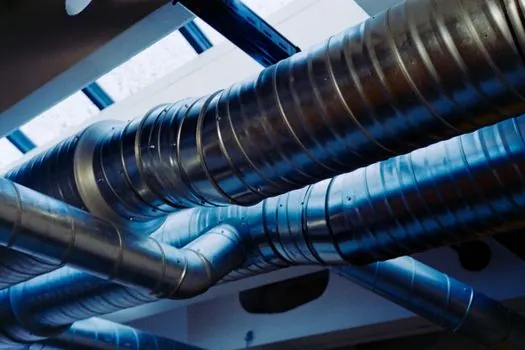
Three architectural patterns dominate cell-level air purification, and the right answer is dictated by release-agent chemistry and by whether you can return cleaned air to the hall. [S5]
Pattern one, electrostatic precipitator plus optional demister, is the recirculation workhorse. The KMA ULTRAVENT and the Keller eLine both run as electrostatic aerosol separators with a demister upstream, sized for either decentralized (stand-alone) or centralized (multi-machine) duty, and they cut total air-handling energy by up to 85% versus once-through exhaust in winter [S1][S5]. Absolent and IMAS offer the same electrostatic core with their own hood packages for foundry fumes and dust [S3][S7].
Pattern two, media filtration with Clean-In-Place wash. KMA's CIP system uses high-pressure, high-temperature soap and water to wash grease out of the filter, which the OEM markets as a fire-spread prevention feature on top of the filtration duty [S1][S2]. Pattern three, integrated local filtration in a self-contained hood. ComTech, Thirumalai Engineering, and similar integrators sell a hood with built-in filtration for cells where make-up air is expensive and external ductwork is not feasible [S4][S9].
For a zinc die casting machine cell where release-agent oil is the dominant contaminant, electrostatic plus demister is typically the lowest total-cost-of-ownership path; for a vacuum die casting machine cell, the lower fume volume lets the hood run smaller, but the heat-recovery upgrade on the exhaust side becomes the dominant energy play [S1].
Comparison: three filter architectures on four decision criteria
Layout the three architectures against the criteria that drive a 2026 cell-level purchase decision.
On energy use, recirculating electrostatic systems are the strongest: documented savings up to 85% versus conventional exhaust, because the cleaned air stays in the hall and the heating load drops [S1]. On fire and oil-load safety, the Clean-In-Place media system has the strongest OEM-stated case, because the high-temperature soap wash removes the oil cake that would otherwise accumulate [S2]. On hood flexibility for low ceilings and gantry cells, the self-contained integrated hood wins, because it eliminates external ductwork and make-up air [S4]. On capex, the once-through exhaust path is the cheapest to install and the most expensive to run, which is why it persists mainly on small-batch cells and on gravity die casting machine stations where fume load is light [S1][S5].
Operating envelope: airflow, heat, and what to do with the cleaned air

Cleaned air from a die casting filter carries 25 to 45% of the thermal energy that was put into the cell by the molten metal, and that energy is recoverable [S1]. In exhaust-air mode the filter train (demister plus electrostatic) can be expanded with a high-efficiency heat exchanger, plus a heat pump if needed, to push recovery above what the exchanger alone delivers [S1]. In recirculation mode the same cleaned air offsets hall heating in winter; the trade-off is that any leakage past the filter becomes a worker-exposure issue, which is why the electrostatic stage is rated for high-grade separation of oily and greasy aerosols specifically [S1].
Air-volume sizing is not a fixed number; it scales with machine tonnage and with cold-chamber versus hot-chamber geometry, and the hood must be designed for the specific cell [S5]. A 300 ton aluminum pressure die casting cell typically pairs a 10 HP fume extraction unit with mild-steel construction and full automation, with downstream filtration sized to the release-agent volume rather than to the machine alone [S9].
Standards, compliance, and what to put on the data sheet
German plant design references TA-Luft for emission standards, VDI 2262-3 for clean-air recirculation, TRGS 900 for workplace limit values, DGUV Regel 109-011 for magnesium processing, and DGUV Regel 109-002 (formerly BGR 121) for workplace ventilation, and a European die casting cell should reference all of them on the filter data sheet [S5]. KMA ULTRAVENT systems are explicitly designed to meet BG occupational-safety and BImSchG environmental-protection requirements in Germany, with both decentralized and centralized configurations [S1].
For North American cells, NFPA and OSHA ventilation rules govern oil-mist exposure limits, and the air filter should carry a documented clean-air delta across the cell, not just an upstream-to-downstream efficiency number [S2][S3]. ComTech hoods are typically built to a 1-year warranty baseline with optional self-cleaning and integrated media stages, which is a reasonable floor for a 2026 spec [S4].
Limitations and failure modes that bite in production
The single most common field failure is filter loading with oily cake, which kills differential pressure and creates a fire hazard; long-term preventive maintenance is the weakest link, and that is the explicit reason KMA developed the high-pressure hot-soap Clean-In-Place system [S2]. The second failure mode is hood mis-sizing: if the hood sits too high or too far from the parting line, the capture velocity drops and the filter sees less oil but the operator sees more, which fails the worker-exposure test even when the filter data sheet looks clean [S3].
The third failure mode is make-up air: a centralized filtration system eliminates make-up air at the cell, but only if the ductwork and the hall-pressure balance are sized correctly; otherwise the cell goes negative and the remote doors start whistling [S4]. Quoting directly from one of the OEM pages: "An air filter which is not clean, can not clean air" [S2]. That line is the engineering summary of the whole air-purification train.
Selection checklist for a 2026 cell retrofit or new build
Start with the alloy: magnesium cells trigger DGUV Regel 109-011, and the hood plus extraction package has to follow magnesium-specific rules rather than the generic aluminum or zinc baseline [S5]. For aluminum and zinc pressure die casting cells, the dominant variable is release-agent chemistry; water-soluble agents point to an ENA coolant-mist separator, and conventional oil-based agents point to an electrostatic stage [S5].
Decide recirculation versus exhaust early, because it fixes the filter architecture, the ductwork, and the make-up-air strategy, and the energy delta between the two can be as large as 85% on a 12-month run-rate [S1]. Specify the hood for the actual cell geometry, not the catalog tonnage band; a 2,000 ton cell under a gantry extractor is a custom hood, not a stock item [S4]. For procurement, track next quarter whether any of the major electrostatic-separator vendors (KMA, Keller, Absolent, IMAS) release a magnesium-rated variant under the updated DGUV framework, and whether ComTech or equivalent integrators extend their standard 200 to 3,500 ton hood range downward for the gravity die casting machine market.
Related analysis: Detent rotary encoders for HVAC control panel knobs: 2026 spec guide.