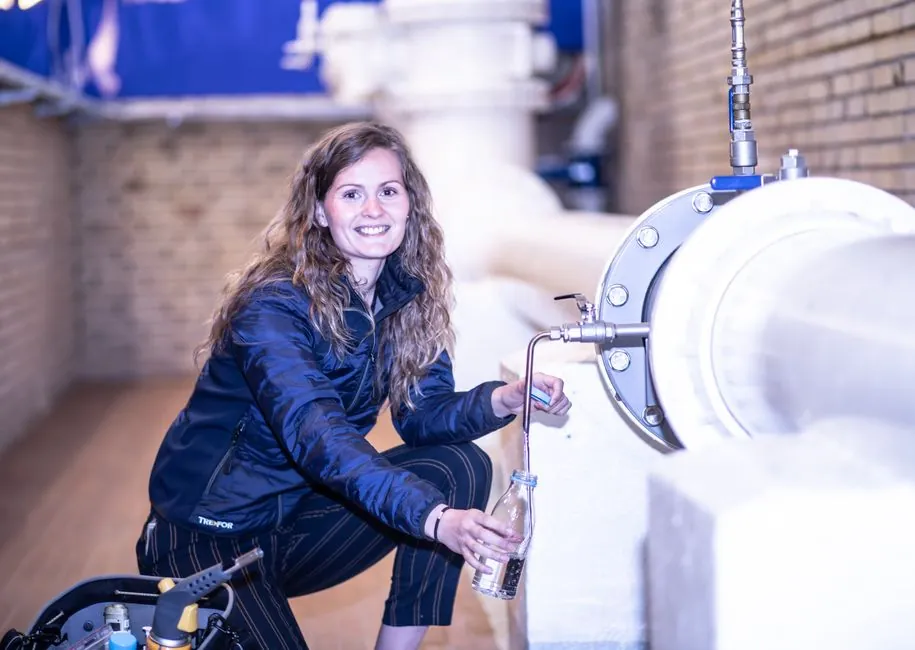
OSHA 1910.137 mandates that rubber insulating sleeves be dielectric-tested before first issue, every 12 months thereafter, whenever the insulating value is suspect, and after any repair [S2].
ASTM D1051 governs the manufacture of the sleeve and ASTM F496 governs its in-service care, with Skarshaug Testing Lab running a 1-minute AC proof at the rated class voltage and a "dip" method for the wet dielectric path [S2].
Scope: What the 2026 Sleeve Commissioning Procedure Actually Covers
The procedure covers Class 00 through Class 4 rubber insulating sleeves worn by line workers for secondary arm-and-shoulder protection against accidental contact with energized conductors [S1].
Burlington Safety Laboratory runs NAIL for PET-accredited sleeve testing at facilities in New Jersey and California, with a published 2-week standard turnaround and an expedited path available [S1]. Independent labs such as Skarshaug and equipment OEMs such as Doble (which sells a dedicated rubber glove and sleeve tester) support the same ASTM F496 flow [S2][S3].
The 2026 deliverable is a passed/failed decision plus a serialized ink-stamped record of test date, test voltage, and lab name, which is what the OSHA 1910.137 audit trail needs [S1][S2].
Five-Step Commissioning Flow from Receiving to Ship-Out
Receiving and check-in: the packing list is reconciled to the customer record, each sleeve is registered to a unique ID, and a physical ID label is affixed for full traceability [S2].
Visual inspection and cleaning: every sleeve is checked to ASTM F1236 for ozone cracking, UV damage, chemical attack, and snags, then washed and machine-dried before any voltage is applied [S2].
Stamped dielectric test: the sleeve is energized for 1 minute at the AC-rated proof voltage for its class, then ink-stamped with the test date, test voltage, and the testing lab's name [S2]. Burlington's flow chains the same prep sequence, with preparatory cleaning/washing followed by machine drying and then the high-voltage step [S1].
Final visual and pack-out: each unit is given a second visual check, paired with its mate, heat-sealed in plastic, and returned; failed units are tagged and returned, with replacement inventory ready at the lab for minimal lead-time [S2].
Decision Criteria: Pass, Fail, and When to Reject

Acceptance: the sleeve must hold the 1-minute AC proof voltage without breakdown, disruptive arcing, or leakage above the lab's rejection limit, and the visual must be free of cuts, ozone cracks, chemical attack, and snags that would compromise insulating properties [S2].
Reject: visible arcing during the proof, a current spike above the limit, or any ASTM F1236 disqualifying damage; rejected units are marked and returned, and the customer can order single-arm, single-sleeve, or full-pair replacements directly from the lab [S2].
For a shot sleeve on a die-casting cell, the same accept/reject logic is built on a documented pass/fail and serialized record, even though the test medium and voltage class are completely different from dielectric PPE.
Comparing the Two Test Methods: Dry AC vs. Dip Method
Lab A (Skarshaug): runs rubber sleeves on the "dip" method at the AC-rated voltage, which is the wet path the standard recognizes for Class 00 through Class 4 [S2].
Lab B (Burlington Safety): follows the same ASTM D1051 / F496 framework and adds a clean/dry prep stage before the high-voltage step, with documentation aligned to NFPA 70E field-handler requirements [S1].
Both labs issue serialized ink-stamped records and both use ASTM F1236 as the visual baseline, so for a safety officer the comparison collapses to turnaround, geography, and replacement inventory rather than to method differences [S1][S2].
Cadence: When Re-Test Is Mandatory, Not Optional
OSHA 1910.137 sets the floor: sleeves must be dielectric-tested before first issue, every 12 months thereafter, whenever insulating value is suspect, and after any repair [S2].
OSHA 1910.137 also allows a 12-month grace for sleeves that were tested but never issued: they may not enter service unless re-tested within the prior 12 months [S2].
Some utility safety programs tighten the cadence to 6 months; Burlington Safety notes that the more conservative interval is permitted under the same OSHA framework when an employer's written program requires it [S1].
Equipment Used: What a 2026 Sleeve Tester Looks Like
Doble's rubber glove and sleeve tester family is purpose-built for dielectric testing of worker PPE, and the OEM's framing is that each item is electrically tested beyond its maximum use to verify it can withstand the stress [S3].
A 2026 commissioning kit is not just the HV source: it is a matched set of water-fill/dip tanks for the wet method, a controlled drying station, ASTM F1236 visual-reference charts, calibrated tensile testing machine fixturing for material checks when sleeves are sent for tear/elongation audits, and serialized ink stamps for the date/voltage/lab fields [S2][S3].
Who This Procedure Is For, and Where It Does Not Apply

It is for utility line crews, electrical contractors, and field-service technicians who wear Class 00 through Class 4 rubber sleeves as secondary protection against energized contact, and for safety officers who own the OSHA 191.137 / NFPA 70E audit trail [S1][S2].
It is not for arc-rated clothing (which is governed by a different ASTM arc-test regime), not for hot sticks or blankets (separate ASTM pathways), and not for industrial shot blasting machine wear sleeves or die-casting shot sleeve consumables, which are mechanical, not dielectric, parts.
Standards, Traceability, and 2026 Audit Signals
Three documents drive the program: ASTM D1051 (manufacture), ASTM F496 (in-service care and testing), and OSHA 1910.137 (the legal cadence) [S1][S2]. NFPA 70E is the field-handler standard that the lab's documentation is structured to support [S1].
Trackable signals for 2026: any new OSHA letter of interpretation on 1910.137 cycle counting, any ASTM F496 revision that shifts the 1-minute proof time, and any NFPA 70E update that changes the in-service care section; watch for serialized-stamp format changes on the lab certificate, which is the easiest field indicator that a standards revision has propagated [S1][S2].
For a related field procedure on hot-chamber cell commissioning intervals, see the hot chamber die casting machine lifespan and replacement guide; for the mechanical side of the same casting consumable, the shot sleeve working principle is the matching reference.