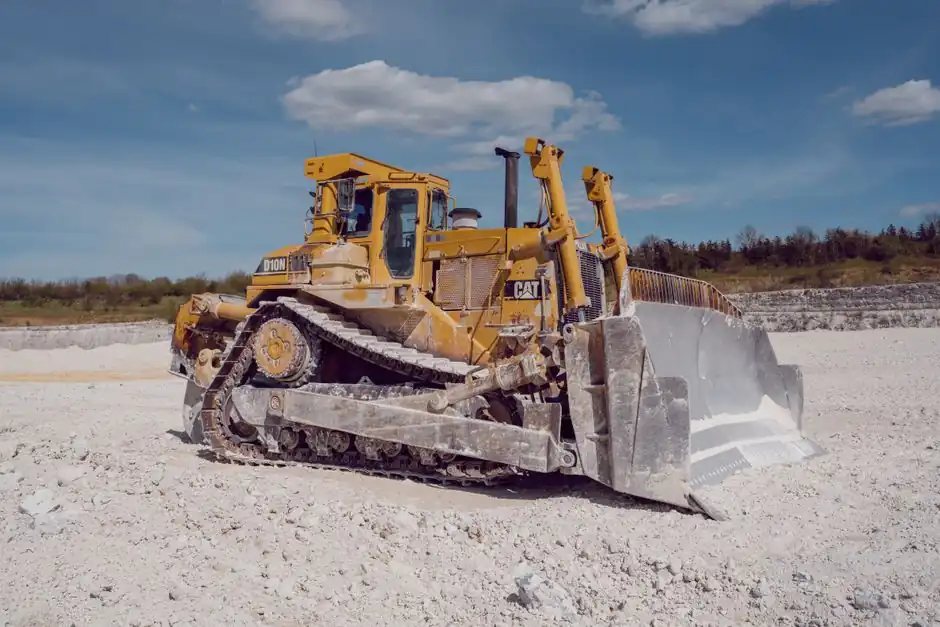
The Caterpillar D6 XE replaces the D6T torque converter and 3-speed powershift transmission with a C9.3B diesel engine driving a generator, power inverters and electric motors, offering up to 35% better fuel efficiency [S3][S5].
The comparison matters most for sustained pushing, loaded turns and high annual utilization; the D6T remains the simpler choice for light, intermittent grading where electric-drive benefits have less time to accumulate.
How the two drivetrains work
The D6T route passes engine torque through a hydraulic torque converter and 3-speed powershift transmission to the final drives. The converter permits slip, which supports engine speed management under changing loads but converts part of the transmitted energy into heat during push-turn-reverse cycles [S1].
The D6 XE starts with the same C9.3B engine family but mechanically decouples the engine from the tracks. The engine drives a generator, a power inverter controls electrical energy between generator and motors, and an electric motor drives each final drive through the steering case. The architecture removes the transmission, torque converter and mechanical steering clutches [S1][S5].
This distinction matters when interpreting “electric drive.” The D7E described in 2018 had no auxiliary battery and was described by Caterpillar as a diesel-electric hybrid powertrain, although it was not labeled “hybrid” on the machine [S4]. The D6 XE is a diesel-electric drive system, not a battery-electric dozer.
Performance comparison by operating criterion
Caterpillar data cited for the D6 XE indicate up to 35% better fuel efficiency than the D6T [S3][S5]. A D7E field test recorded 25% lower fuel consumption than the D7R Series 2, but that earlier machine is not directly equivalent to the D6 XE [S4].
Productivity is workload-dependent. Electric drive maintains commanded power across speed changes, gives full torque to both tracks during counter-rotation turns and eliminates the momentary hesitation associated with mechanical gear shifts [S1][S5].
Cooling and component protection differ as well. The D6 XE electric-drive components are liquid-cooled and sealed against environmental contamination, while the switched-reluctance generator does not require separate cooling. Caterpillar states that the architecture generates less heat than its earlier permanent-magnet design [S3][S5].
Cost and maintenance trade-off
The D6 XE requires a generator, power inverters, electric drive motors and associated power electronics that the conventional D6T does not require [S1].
Torque-converter drive has lower parts complexity in some respects, but it contains a torque converter, transmission and hydraulic-control system whose rebuilds and fluid service remain workshop requirements. The D6 XE eliminates the transmission, torque converter and associated fluid consumption, reducing the number of mechanical wearing components [S1][S3].
Electric drive is not maintenance-free. Its generator, inverter, motors, cabling, connectors and cooling system require capable technicians and diagnostic support. The D6T advantage is therefore local service familiarity and a broadly understood repair system, not lower acquisition cost [S1][S5].
Choose by duty cycle, not drivetrain label
Choose the D6 XE when the machine spends substantial hours pushing heavy material, loading the blade, carrying loads or making continuous full-power turns. Those conditions repeatedly demand power control and create opportunities to reduce converter losses, maintain ground speed and recover braking energy [S1].
Choose the D6T when work is dominated by light finish grading, short pushes, low annual utilization or intermittent single-machine deployment. With fewer productive hours, the D6 XE has less opportunity to recover its acquisition premium through fuel, labor and rebuild savings [S1]. Fleet standardization can also dominate the equipment decision because diesel-electric support requires technicians familiar with power electronics and high-voltage components.
Do not select the D6 XE merely because it is described as more powerful. The D6 XE has no torque converter stall and can ramp into a load, but the blade, undercarriage and operating technique still determine how much material reaches the push. Comparing production at the same blade fill, material type, grade and cycle time provides a more defensible business case than comparing rated power alone [S3][S5].
Service-life and duty-cycle boundaries
Caterpillar’s D7E field report provides useful electrical-scale evidence: its 9.3 L turbocharged inline-six produced 235 hp, drove a generator supplying up to 330 A at 480 V, and powered two brushless motors of approximately 600 lb each. Those figures describe the D7E, not the D6 XE, so they should not be used as D6 XE specifications [S4].
The D7E weighed about 60,000 lb, had a 5 ft high and 13 ft wide blade, delivered 10% higher pushing performance than the D7R Series 2 and consumed 5–9 gal/h in full work mode with a 126 gal tank [S4]. Its architecture also converted generated AC to DC for accessories, contributing 7 percentage points of the overall efficiency improvement in that test [S4].
For the D6 XE, the defensible service claims are lower powertrain rebuild cost, no transmission or torque converter, reduced fluid consumption and sealed, liquid-cooled electrical drive components [S3][S5]. A site with extreme heat, severe dust, continuous downhill loading or very high annual hours should include cooling capacity, connector condition and electrical-diagnostic support in the acceptance test rather than assuming the headline efficiency gain covers those conditions.
Acquisition, payback and operating checks
A valid comparison requires four measured inputs: diesel consumed per hour, productive machine hours, avoided mechanical rebuild cost and the capital premium paid for the D6 XE. Caterpillar’s published D6 XE payback case used 1,500 hours per year and predicted less than two years in typical construction applications, while explicitly noting variation by application, utilization and operator [S5].
The electric-drive choice is strongest when annual hours are high, pushing loads are sustained and the local workshop can support electrical diagnostics. The torque-converter choice is strongest when utilization is low, the fleet values standardized mechanical servicing, or the work pattern limits the hours during which electric-drive efficiency and regenerative benefits can accumulate [S1][S3].
Before ordering, ask the dealer to demonstrate counter-rotation turns, loaded-blade acceleration, downhill machine control and fault diagnostics under site conditions. Confirm fuel and production baselines against the same blade, material and operator, then calculate payback from measured values rather than the 10–35% range or the less-than-two-year example [S3][S5].
For related equipment decisions, compare battery-electric and diesel excavator architectures separately, because an excavator’s operating profile and energy storage requirements differ from a generator-fed dozer.