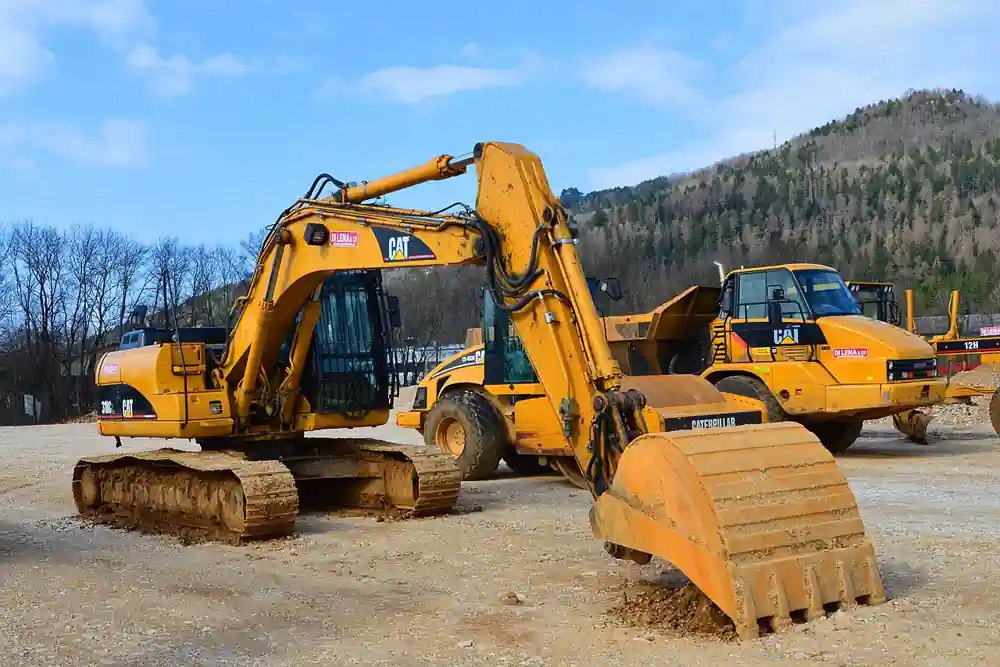
A battery-electric excavator is a crawler or wheeled excavator whose diesel engine and tank are replaced by a lithium-ion battery pack feeding electric drive and hydraulic pumps. It digs with comparable force and speed to its diesel sibling of the same operating class, produces no tailpipe emissions, and runs a shift-length duty cycle only when the site has the charging infrastructure to match.
Specifying one is an energy-planning exercise more than a machine-selection exercise. The datasheet lines that matter are battery capacity in kWh, usable state-of-charge window, energy draw in kWh per hour at the intended duty, charge power in kW and charge time, and cycle-life warranty in equivalent operating hours. This page decodes those lines, maps which site duties the battery machine wins today, and states plainly where the diesel excavator remains the correct tool.
The battery-electric excavator is the electrified member of the earthmoving family. The base excavator page covers the hydraulic machine itself, boom, stick, bucket, and swing; this page covers what changes when the energy source becomes a battery: drivetrain architecture, duty-cycle energy accounting, charging logistics, and the economics that decide fleet mixes on emission-regulated and indoor sites.
A battery-electric excavator succeeds or fails on duty-cycle arithmetic: kWh in the pack against kWh per hour at the bucket, and kW at the charger against minutes between shifts. This page gives the energy math, the machine classes available, the site infrastructure plan, and the RFQ lines that make the purchase auditable from the first shift to the warranty file.
Chapter 1 / 06
What Is a Battery-Electric Excavator
A battery-electric excavator keeps the working end of the hydraulic machine: boom, arm, bucket cylinders, swing drive, and travel drives all run on hydraulics or final electric drives as before. What changes is the prime mover. A high-voltage battery, typically 350 to 800 V nominal in mid-size machines, feeds one or more inverters; electric motors replace the diesel to drive the main hydraulic pumps, and on many designs the swing circuit recovers braking energy that a diesel machine burns off through valves.
The selection question arises on sites where diesel is unwelcome or expensive: indoor demolition, tunneling and underground utility work, urban jobs with noise windows and emission rules, landfill and water-treatment sites with emission credits, and corporate fleets with decarbonization targets. In those settings the machine is not competing on purchase price; it is competing on total cost per hour under a constraint the diesel cannot satisfy at any price.
What is actually being decided is an energy contract between machine and site. A mid-size electric excavator carries a published battery capacity in the range of roughly 90 to 350 kWh depending on class and maker, of which about 80 to 90 percent is a usable window. It draws somewhere between 15 and 40 kWh per hour in typical digging duty, so a single charge covers roughly 4 to 8 hours of standard work, longer in light material handling and much shorter in continuous heavy grading. Those three numbers, capacity, draw, and charger power, are the entire planning problem; everything else in the datasheet is secondary.
The comparison to diesel must be done once, in consistent units, and then reused. A 20-tonne-class diesel excavator burns roughly 15 to 25 liters per hour digging; at about 9.8 kWh of thermal energy per liter that is 150 to 245 kWh of fuel energy per hour, of which the diesel drivetrain converts only a fraction into hydraulic work. The electric machine draws its 15 to 40 kWh per hour as already-refined electricity, so like-for-like comparisons belong at cost per hour (local electricity tariff times draw, against pump price times liters) and at site energy (grid kWh against fuel kWh delivered), never mixing the two bases in one table.
Fleet context frames the decision. A site that also runs a wheel loader, a backhoe loader, or a motor grader faces the same electrification question unit by unit; a dump truck or a mining dump truck on haul cycles has a different, energy-heavier profile; a crawler crane or a rotary drilling rig has duty peaks that stress the battery harder than digging; a road roller electrifies easily because its compaction duty draws modest, steady power. Buyers who solve the excavator's charging infrastructure usually solve half of the fleet's, because the charger, the grid connection, and the load-management panel are shared assets.
The regulatory and commercial drivers decide urgency, not suitability. Low-emission-zone rules in European cities, diesel bans in tunnels and enclosed demolition, night-work noise limits, and customer sustainability clauses in earthmoving contracts all convert the electric machine from a cost experiment into the only compliant bid. Where none of those constraints apply, the purchase case rests on energy cost and maintenance alone, which is a harder, tariff-dependent arithmetic and should be run honestly before the order.
The energy ledger, stated once
Keep three ledgers separate and the comparison stays honest. Machine ledger: kWh drawn from the pack per hour at the stated duty, and kWh per cycle for repetitive work. Site ledger: kWh delivered by the charger per week, charger losses included, times the electricity tariff plus demand charges. Diesel ledger: liters per hour times delivered fuel price, plus fluid and filter servicing. The first error buyers make is comparing the machine ledger to the diesel ledger directly; the second is forgetting charger losses and demand charges; both make the electric machine look better than it runs, and both surface in the first quarter of operation.
Chapter 2 / 06
Working Principle and Machine Types
Drivetrain architecture
Three architectures appear in production machines. Pump-direct: an electric motor spins the same variable-displacement hydraulic pump set the diesel drove, keeping the hydraulic architecture and attachments identical; this dominates retrofits and first-generation OEM designs. Multi-motor distributed: separate motors for pump, swing, and ancillaries let each run at its own efficient point and let swing braking feed the battery; most purpose-built mid-size machines take this route. Full electric actuation, where cylinders are replaced or assisted by electric drives, remains rare in excavators and appears mainly in compact platforms.
Energy recovery is where the architecture pays. Swing a loaded upper structure 90 degrees and brake to a stop: a diesel machine dumps that kinetic energy as heat; a distributed electric machine returns a meaningful share to the pack. On repetitive truck-loading cycles, published fleet data from major manufacturers credits swing and boom-down recovery with a substantial share of total energy savings, which is why cycle work flatters the electric machine more than continuous grading does.
Classes a catalog actually offers
Compact class, roughly 1 to 3.5 t operating weight: battery packs of 10 to 30 kWh, indoor-and-renovation duty, charge from wall AC overnight. These compete with diesel on noise and access, and their energy draw is small enough that a 16 A socket is the entire infrastructure. Mid class, roughly 6 to 10 t: packs of 40 to 100 kWh, landscaping and utility trenching, usually 20 to 50 kW AC or entry DC charging. Standard class, roughly 18 to 26 t: packs of roughly 90 to 350 kWh by maker and option, general earthmoving and truck loading, DC fast charging at 50 to 150 kW where the site allows. Larger classes exist as prototypes and limited-series machines; a mining dump truck electrified at the same energy discipline is a different product with trolley-assist options.
Charging follows the same split. Compact machines use onboard AC chargers and standard sockets. Mid and standard machines ship with CCS-type DC ports in European and North American markets (regional standards differ), accept 50 to 150 kW where the grid connection allows, and support opportunistic top-ups during breaks: at 100 kW, ten minutes adds roughly 16 kWh, which is about half an hour to an hour of mid-class digging, the arithmetic that makes lunch-break charging a real production strategy. Some makers offer battery-swap or spare-pack programs for multi-shift duty; the trade is a second pack's capital against the schedule freedom, and the swap infrastructure itself becomes a site asset to plan and permit.
Power electronics and control
The inverter layer manages motor drive, regeneration, and battery protection. The machine controller interlocks the high-voltage system: contactors open on fault or emergency stop, insulation monitoring watches the pack-to-chassis resistance, and a service disconnect makes the machine safe for maintenance. Battery thermal management is liquid in mid and standard classes, holding cells in the band where both power and calendar life survive; a machine parked through a cold night spends real energy preheating its pack before high-power digging, and cold-weather derating belongs in the duty plan for any market with winters.
The machine's electrical cabinet reads like a small industrial plant, and the maintenance contract should name every row of it. A main contactor and precharge circuit bring the bus up softly; a drive motor per hydraulic pump group, each on its own inverter stage; on machines with electrohydraulic pilots, a servo motor or proportional electric actuator replaces pilot hydraulic valves for joystick commands; and the low-voltage side distributes through a conventional automotive-style fuse and relay architecture. Protection follows industrial practice scaled to 24 V control: a thermal relay or motor protection relay guards auxiliary motors like fans and compressors, and a circuit breaker head protects each distribution branch. None of this changes the operator's day; all of it changes who is allowed to open the cabinet door.
Telematics close the control loop. Every current machine reports state of charge, energy per hour, charge events, and fault codes over cellular; fleet dashboards aggregate the kWh ledger automatically. When specifying, require the telematics data export format and retention policy in writing, because the warranty conversation in year five will be conducted on this data, and buyer-side copies are the only durable ones. Geofenced reporting also earns its keep on urban sites with noise or emission windows: the log proves when the machine ran and when it was parked, which settles neighbor complaints and permit audits without argument.
Chapter 3 / 06
Construction, Components, and Duty Boundaries
Battery and structure
Packs use lithium-ion chemistry, in current production mostly NMC or LFP families, packaged in reinforced cages between the tracks or as counterweight-integrated modules. The structural choice matters for service life: a pack that drops out as modules allows capacity restoration or cell-group replacement at mid-life instead of a whole-pack event. Frame loading is unchanged from diesel because the battery mass sits where the engine and counterweight sat; operating weight and balance targets are matched so attachments and buckets carry over.
The hydraulic system is largely inherited: main pumps, control valves, a hydraulic power unit for pilot pressure where fitted, and the same cylinder bore and rod sizes. Cooling differs: instead of one big diesel radiator, the machine manages two smaller circuits, hydraulic oil and battery electronics, and both draw fan power the diesel machine spent anyway. Ancillaries that were belt-driven move to electric motors: fans, HVAC compressor, and the hydraulic pump for pilot circuits, each an efficiency gain and a parasitic-load line on the energy budget.
Duty boundaries
State plainly where the battery machine stops being the right choice today. Continuous high-load duty, mass grading or production trenching at full hydraulic load for full shifts, draws the pack down faster than published "typical duty" numbers and can force a mid-shift charge the schedule cannot absorb. Sites without grid power, remote greenfield earthmoving, have no charging path unless a generator runs, which erases the emission case and usually the cost case. Cold climates derate: below roughly -20 deg C, pack heating and reduced regen take a visible bite out of usable energy. And high-utilization rental duty, where the machine runs two shifts on one charger plan, stresses warranty terms that were written for one.
The boundaries that do NOT apply are the ones buyers assume first. Digging force and lift capacity are set by the hydraulic system, not the energy source; a same-class electric machine puts the same breakout force into the same bucket. Attachment compatibility holds: hydraulic hammers, grapples, and tilting buckets run off the same auxiliary circuits, and the hydraulic valve sections that direct them carry over from the diesel design. And travel speed and gradeability match class norms; only the travel energy comes off the same pack budget, which long repositioning moves consume exactly like digging does.
Attachments and the energy budget
Attachments deserve their own line in the duty plan because each one taxes the pack differently. A hydraulic hammer runs the auxiliary pump at high pressure and intermittent flow; its energy draw per hour can exceed the dig cycle it replaces, and hammer duty should be quoted with its own kWh-per-hour figure in the RFQ. Grapples and magnets in scrap and demolition yards idle low but peak hard, favoring the regenerative architecture. Tilting buckets and compactors add control-valve parasitic loads that the diesel masked. The rule: any attachment in the fleet's tool table gets a stated energy assumption in the duty annex, or the runtime guarantee is being written against work the site does not do.
Weight, transport, and the counterweight question
Battery mass lands where the engine block and fuel tank sat, and makers use it deliberately as counterweight, so trailer permits and lift plans usually match the diesel sibling. Two practical differences: the pack's center of mass is fixed, where a draining diesel tank shifted balance slightly through the shift; and the pack imposes transport rules, because a damaged lithium module on a trailer is a hazmat conversation that diesel never prompted. Fleets crossing borders should carry the machine's transport documentation pack, which the OEM supplies on request and which belongs with the RFQ deliverables, not in a dealer's drawer.
Chapter 4 / 06
Key Specification Parameters
The decode table lists the lines that decide whether a quoted machine meets the site plan, with the catalog spread across classes and what each line means for production.
Parameter
Compact 1 to 3.5 t
Mid 6 to 10 t
Standard 18 to 26 t
Operating weight
1,000 to 3,500 kg
6,000 to 10,000 kg
18,000 to 26,000 kg
Battery capacity, nominal
10 to 30 kWh
40 to 100 kWh
90 to 350 kWh
Usable window
80 to 90%
80 to 90%
80 to 90%
Energy draw, typical duty
1.5 to 4 kWh/h
5 to 15 kWh/h
15 to 40 kWh/h
Runtime per full charge
4 to 9 h
4 to 8 h
4 to 8 h typical duty
Charge power, max
3 to 11 kW AC
20 to 50 kW
50 to 150 kW DC
Full charge time
3 to 8 h
1.5 to 4 h
1 to 4 h by charger
Peak motor power
10 to 25 kW
40 to 70 kW
100 to 200 kW
Digging force vs diesel sibling
class-equal (hydraulic system unchanged)
Battery warranty
2 to 5 yr
5 yr or hour-based
5 to 8 yr or hour-based, to 70 to 80% SOH
Read the runtime line against the duty definition, not the brochure. "Typical duty" in vendor documentation usually means mixed digging and repositioning at moderate load; a continuous heavy cycle can nearly halve it, while material handling with recovery can extend it. The honest way to specify runtime is to name your duty: state the cycle, the bucket, the material, and the target production per hour, and require the vendor to answer in kWh per hour for that duty, which their field data groups can do. At handover, demand the same number demonstrated live on the telematics screen: one hour at the RFQ workload with the kWh counter visible, and one charge session at rated power with the state-of-charge climb against the clock; if the machine cannot show its own numbers on its own display, the guarantees are paperwork rather than practice.
The warranty line deserves the same decoding discipline. A state-of-health floor of 70 percent at end of year eight means the machine is guaranteed to still hold 70 percent of nameplate energy, which converts directly to runtime: an eight-hour machine at floor is a five-and-a-half-hour machine. Hour-based caps matter more than years for high-utilization fleets, because a machine run two shifts reaches the cap in half the calendar time. Check what voids the warranty: charging outside the approved charger list, deep discharges in storage, operation beyond the cold-derate curve without preheat, and unauthorized enclosure opening are the usual exclusions, and each is a site-discipline item rather than a design item.
The second table is the site energy plan the RFQ should attach, sized for one standard-class machine plus growth.
Site element
One machine, 150 kW charger
Fleet of 3 to 5 machines
Notes
Grid service
3-phase, 200 to 250 kVA demand
400 kVA and up
Utility lead time often exceeds machine delivery
Charger
DC 100 to 150 kW
2 to 4 DC units + load management
Load mgmt avoids peak-demand tariffs
Break top-up at 100 kW
16 kWh in 10 min
same per machine
About 0.5 to 1 h mid-class digging
Overnight plan
AC trickle to balance cells
staggered DC sessions
Off-peak tariff capture
Cold-site provision
pack preheat before shift
heated storage or shore power
Protects both runtime and pack life
Chapter 5 / 06
Selection Decision Factors
Work the decision in this order; each step either fixes a number or redirects the purchase.
Log the duty first: one to two weeks of hour-by-hour utilization on the diesel machine being replaced, with load notes. Everything downstream keys off this log.
Convert the log to energy: hours at rough load mix, times the class draw band, gives the kWh per shift the site must supply.
Check the site grid: available service size, distance to the parking area, and utility interconnection lead time. This step decides feasibility before any machine is chosen.
Match machine class to the real attachment and bucket needs; do not upsize the class for battery range, because the bigger pack also raises charger and grid demands.
Set the charging pattern: overnight full, break top-ups, or battery-swap if the maker offers it; verify the pattern against shift schedule and meter tariff structure.
Compare total cost per hour over the holding period: energy, maintenance, and residual value against finance; diesel fuel and its maintenance delta on the other side.
Review warranty terms in hours and years: battery state-of-health floor, coverage of capacity loss, thermal management repairs, and who diagnoses the high-voltage system.
Confirm emissions compliance value: which local rule, permit, or contract clause the machine satisfies, and the documentation the site must keep.
The cost table shows the structure of the comparison for a standard-class machine on a two-shift-capable urban site; fill local tariffs and utilization to make it a decision table. Maintenance lines reflect the electric drivetrain's fewer fluids and filters and the diesel's mature parts pricing.
Cost element
Battery-electric, per hour
Diesel, per hour
Energy at point of use
15 to 40 kWh x electricity tariff
15 to 25 L x pump price
Engine or pack maintenance
low: fluids and filters largely gone
oil, filters, aftertreatment, turbo life
Hydraulic and undercarriage
class-equal
class-equal
Charging infrastructure
amortized charger + demand charge
fuel storage and delivery
Carbon and noise compliance value
permits, night work, indoor work enabled
constraints and penalties risked
Residual after 5 to 8 yr
young market, SOH-dependent
mature pricing curve
What to write in the RFQ, verbatim:
Duty annex: cycle description, bucket size, material, target production per hour, shift length, and the utilization log behind it.
Energy guarantee: kWh per hour for the stated duty, and runtime per full charge at the stated usable window; measurement method on machine telematics.
Charging: port standard, max DC power, AC options, required charger models, and shore-power provision for storage.
Performance: operating weight, digging forces, lift capacities at radius, swing torque, travel speed, all matching class norms.
Safety and service: high-voltage interlocks, insulation monitoring, service disconnect, rescue procedure sheet, technician certification requirements, and diagnostic tool access.
Site: grid service size and charger plan the vendor must confirm compatibility with.
Two negotiation clauses earn their keep in the first year. The data clause: buyer access to raw telematics exports, not just the vendor portal, so the energy ledger and warranty record live on both sides of the relationship. The training clause: certification for at least two of your own technicians on high-voltage awareness and diagnostic access, because every hour of downtime on an electric machine that waits for a dealer technician is an hour the diesel fleet would have worked; machines whose high-voltage service is dealer-locked should say so in the quotation, and that fact belongs in the comparison, not in a footnote discovered at first fault.
Chapter 6 / 06
Field Practice: Charging, Safety, and Maintenance
Charging operations
Run charging as a production routine, not an afterthought. Full charge overnight on the cheapest tariff window; top-up during the lunch break whenever the day's plan is tight; record kWh per shift from telematics and compare against the duty log monthly, because a drifting kWh-per-hour number is the earliest signal of both duty creep and pack degradation. Keep the charger's load-management panel coordinated with the site's peak-demand structure; an uncoordinated second charger can push the site into a higher tariff bracket that erases the fuel savings.
High-voltage safety
The high-voltage system is safe by design and dangerous by mishandling. Interlocks de-energize on fault and on emergency stop, insulation monitoring runs continuously, and a manual service disconnect makes the pack safe for hydraulic work near the cabling. Site rules that matter: only trained and certified technicians open high-voltage enclosures; rescue plans for an electric-machine incident differ from diesel fire response and must be written with the local fire service; and the parking area layout keeps charge cables out of travel paths, because a crushed cable is an incident, not an inconvenience.
Maintenance intervals
Daily: walk-around, cable and connector inspection, coolant and hydraulic levels, charge-port cleanliness. Every 250 to 500 hours: hydraulic oil and filter service per class norms, undercarriage measurement, torque checks on the same schedule as the diesel sibling, plus battery enclosure inspection and cooling-circuit checks. Annual: high-voltage insulation test, thermal-image scan of the pack and inverters under load, connector wear check, and a telematics health export filed to the warranty record. The maintenance calendar loses the diesel's engine oil and filter lines and gains electronics diagnostics; net service hours drop, but the skill mix shifts and the service contract should say who holds it.
Fleet integration
The excavator shares its charger economics with every other electric unit the site adds: a skid steer loader, an electric dumper, or a future battery bulldozer all draw from the same service. Conversely the hydraulic attachments, ground-engaging tools, and parts channels remain shared with the diesel fleet: the same hydraulic pump service partners, the same hydraulic cylinder and hydraulic motor rebuild shops. Plan storage with shore power so packs winter above derate thresholds, and log state-of-health at every service so the residual-value discussion at resale is a data conversation, not a negotiation from photographs.
First-year operating rhythm
Set the operating rhythm in the first month and it holds for the machine's life. Week one: baseline the kWh-per-hour log against the duty annex from the RFQ; if the site runs 30 percent over the assumed draw, renegotiate the charging plan before it becomes an overtime argument. Month one: run the charger on the tariff-optimal window and record actual energy cost per shift; this number, not the brochure comparison, is the one the fleet manager defends at budget review. Quarter one: hold the first high-voltage safety drill with the local fire service present, file the incident-response sheet in the site office, and verify the telematics export lands in buyer-side storage unattended. These four routines convert an unconventional machine into an ordinary line item, which is the real definition of fleet-ready.
FAQ
How long does a battery-electric excavator actually run per charge?
On mixed typical digging duty, expect 4 to 8 hours across the mid and standard classes; compacts reach similar hours at far lower draw. Continuous heavy grading can cut that toward 3 to 5 hours, while truck-loading cycles with swing recovery stretch it. Specify your duty in the RFQ and require the answer in kWh per hour for that duty; that single number makes runtime predictable for your site instead of average.
Is an electric excavator as powerful as the diesel of the same class?
At the work end, yes. Breakout force, lift capacity, and swing torque come from the hydraulic system, which is carried over, and peak electric motor power covers full hydraulic demand. What differs is endurance at full load: the battery sets an energy budget per shift where the diesel sets only a fuel-log cost. Power is a class match; energy is the planning variable.
What charging infrastructure does a standard-class machine need?
A DC charger of 50 to 150 kW on a three-phase service with roughly 200 to 250 kVA of demand headroom for one machine, plus load management if more units follow. Ten minutes at 100 kW adds about 16 kWh, roughly half an hour to an hour of mid-class digging, so break top-ups are a real production tool. Utility interconnection lead time is often the schedule-critical item, so start it before signing the machine order.
When does diesel remain the better choice?
Remote sites without grid service, continuous full-load production shifts that cannot absorb a mid-shift charge, extreme cold below roughly -20 deg C without heated storage, and resale into markets without service coverage. In those cases the diesel machine remains the economic answer, possibly paired with one electric unit for the emission-constrained zones of the same project.
How does cost per hour compare with diesel?
Energy at the point of use usually favors the electric machine strongly: 15 to 40 kWh per hour at industrial tariffs against 15 to 25 liters of diesel per hour at pump prices. Maintenance drops with the engine gone. The honest comparison adds amortized charger and demand charges, and the residual-value question, which is young but improving. On emission-regulated and indoor sites the machine also earns work the diesel is simply not allowed to bid.
How long do the batteries last, and what happens at end of life?
Warranties currently run 5 to 8 years or an hour count, to a state-of-health floor around 70 to 80 percent, on machines designed for thousands of operating hours per year. Module-level replacement, where the pack design allows it, restores capacity at a fraction of pack price. At true end of life the maker's take-back channel routes cells to recycling; put the take-back clause in the purchase contract, because lithium-ion recycling economics and regulation will move before your machine retires.
Can it work in tunnels and indoors where diesel is banned?
That is the machine's home ground. No tailpipe means no ventilation-for-dilution cost, and noise drops enough to extend work windows under urban noise rules. The planning items shift to charging inside the space, battery incident response in a confined area, and matching the machine's energy budget to the cycle the tunnel actually runs; with those solved, indoor and underground work is where the electric excavator pays back fastest.