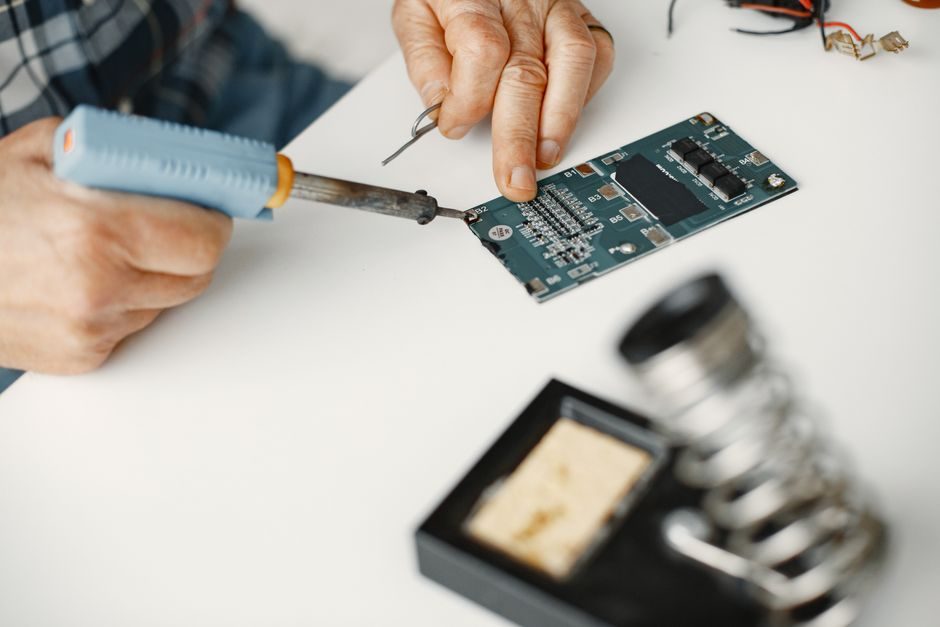
A digital multimeter (DMM) is specified by matching its safety category, true-RMS sensing capability, display resolution, calibration pedigree, and parameter coverage to the actual measurement environment, not by chasing the highest digit count or the lowest price [S3].
Selection draws on three live supplier catalogues: KUSAM-MECO and TPI Europe both market DMM ranges aimed at Indian industrial and European HVAC/R/CBM users respectively [S1][S2], while Keysight's 34465A Truevolt six-and-a-half-digit bench platform remains a reference point for electronics-bench procurement [S5]. The side-by-side decisions that follow apply whether the buyer is specifying a handheld for a switchgear room or a bench unit for a calibration lab.
Definition and scope: what a 2026 digital multimeter actually covers
A DMM is a single instrument that measures multiple electrical quantities — at minimum DC voltage, AC voltage, DC current, AC current, and resistance — with the result displayed as a numeric value rather than a needle deflection [S3]. Modern DMM ranges extend that base set with capacitance, frequency, temperature (via thermocouple input), continuity/diode test, and on industrial SKUs DC milliohms and process-loop mA simulation [S1].
TPI Europe's DMM catalogue explicitly segments SKUs across electrical, electronic, commercial, HVAC/R, and industrial use cases, confirming that one form factor is no longer expected to cover all sites [S2]. KUSAM-MECO separately catalogues a DC Milliohm Meter and a Gas Analyzer as distinct product lines, reinforcing that a DMM is the electrical-measurement block of a wider portable test-instrument kit rather than a universal replacement for those instruments [S1]. For broader reference on how measurement instruments pair with process sensing, see the pressure transmitter selection guide — the calibration and traceability logic is the same even though the measurand differs.
Selection criteria: the six filters that actually decide fit
Filter 1 — Safety category and voltage class. CAT II 600 V handheld units suit appliance and panel work; CAT III 600 V / CAT III 1000 V covers distribution panels; CAT IV 600 V is required at service entrance and outdoor overhead-line terminations. Mismatched category is the most common audit finding on DMM procurement, and a higher CAT rating does not retroactively protect a lower-rated probe set [S2].
Filter 2 — True-RMS vs average-responding. True-RMS sensing is required when the load is non-linear (VFD outputs, LED drivers, computer PSUs); average-responding meters can read 10–40 % low on those waveforms. TPI Europe's HVAC/R and industrial SKUs list true-RMS as a named option, signalling that it is a deliberate SKU split rather than a universal feature [S2].
Filter 3 — Display resolution and basic DC accuracy. Resolution runs from 3.5 digits (1,999 count, field-service grade) through 4.5 digits (19,999 count, electronics bench) up to 6.5 / 7.5 / 8.5 digits on laboratory bench DMMs such as the Keysight 34465A Truevolt series [S5]. Bench buyers should also demand a published 24-hour basic DC accuracy spec, not only a digit count.
Filter 4 — Calibration pedigree and traceability. NIST-traceable calibration certificates are sold as a configurable line item on new DMMs and calibrators, and the certificate must list the environmental conditions at the time of test so subsequent in-house comparisons are valid [S4]. ISO/IEC 17025-accredited calibration labs are the typical source; without that pedigree, an instrument's "accuracy" is unverifiable.
Filter 5 — Parameter coverage. Confirm the SKU covers the actual measurands in your loop: mA DC with simulation for loop commissioning, DC milliohms for bonding/ground tests, capacitance for HVAC/R start-run capacitor checks, frequency for VFD output verification, and temperature via type-K thermocouple input for thermal surveys [S1][S2].
Filter 6 — Application tier. Match the SKU to the site: HVAC/R and commercial electricians typically need 4,000-count true-RMS handhelds with capacitance and temperature; industrial process technicians need CAT III 600 V or higher with mA simulation; electronics R&D and calibration labs move to 6.5-digit bench DMMs such as the Keysight 34465A Truevolt family [S2][S5]. The application tier also drives expected mechanical ruggedness (drop test, IP rating) and warranty terms.
Who a digital multimeter is for — and who it is not for
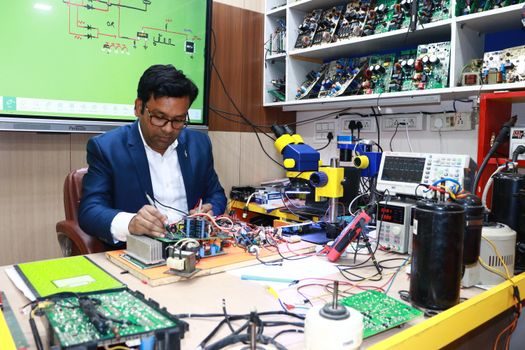
A DMM is the right tool for commissioning, troubleshooting, and periodic verification of AC/DC power, control loops, and low-voltage electronics on a portable or bench footprint [S3]. It is not a replacement for a dedicated flow meter on a process line, a pressure sensor on a hydraulic skid, or an industrial valve positioner — those are continuous process measurands with their own selection logic, not point-in-time electrical quantities. Likewise, a DC milliohmmeter is a separate SKU from a general DMM and should be procured as such when bonding/ground testing is in scope [S1].
Handheld vs benchtop: a criteria-based comparison
The decision between a handheld DMM and a benchtop DMM reduces to four criteria that the buyer can score line-by-line. Power source: handheld runs on AA/9 V batteries for site isolation; benchtop needs mains and accepts external reference inputs. Display resolution: handheld tops out near 50,000 count (4.7 digits); benchtop starts at 6.5 digits and goes to 8.5 digits [S5]. Connectivity: handheld is typically Bluetooth- or IR-isolated; benchtop adds GPIB, USB-TMC, and LAN/LXI for automated test. Safety category: handhelds cover CAT III 1000 V / CAT IV 600 V; benchtops are normally CAT II 300 V because they sit behind a bench isolation transformer and are not rated for live distribution work [S2][S5].
Scoring those four criteria almost always forces the buyer to two distinct procurement lines rather than one universal SKU. A shop trying to use a 6.5-digit bench DMM for live panel work is mis-applying the instrument category; a field technician using a CAT II 600 V handheld to verify a 480 V distribution bus is exceeding the instrument rating. Both failure modes are procurement errors, not operator errors.
Real use cases across the three application tiers
Tier 1 — HVAC/R and commercial maintenance. A 4,000-count true-RMS handheld with capacitance, temperature, and non-contact voltage detection covers fan-motor current draw, start-capacitor health checks, thermocouple-based supply-air readings, and basic 230 V receptacle verification. TPI Europe's CBM-targeted catalogue line is built around this envelope [S2].
Tier 2 — Industrial process and panel work. A CAT III 600 V or CAT III 1000 V handheld with mA DC source/simulation is the standard commissioning tool for 4–20 mA loops, supplementing the dedicated digital panel meter that reads the loop in service. KUSAM-MECO positions its DMM line at this Indian industrial tier and pairs it with separate DC milliohm and gas-analyzer SKUs for adjacent measurements [S1].
Tier 3 — Electronics bench and calibration lab. A 6.5-digit bench DMM such as the Keysight 34465A Truevolt supports sensor calibration, ATE racks, and ISO/IEC 17025 reference measurements, with the manufacturer's selection guide and "10 things to know" documentation published as buyer reference [S5]. The same instrument family underpins the NIST-traceable calibration workflow that third-party labs sell as a service line [S4].
Limitations, failure modes, and procurement pitfalls
The single most expensive pitfall is category mismatch: specifying a CAT II handheld for CAT IV service-entrance work voids the safety rating of the entire probe-and-instrument system, regardless of the DMM's brand or price. The second is treating true-RMS as a marketing line: average-responding meters are still shipped into non-linear-load sites and read low on VFD outputs, which leads to misdiagnosed "motor overload" trips [S2].
Resolution is also routinely oversold. A 50,000-count handheld does not deliver 6.5-digit accuracy; the basic DC accuracy spec at 24 hours is the figure that matters for any calibration use case, and it is published for bench DMMs such as the 34465A but is rarely meaningful on a field-grade display [S5]. For background on how accuracy budgets cascade through a measurement loop, the differential pressure transmitter selection guide walks the same uncertainty arithmetic against a different measurand.
Calibration pedigree is the third pitfall. A "calibrated" sticker without an accredited lab number, environmental conditions, and a list of standards used is not a NIST-traceable certificate; it is a label [S4]. Procurement language should require the issuing lab's accreditation scope, the standards referenced, and the as-found / as-left data.
Standards, sourcing, and supplier landscape

No single IEC standard governs "the DMM"; instead the procurement spec is a stack — IEC 61010-1 for general electrical safety, the IEC 61010-2-033 series for measurement-specific requirements, the CAT rating derived from IEC 61010, and the calibration traceability back to NIST or a national metrology institute via ISO/IEC 17025-accredited labs [S4]. The buyer's RFQ should name the IEC 61010 family and the calibration standard; it should not name a digit count as if digits alone were a safety metric.
Supplier landscape as of mid-2026 is fragmented by region. KUSAM-MECO serves the Indian industrial market with a broad DMM/clamp/milliohm/gas-analyzer portfolio [S1]; TPI Europe focuses on HVAC/R, CBM, and electrical SKUs for the European trade [S2]; Keysight anchors the 6.5/7.5/8.5-digit bench segment globally with the Truevolt series and a published selection guide [S5]. Buyers specifying a fleet should treat the regional catalogues as evidence of application tier, not as a price benchmark. For a second cross-instrument sanity check on parameter-coverage decisions, the online water quality analyzer buying guide follows the same six-criteria scoring logic for a different sensor family.
Trackable signals for the next procurement cycle: (1) whether supplier datasheets start quoting IEC 61010-2-033 amendment status alongside CAT ratings, since that amendment is the main safety-standard churn point for handheld DMMs; (2) whether NIST-traceable calibration line items move from optional to mandatory in vendor RFQ templates — a shift already visible in lab-tier procurement but not yet universal in field-tier purchasing [S4][S5].