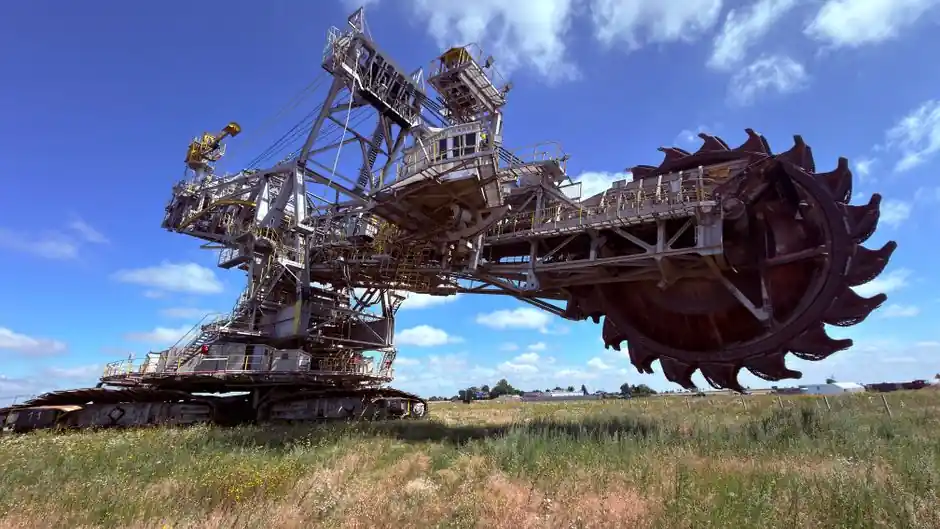
For mining power transmission, the disc coupling is the right answer on the high-speed motor-to-gearbox or gearbox-to-compressor shaft, and the wrong answer on the main hoist, swing, or propel drives of an electric shovel where shock loads dominate. Mining-duty disc couplings built to API-610 and ATEX cover speeds up to 3,800 RPM with disc packs rated for 1/2° to 1-1/2° of angular misalignment per flex plane [S4].
The selection question is not "disc or gear" as a brand preference, but a torque, speed, environment, and maintenance-access map. Disc couplings transmit torque through thin stainless-steel disc packs (commonly AISI-301) that flex elastically, with no lubrication, no backlash, and torsionally rigid response [S1][S4]. Gear couplings carry higher absolute torque through sliding gear teeth, but demand regular greasing and tolerate the abrasive dust common in mineral processing [S1][S3].
Where Disc Couplings Fit in a Mining Equipment Train
Disc couplings are a strong fit on the high-speed end of mining equipment trains: pump drives, fan drives, compressor shafts, and the motor-to-reducer interface on conveyor or mill pinions where speed exceeds roughly 1,800 RPM [S1][S5]. Reijay's mining coupling guide lists heavy-duty metal diaphragm (disc) couplings as the standard for the high-speed motor-to-reducer interface on electric shovels, citing maintenance-free operation, zero backlash, and dust tolerance as the deciding factors [S5].
Disc couplings are a weak fit for the main hoist, swing, propel, and crowd gearboxes on rope shovels and hydraulic excavators, where peak torque spikes dominate the duty cycle. Reijay routes those transmissions to drum gear couplings, which handle large angular misalignment and repeated impact loads from digging [S5]. For background on the underlying design class, see the disc coupling reference.
Disc vs Gear vs Jaw: A Decision Map for Mining Specifiers
The three coupling families compete for the same shaft ends, and the deciding criteria are torque density, misalignment budget, speed, environment, and maintenance access. Disc couplings lead on torque density (more torque per outside diameter), zero backlash, and lubrication-free service, and lose on absolute peak-torque capacity and shock absorption [S1][S3]. Gear couplings lead on raw torque and large angular misalignment, at the cost of mandatory lubrication and wear-part replacement [S1][S3]. Jaw couplings lead on cost and vibration damping via an elastomeric spider, but are limited to moderate torque and speed [S3].
For a typical open-pit truck or shovel driveline, the mechanical-transmission path (engine, torque converter, gearbox, drive axle) routes the shock-load sections to gear or drum-gear couplings, while the high-speed accessory drives (cooling fan, hydraulic pump, air compressor) route to disc couplings [S5]. For comparison data, the gear coupling reference catalogues the high-torque class, and the jaw coupling reference covers the elastomeric-spider class used on lighter auxiliary drives.
API-610, ATEX, and the Disc Pack Specs That Matter
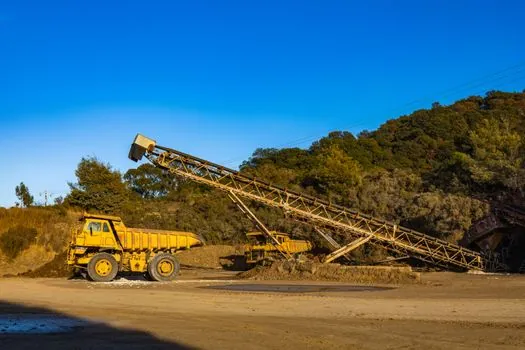
Disc couplings for mining pumps and compressors should meet API-610 (8th edition or later) for balance class, anti-flail piloting, and unitized disc pack repeatability; Lovejoy documents support of API-610 up to 3,800 RPM on its SU, SX, DI, and SXC lines [S4]. For European Union and UK underground or dust-classified installations, ATEX certification on the specific coupling model line is required, and Lovejoy's SU, SX, DI, SXC, SXCS, SXCST, DIR, DILR, DIRA, and DIRLA product lines are ATEX Certified [S4].
Disc pack geometry drives the misalignment budget. Lovejoy's profile is rated for 1/2° to 1-1/2° of angular misalignment per flex plane and is built from AISI-301 stainless steel for fatigue endurance and corrosion resistance, with 4-bolt, 6-bolt, and 8-bolt unitized pack options where 8-bolt transmits higher torque but accepts less angular misalignment [S4]. Two flex planes (one at each disc pack, the standard SX configuration) accommodate parallel, angular, and axial misalignment simultaneously, with bore sizes up to 13 inches (330 mm) on the SX line [S4].
Failure Modes and Mining-Specific Constraints
The two failure modes that kill disc couplings in mining are fatigue cracking of the disc pack and pilot-bearing wear on floating-shaft arrangements. Disc pack life is governed by total disc stack thickness, individual disc laminate thickness, and disc material grade; under-sizing any of the three accelerates fatigue cracking, per the design factors laid out in Pumps & Systems' three-factor framework [S7]. AISI-301 stainless is the de facto standard for fatigue endurance and corrosion resistance, but laminate thickness must be matched to the torque and cyclic-load profile, not the catalogue headline number [S4][S7].
For mining, the additional constraints are dust ingress, moisture, and maintenance access. Disc couplings win on dust because they have no sliding lubricated surfaces; gear couplings require sealed lubrication systems and periodic grease inspection in the same environment [S1][S3]. Shaft guarding is mandatory: Lovejoy explicitly states it is not recommended to operate any disc coupling without coupling guards, even though the disc pack can be visually inspected with a strobe light while the machine is running [S4].
Selection Workflow for a Mining Procurement Engineer
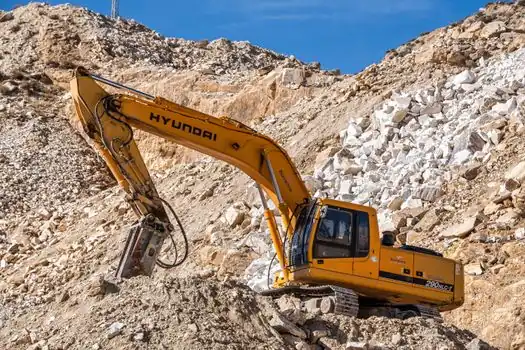
A spec-first workflow starts with the duty cycle, not the coupling catalogue. Calculate peak torque including the service factor for the driven machine (crushers, mills, and conveyors each carry their own multiplier), then derive required torque and confirm speed in RPM. Match the coupling to API-610 if the driven equipment is a process pump, and to ATEX if the installation is classified [S4].
Confirm the misalignment budget after installation: thermal growth, piping strain, and base settling can each add 0.1° to 0.3° beyond the factory alignment tolerance, and the disc pack's per-flex-plane rating must cover the sum [S4]. Specify unitized disc packs rather than loose laminar stacks to preserve balance class and to allow strobe-light inspection without disassembly [S4]. Finally, on the shovel hoist, swing, and propel drives, route to drum gear couplings; on the high-speed pump, fan, and compressor shafts, route to disc couplings [S5]. The fluid coupling reference covers a related class sometimes seen on conveyor soft-start drivelines, and the coupling-clutch reference catalogues combined torque-limiting units. For a broader driveline component map on heavy equipment, see the mining motor grader sizing reference.