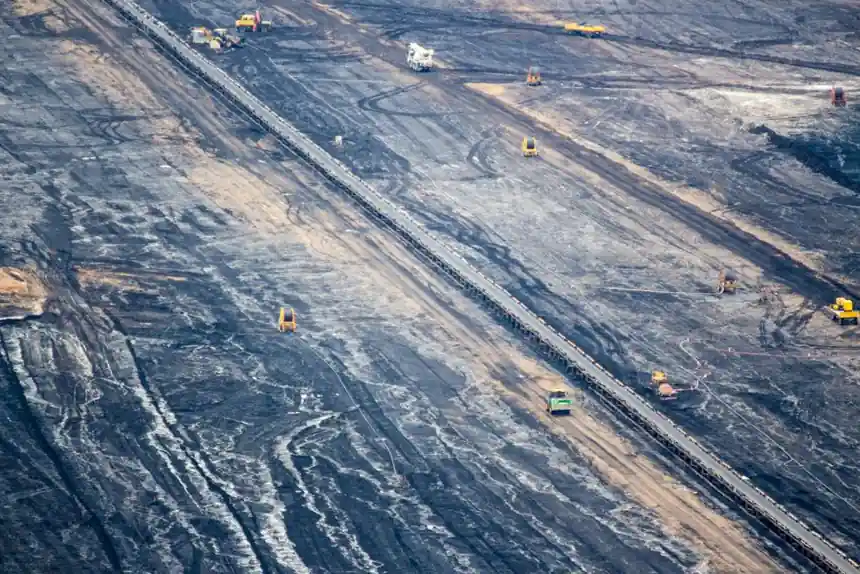
Mining-class motor graders span 218 hp at 32,411 kg / 71,454 lb (Komatsu GD-series) up to 535 hp (399 kW) at 74,800 kg / 165,314 lb with a 24 ft blade on the 24 Motor Grader [S4][S5]. Caterpillar positions its mining grader range for fleets running 136-tonne haul trucks and above, with the larger frame at 32,411 kg / 71,454 lb and 4 m class blade width [S1].
Selection for mining duty is driven by four hard numbers: engine power (hp / kW), operating weight, blade length, and frame configuration (articulated vs rigid). Each maps directly to the task, whether it is maintaining a 30 m wide haul road, dressing a dump pad, or cutting a drainage ditch along a bench [S3].
Engine Power and Operating Weight Classes
Mining graders sit in the upper engine-power band of the broader grader market, where output ranges from 100 hp on light road models to 280+ hp on heavy construction frames [S3]. A 220 hp class machine (CASE 865B) and a 196 hp class machine (CAT 140 GC) define the heavy-construction entry, while the Komatsu GD-series delivers 218 hp (163 kW) at 2,100 rpm and 37,346 lb operating weight for mid-range mine roadwork [S3][S5].
For haul-truck fleet support, 535 hp (399 kW) units weighing 74,800 kg / 165,314 lb are now standard offerings, with a 24 ft moldboard to cover a full haul-road lane in fewer passes [S4]. Cat's mining-grade models target fleets running 136-tonne trucks, putting the smaller frame at 25,968 kg / 57,250 lb and the larger at 32,411 kg / 71,454 lb, both with 4 m class blades [S1]. Operating weight across the category runs from roughly 15,800 kg (BEML BG605A) at the construction/mining crossover, through 20,000+ kg heavy frames, up to the 74,800 kg mining-class platform [S3][S4].
Blade Geometry, Hydraulic Systems, and Frame Type
Standard motor grader blades run 10-14 ft in length for general construction, with the Komatsu GD705-5 carrying a 14 ft moldboard as a typical heavy-frame benchmark [S3]. Mining-specific machines extend that envelope, with the 24 Motor Grader using a 24 ft blade to match 100+ ton haul-truck tire tracks and reduce the number of passes needed to dress a lane [S4].
Modern graders use load-sensing hydraulics to manage blade-down pressure, circle rotation, and articulation, replacing earlier fixed-displacement systems and giving operators finer control at low ground speeds [S3]. Komatsu fits its grader line with excavator-style hydraulics and a dual-mode transmission to balance fine grading with heavy push loads [S5]. Articulated frames add a hinged joint between front and rear modules, improving maneuverability on tight bench corners and switchbacks, while rigid frames hold a single fixed chassis suited to long, straight haul-road sections [S3].
Selection Criteria: Mining Haul Roads vs Pit Floors
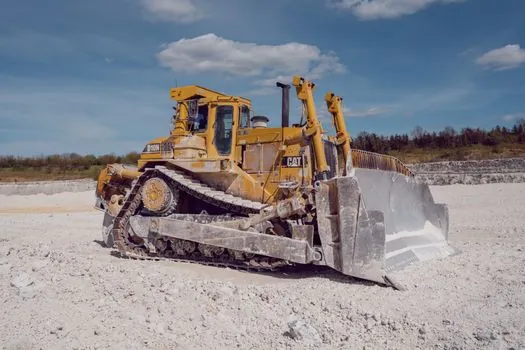
For continuous haul-road maintenance behind 100+ ton trucks, the binding constraints are high blade-down pressure, a wide moldboard (16-24 ft), and 400+ hp to push aggregate at speed without stalling [S4]. The 535 hp / 74,800 kg / 24 ft configuration exists specifically because lighter machines cannot hold grade under loaded haul-truck traffic, and the cycle cost of repeated rework exceeds the acquisition premium [S4][S2].
For pit-floor cleanup, bench dressing, and dump-pad work, 200-300 hp articulated frames in the 25,000-35,000 kg class are the common choice, matching the duty cycle of a 136-tonne truck fleet without the fuel burn of a 535 hp platform [S1]. Below that, 74 hp utility graders (Mahindra G9075) handle light road maintenance and ancillary tasks but lack the mass and hydraulic capacity for mining-grade material [S3]. Spec the grader against truck class, not against average road width: a 24 ft blade on a 535 hp chassis is wasted on a 30-tonne fleet, and a 14 ft / 220 hp frame cannot hold grade behind 200-tonne trucks.
Operating Considerations and Failure Modes in Mining
Motor graders in mining carry three axles, a center-mounted blade, and an engine-driven hydraulic system, with the moldboard positioned between the front axle and the tandem rear bogies for fine surface control [S2]. On rough haul roads, deformed surfaces accelerate tire wear on haul trucks, raise fuel burn, and increase the risk of load-shedding events, which is why graders are typically deployed on a defined cycle rather than only on demand [S2].
Common failure points on mining graders circle around hydraulic contamination (load-sensing systems are sensitive to particle count), circle-and-drawbar wear under heavy push loads, and moldboard edge consumption in abrasive shot rock [S3]. Frame selection matters here: rigid frames transfer more shock into the drivetrain during off-center loads, while articulated frames absorb that load through the hinge, reducing structural fatigue on uneven bench surfaces [S3]. The Komatsu excavator-style hydraulic architecture is a deliberate design choice to share proven components across product lines and shorten service intervals on contaminated mine sites [S5].
Standards, Sourcing, and Total Cost Drivers
No single ISO or SAE standard governs the motor-grader specification envelope, but fleet-level decisions are increasingly tied to on-board telematics and grade-control integration, both of which Komatsu explicitly couples to its hydraulic and transmission platforms [S5]. Caterpillar pairs its mining graders with VisionLink fleet management, which is relevant when standardising a mixed-fleet service and parts strategy across a mine site [S1].
For first-time buyers, total cost extends well beyond the motor grader price, with articulated frames, load-sensing hydraulics, and GPS grade control as the three line items that move a quote most [S3]. Buyers comparing the mining dump truck interaction and the AC motor drive options on hybrid-electric grader prototypes should match the machine class to the truck class before negotiating attachments. For broader equipment context, the hydraulic layout differences between graders and backhoe loaders inform whether a mine shares service tooling across both fleets. Trackable signals to watch: OEM announcements of 400+ hp electric-drive grader pilots, telematics data tying blade-pass frequency to haul-tr tire wear, and revised grade-control integration roadmaps from Cat, Komatsu, and CASE within the next two quarters [S1][S3][S5].