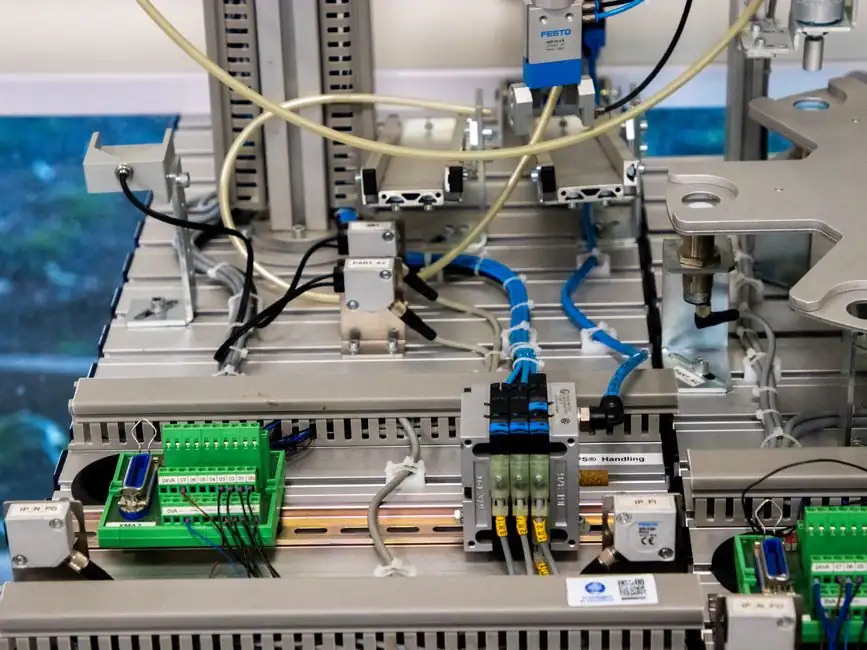
The Yungu (Gu'an) G6 active matrix organic light-emitting display (AMOLED) panel production line was engineered for a designed capacity of 30,000 pieces per month, a 30 billion RMB total investment, and a 573-day build cycle from pile foundation to process equipment start-up, with 24 single buildings covering array, organic evaporation, touch/screen, R&D, mask cleaning, lining cleaning, and power station facilities [S1].
China Star Optoelectronics Technology (CSOT) signed a 35 billion yuan ($5.08 billion) contract on 2017-03-31 to build a sixth-generation LTPS-AMOLED panel line at Wuhan East Lake High-tech Development Zone (Optics Valley) [S5]. A separate 11.5 billion yuan ($1.72 billion) TFT-LCD panel and mold production line agreement was signed in Optics Valley on 2020-10-29 between Laibao Hi-Tech and the East Lake zone [S4]. Both projects sit inside a domestic fab corridor where line generation, cleanroom class, and capacity targets define the design baseline.
Substrate generation and the capacity anchor
Substrate generation is the single design parameter that ripples through every downstream decision. The G6 (1500x1850 mm glass) format used at Yungu Gu'an supports a 30,000 pieces/month design point on full-flex AMOLED [S1]; the G6 LTPS-AMOLED line at CSOT Wuhan uses the same generation class for flexible display output [S5]. Larger G8.5 (2200x2500 mm) and G10.5 (2940x3370 mm) generations target LCD and OLED TV mother-glass economics but require taller cleanroom volumes and heavier cassette/transfer automation.
For a greenfield AMOLED project, designers should anchor the cleanroom height at roughly 4.5–6.0 m above the raised floor to clear the evaporator and encapsulation tool envelopes, and they should plan the automatic molding line interfaces for substrate carrier handoff at the array-to-cell hand-off bay. Capacity targets below 15,000 pieces/month on G6 generally fail the depreciation curve for full-flex AMOLED tooling because the evaporator capex dominates the bill of materials.
Cleanroom class, process islands, and material flow
AMOLED backplane and OLED evaporation steps require ISO Class 5 (Class 100) or cleaner local environments inside a Class 6 or Class 7 surrounding cleanroom, and they must be separated by air-showers and over-pressurized corridors between the array, evaporation, and encapsulation islands [S1]. The Yungu Gu'an plan splits the fab into 24 single buildings so that the array plant, organic evaporation and box plant, touch and screen factory, R&D line plant, mask cleaning workshop, and lining cleaning plant each maintain their own pressure cascade and process exhausts [S1].
For TFT-LCD lines, the molding line concept shifts from vacuum-chamber automation to conveyor-and-robot arrays feeding color filter, cell, and module lines, with the conveyor sorting line handling glass cassette routing between inspection, repair, and packing islands [S4]. Designers should plan for 30–60 minutes of buffer stock at each island to absorb upstream tool downtime without starving downstream tools, and they should size the AMHS (Automated Material Handling System) overhead hoist track to at least 1.2x the peak inter-bay traffic of the bottleneck tool group.
Tool selection, vendor banding, and capex spread
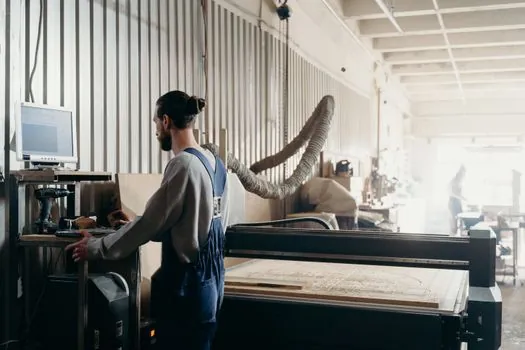
The Yungu Gu'an 30 billion RMB envelope aligns with that distribution, with process equipment installation forming the final leg of a 573-day construction-to-start-up sequence [S1].
For mid-tier sandwich or building panel production lines that share less stringent cleanroom demands, sourced equipment in 2026 catalogues shows price bands of US$30,000–45,000 for PVC/WPC hollow wall panel extrusion lines (1 set MOQ) and US$2,000,000–10,000,000 for AAC block panel production lines, both shipped from Chinese manufacturers (2026-04) [S2][S6]. These bands are a useful sanity check when sizing auxiliary lines for cleanroom perimeter walls, raised-floor panels, and process-gas facility enclosures inside a fab build-out.
Power, exhaust, and process utility sizing
Process utilities drive the operating cost per piece more than the tool capex amortisation. A G6 AMOLED evaporator cluster typically pulls 1.5–3.0 MW per tool at peak, with chilled water at 6–10 °C and process vacuum in the 10⁻⁶ to 10⁻⁷ Pa range for organic deposition [S1]. The Yungu Gu'an site includes a dedicated power station among its 24 buildings, sized for the simultaneous ramp of all process islands during mass-production tuning [S1].
Exhaust treatment for AMOLED requires a line frequency furnace equivalent for sub-fab thermal destruction of solvent and organic precursor waste streams, with NF3 and other PFC abatement at the cluster pump outlets. For resin-bonded or composite perimeter panels in a fab facility, the resin sand line process family supplies moulded architectural elements that survive cleanroom-area wash-downs without outgassing under ISO Class 6 exposure.
Schedule, risk gates, and supplier interfaces

The 573-day Yungu Gu'an schedule breaks into roughly 90 days for pile foundation, 180 days for main structure, 180 days for clean electromechanical build-out, and the remaining window for process equipment installation and pilot ramp [S1]. The construction-to-start-up gate is the highest-risk transition because cleanroom certification, vibration table acceptance, and process-gas purity all have to clear before the first substrate can be loaded.
Buyers comparing display panel production line options in 2026 should use a structured gate: (1) substrate generation match to product roadmap, (2) cleanroom class with documented pressure cascade, (3) process utility sizing per peak tool group, (4) AMHS throughput with bottleneck simulation, and (5) schedule-to-start-up with named construction and qualification milestones. A line that fails any one gate typically costs more over a 10-year horizon than the cheapest capex quote, as the 3D printing demand forecast 2026-2030 for similar precision manufacturing shows in adjacent sectors. Engineers scoping a 2026–2027 AMOLED or TFT-LCD build can cross-reference the display panel capacity planning 2026 signals and the display panel manufacturing equipment guide 2026 to validate the demand band and the equipment shortlist before locking the layout.