Installing a vehicle restraint is strongly recommended at docks where forklifts enter trailers because vehicle restraints help prevent trailers from leaving the dock during loading and unloading.
The restraint must match the trailer fleet, engage before loading starts, and be coordinated with the dock leveler so the bridge lip cannot operate while a trailer is unsecured.
Does Every Dock Leveler Require a Vehicle Restraint?
A dock leveler is not mechanically complete without a vehicle restraint, although there is no evidence that every low-volume dock needs the same system architecture.
A full-time trailer-handling dock should use a dedicated vehicle restraint rather than relying solely on manually placed wheel chocks. The restraint physically captures the trailer and prevents premature departure, while chocks depend on correct placement and can slip, be moved, or be omitted [S2][S3].
A low-volume dock may qualify for a documented alternative, such as chocks and a formal driver-attendant procedure, but the risk review must cover trailer creep, early departure, landing-gear collapse, trailer upending, and trailer pop-up [S3]. The dock leveler alone addresses the height difference between the dock and trailer bed; it does not immobilize the trailer.
Trailer Restraint Options Compared
Wheel chocks, RIG-bar restraints, wheel-engaging restraints, and powered systems control different trailer movement modes, and they should be compared by engagement method, operating control, and suitable vehicle application. [S3]
Wheel-engaging restraints extend coverage to trailers lacking an accessible RIG bar, while powered units add controlled sequencing and remote status indication [S5].
Why the Restraint and Leveler Must Interlock
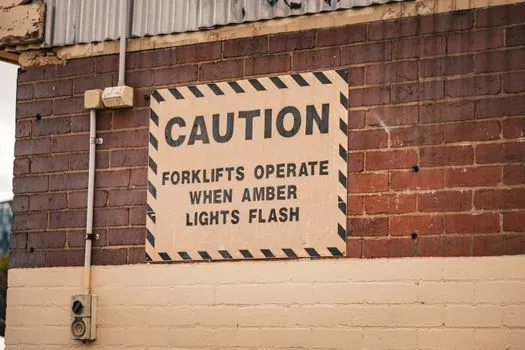
An interlock between a hydraulic or pneumatic dock leveler and a vehicle restraint prevents the leveler from operating until the trailer is secured, reducing exposure to an unsupported bridge lip and an unsecured trailer [S4].
Interlocking also addresses the sequence of failure. Forklift entry can transfer weight into and out of a trailer, producing gradual creep; an air-ride trailer can move incrementally while the leveler lip still appears to make contact [S3]. If the trailer shifts farther, the lip loses purchase and a gap opens between the dock and trailer bed.
Early departure presents a separate hazard because the leveler may remain deployed after the driver moves the truck. The restraint therefore serves as a physical lock, while red and green light communication can tell the driver when to approach or leave. Communication systems can stand alone, pair with chocks, or integrate with a restraint [S5].
The interlock is not a substitute for a maintenance program. Loosened bolts, corrosion, wear, or mounting misalignment can prevent full engagement, so inspection and functional testing must cover every restraint on a defined schedule [S1].
Selecting a Restraint for the Trailer Fleet
Trailer dimensions, weight, landing-gear design, bed height, RIG-bar availability, and expected approach angle determine the restraint specification, and a mixed fleet requires more than a single universal engagement point [S1].
Assess the trailer types that regularly use the dock, including their weight, overhang, bed design, and RIG-bar geometry. The mounting area must be level, clear, and capable of supporting the restraint mechanism; a sloping or irregular surface can cause poor alignment and incomplete engagement [S1].
The restraint capacity must exceed the applied loads from the vehicles served. Installing a unit below the operating weight range creates a credible premature-failure mode, and physical mounting onto the dock face must follow the equipment manufacturer's specified tools, materials, and geometry [S1].
Operators should still verify full engagement before allowing a forklift into the trailer, rather than relying on the device's physical position alone [S1].
Installation, Testing, and Operator Controls
A defensible installation includes site assessment, manufacturer-compliant mounting, engagement testing with different vehicle types, operator training, and a repeatable inspection program for wear, corrosion, and alignment [S1].
Test the restraint with the actual trailer mix, including different heights, weights, RIG-bar positions, and overhangs where applicable. A one-time commissioning test is insufficient because loading cycles can reveal alignment changes, damaged components, and reduced engagement reliability [S1].
Training must cover four operational points: engage the restraint before loading or unloading, verify complete engagement, recognize malfunction or misaligned hardware, and execute the emergency-release procedure. Forklift operators and dock personnel should be included, since the restraint protects both the crew and equipment entering the trailer [S1].
Powered systems also require a planned response to power loss, hydraulic failure, emergency release, and remote-control failure. The interlock should be commissioned as one safety function with the leveler, not treated as an accessory whose status is checked informally [S4].
Operational Limits and Failure Modes
The main failure modes are trailer creep, early departure, landing-gear collapse, trailer upending, and trailer pop-up, and each requires a different combination of restraint selection, communication, and dock procedure [S3].
Trailer creep can open a gap while the leveler remains deployed; early departure can strand a forklift between the dock and trailer; landing-gear failure can lower the trailer after engagement; and upending or pop-up can alter the interface during loading. A system cannot compensate for an incompatible trailer geometry, an obstructed approach, or an overloaded restraint [S3][S1].
Do not treat visual proximity between the leveler lip and trailer bed as proof that the trailer is secured. The bridge lip may conceal movement, and a restraint that is visually present can still be misaligned, worn, uncoupled, or incompletely engaged [S1][S3].
Records should document the trailer type, restraint engagement result, leveler interlock status, inspection findings, and corrective action for each applicable dock. This creates a traceable control rather than relying on a driver and attendant reaching the same informal conclusion at each exchange.
Final Engineering Decision

The practical answer is yes: install a vehicle restraint wherever a dock leveler permits powered industrial trucks to enter a trailer, unless a documented risk assessment supports an alternative control with equivalent protection. [S3]
For normal road-trailer service, specify a correctly sized RIG-bar restraint, install it on a sound mounting surface, and interlock its secure state with the leveler. Use wheel-engaging equipment where RIG bars are unavailable or obstructed, and keep manual chocks as a documented secondary control rather than the only barrier.
Track two operational signals after installation: the proportion of trailer exchanges with verified restraint engagement, and the number of maintenance findings involving loose fasteners, corrosion, damaged cables, or alignment faults [S1]. The decision remains valid only while the restraint matches the trailer fleet and the interlock is tested as part of routine commissioning and maintenance.