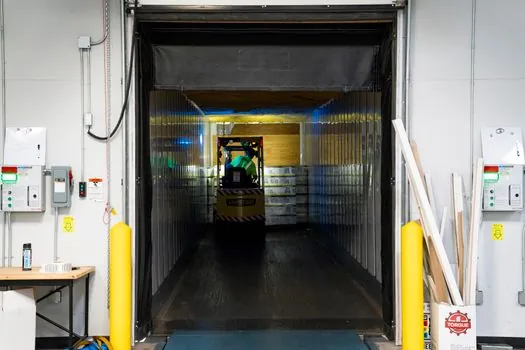
A fully installed pit-style dock leveler generally costs about $5,000 to more than $25,000 per door, with the wide range driven by capacity, leveler type, pit preparation, installation labor, and electrical service [S1].
The 2026 equipment guide places installed mechanical pit levelers at $5,500–$11,000 and hydraulic pit levelers at $7,000–$12,000, but its standard installation assumptions include an existing pit or pit-kit steel rather than major concrete work [S3].
Installed Price by Dock Leveler Type
Mechanical pit levelers are the lowest-cost full-size pit option at $5,500–$11,000 installed, compared with $7,000–$12,000 for hydraulic pit levelers and $12,000–$20,000 or more for vertical-storing hydraulic units [S3].
An edge-of-dock mechanical leveler costs $2,500–$4,500 and suits a 20,000–30,000 lb capacity requirement where the dock-to-trailer height difference is no more than about 6 inches and no pit is available [S1][S3].
Mechanical pit equipment uses a manual release mechanism, hydraulic equipment adds powered movement, and available leveler capacities range from 30,000 to 80,000 lb [S1][S3][S5].
How Pit Concrete Changes the Per-Door Budget
Pit-style leveler prices include the unit, freight, and standard installation and assume an existing pit or include pit-kit steel, but exclude major concrete work [S3].
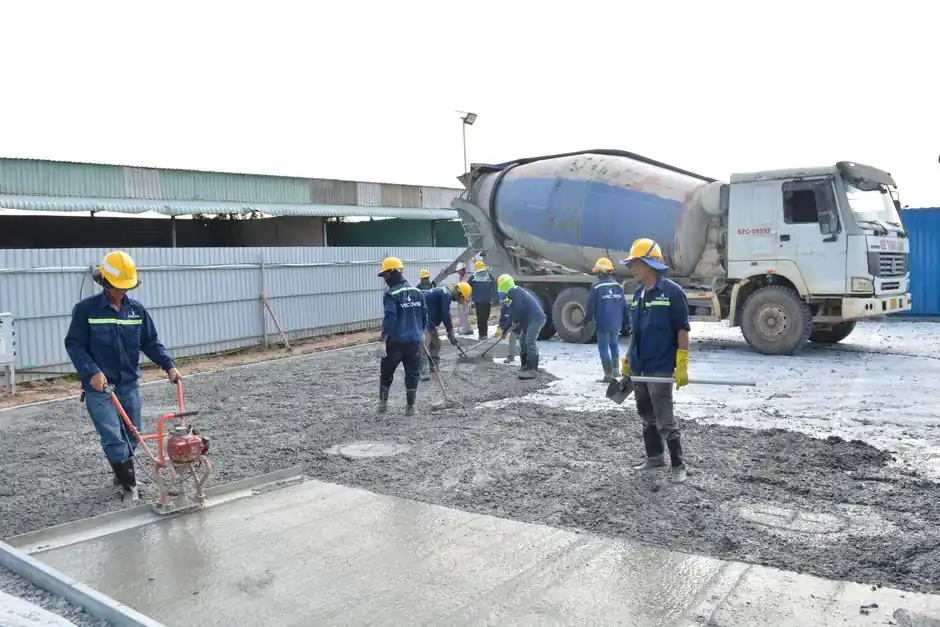
That means an $8,000 hydraulic leveler with an existing suitable pit is not comparable with the same equipment installed into a new opening. The second scenario can add $2,600–$6,000 before electrical work, excluding any remediation of floor conditions or utilities discovered during demolition.
For a broader dock project, a concrete dock platform and pit are budgeted at $25,000–$50,000, while the leveler, restraints, seals, bumpers, and door are listed at $15,000–$30,000 combined [S7].
Electrical Service Is a Separate Cost Driver
Electrical installation is an additional pricing consideration [S2]. Older market guidance estimates about $500 for leveler installation when no electrical wiring is required, but explicitly lists electrical installation, concrete work, curb steel, freight, and tax as additional pricing considerations [S2].
Hydraulic and air-powered units add more control and power requirements than a manually released mechanical leveler. Mechanical systems use springs and a manual release mechanism, while hydraulic systems use push-button operation and powered movement; that functional difference affects both the equipment price and the electrical scope [S1].
Control selection should also be priced rather than treated as a free accessory. The selection tradeoffs between pendant and panel controls are detailed in Dock Leveler Activation Pendant vs Push-Button Panel.
Per-Door Cost Model for a Typical Pit Installation
A hydraulic pit leveler starts with a listed installed cost of $7,000–$12,000, which includes the unit, freight, and standard installation but excludes major concrete work [S3]. Excluding electrical and tax, this produces a $9,600–$18,000 range for the leveler and civil work.
A mechanical pit leveler has a listed installed cost of $5,500–$11,000, which includes the unit, freight, and standard installation but excludes major concrete work [S3]. Freight and tax also belong in the project total because they are separate from the quoted leveler material or installation price [S2][S5].
The comparison should be made on delivered scope, not the equipment invoice alone: mechanical equipment costs less than hydraulic equipment but places more physical demand on operators and has more moving parts subject to wear [S1]. Hydraulic equipment has a higher installed price but is specified for higher-volume operation, including docks handling more than 10 trucks per day [S3].
Civil, Equipment, and Lifecycle Cost Tradeoffs
Freight and tax still require dedicated lines in the estimate, even when the supplier presents the leveler as installed [S2][S5].
The 2026 guide allocates $300–$800 per dock position per year for maintenance [S3]. Mechanical dock levelers use springs and a manual release mechanism [S1].
For facilities that cannot close a dock for weeks, an exterior modular installation may avoid the disruption associated with demolition, concrete pouring, and complex electrical work. One exterior system was described as capable of retrofitting a dock door in one day, although that is a product-specific configuration rather than a general installation time [S4].
When an Exterior or Edge-of-Dock System Is Better
An edge-of-dock leveler is the rational selection when the trailer-bed height difference is approximately 6 inches or less, the dock face has adequate structure, and no pit can be built [S1]. Its $2,500–$4,500 installed range can be $3,000–$7,500 below a mechanical pit installation before counting pit concrete and electrical work [S3].
An exterior modular system is the rational selection when excavation would disrupt operations or when the dock face cannot accept a recessed pit. The Dock House approach uses an adjustable steel frame bolted to concrete or asphalt, with the exterior leveler and door enclosure assembled outside the building; it requires no internal slab excavation [S4].
Neither alternative automatically solves every site condition. Edge-of-dock equipment remains constrained by low height differential and lower listed capacity, while an exterior installation adds a structure outside the wall and may require additional site preparation. A recessed hydraulic pit leveler remains the stronger choice for 10 or more trucks per day and 30,000–80,000 lb dynamic loading requirements [S3].
Scope Checklist for an Installed Price
An installed quote should identify the leveler model, capacity, platform size, pit condition, pit-kit steel, concrete quantity, electrical supply, controls, freight, tax, installation, and warranty. Pit-mounted equipment commonly ranges from 6 ft × 6 ft to 7 ft × 12 ft, with capacities listed from 30,000 to 80,000 lb [S2].
Capacity must be checked against the actual forklift and load rather than copied from a generic product table. One published method multiplies combined forklift and load weight by 2.55 and rounds upward, producing a 40,000 lb selection from a 12,000 lb forklift carrying 3,500 lb; trailer height difference, approach slope, vehicle configuration, and daily truck count also affect the decision [S5].
The cleanest quote basis is therefore installed cost per operational door, with civil work and electrical shown separately, capacity demonstrated from actual equipment, and annual maintenance included in the ownership comparison. A dock without a usable pit should be priced as a concrete-and-utilities project, not as a leveler replacement, because the pit-kit range of $600–$1,000 is only one component of the $2,000–$5,000 new-pit civil allowance [S3].