
The DBS3-60N automatically bends bars on two bending heads and lists bending capacity for Ø8–57 mm diameters at 850 N/mm² [S4].
GUTE lists bar benders, CNC automatic bending machines, and other rebar-processing equipment among its products [S3].
How Two Heads Produce Symmetric Reinforcement Shapes
The DBS3-60N bends automatically on two heads with one operator, and its closest spacing is 105 cm, giving fabricators freedom to form bars with bends at both ends [S4]. Automatically swiveling support arms reposition between the heads, while segmented clamps hold several bars during a cycle [S4].
The DBS3-60N provides a minimum size of 105 cm between its bending heads and offers flexibility in the producible bar shapes [S4]. The same line accepts Ø8, 10, 12, 14, 16, 20, 22, 25, 28, 32, 36, 40, 43, 50 and 57 mm metric diameters [S4].
Programmable shape controls, a touchscreen, production statistics and a graphical interface are available on the DBS3-60N [S4].
Capacity Comparison Across Double-Head Machine Classes
The DBS3-60N supports up to 10 bars per cycle at Ø8 mm with bending mandrels, decreasing to 4 bars at Ø20 mm and 1 bar from Ø36 through Ø57 mm; with bending hearts, it supports 10 bars at Ø8 mm and 3 bars at Ø22–25 mm [S4].
These figures belong to different equipment classes, so 18 kW must not be substituted for the DBS3-60N capacity table or used to infer its cycle time.
Compact hand tools serve a different production regime. Crescent indexing benders cover 3/8 and 1/2 inch rebar [S5], while another model bends 3/4 inch bar through a 14-position indexing head [S7]. A separate portable bending head handles bar up to 5/8 inch and uses dual slots to provide multiple bending positions [S6].
Selection Criteria for Mirrored and Symmetric Bends

Bar diameter and strength determine the machine class: the DBS3-60N is rated for Ø50 mm at 850 N/mm², while the broader published capacity table extends to Ø57 mm [S4].
Minimum head clearance is decisive when the legs must be equal or closely matched. The DBS3-60N provides a minimum spacing of 105 cm between its bending heads, and its left- and right-hand versions support factory-layout integration [S4].
Bend geometry also sets the tooling requirement. The DBS3-60N offers a choice of bending rollers and bending hearts [S4]. Smaller hand benders use indexing positions instead of the adjustable rails available on production equipment [S5][S7].
Control Options, Feed Sequence and Automation
The DBS3-60N has a modern control with freely programmable bar shapes, a touchscreen, production statistics, and a graphical interface [S4].
Segment bending creates large radii, while bending hearts permit positive and negative rotation and mandrels support positive rotation [S4].
For upstream bar preparation, a wire straightening and cutting machine can produce straight lengths before bending, while a rebar straightener serves the same preparation function as a separate production stage [S2]. The rebar bender then performs the forming operation, and downstream rebar cutting can prepare bar to the required cut-to-size length [S2].
Operating Limits, Safety and Workpiece Constraints
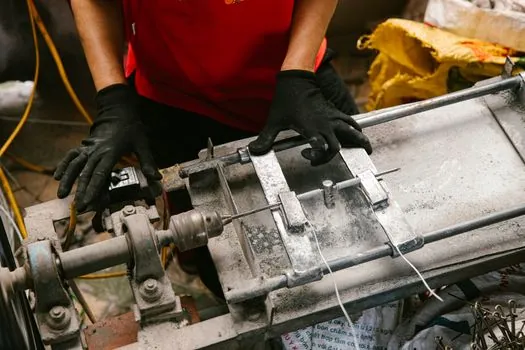
The DBS3-60N can process 10 bars per cycle at Ø8 mm with mandrils, 5 at Ø16 mm, 3 at Ø25 mm and 1 at Ø50 mm [S4]. The DBS3-60N operates with one operator and uses automatically swiveling support arms and a segmented clamping system [S4].
The DBS3-60N operates with one operator and uses automatically swiveling support arms between its bending heads [S4].
Bar condition and geometry remain hard limits. Portable tooling such as the Crescent line is not interchangeable with an 850 N/mm² double-head production machine: Crescent examples address 3/8, 1/2 and 3/4 inch bars [S5][S7], while the DBS3-60N is documented as a Ø50 mm machine at 850 N/mm² [S4].
Applications, Maintenance and Purchase Verification
Schnell lists CUT & BEND as a product category, while GUTE lists stirrup benders, rebar shear lines, and an automatic steel bar truss resistance welder among its products [S2][S3]. Schnell lists CUT & BEND as a product category [S2].
For repeatable output, the machine data include programmable shapes, production statistics and diameter-dependent speed adjustment rather than only a headline bend angle [S4].
Before ordering, verify maximum diameter at the required strength, bars per cycle, minimum head spacing, roller diameter, bend direction and factory footprint. Portable indexing tools remain suitable for isolated 3/8, 1/2, 3/4 or 5/8 inch work, while automatic double-head lines suit batch fabrication of matched end shapes [S4][S5][S6][S7].
For symmetrical production, track three acceptance points: first-bend repeatability at the smallest 105 cm head spacing, cycle count at the specified diameter, and roller clearance for the required bend radius [S4].