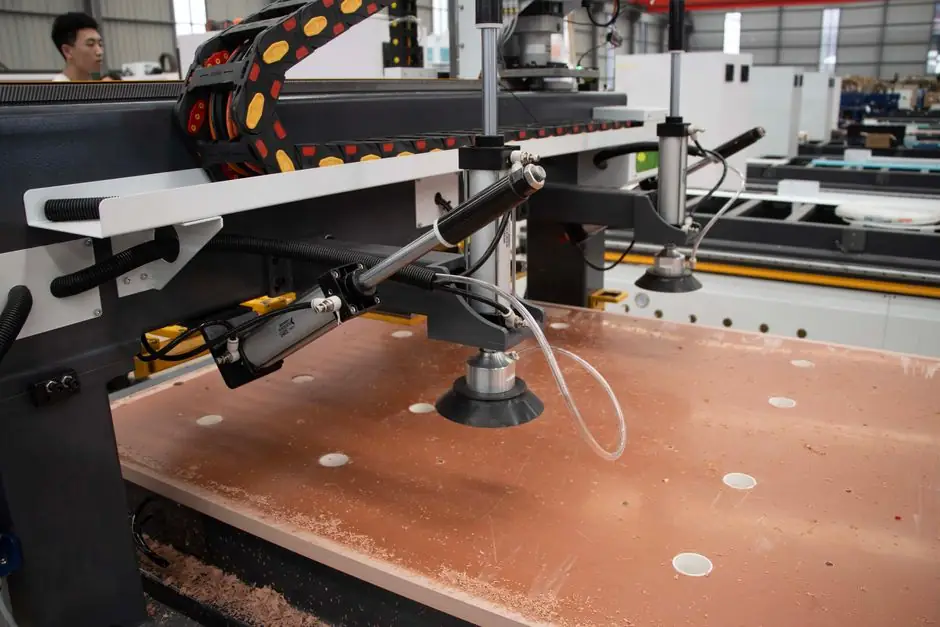
A 2026 commercial drone assembly line is best scoped as three coupled sub-lines: a frame and motor cell, an avionics and battery cell, and a flight-test plus calibration cell, with throughput governed by takt rather than by headcount [S3].
For plants building heavy-lift and cinema-grade aircraft, the airframe cell must clear FAA Part 107 and Section 44807 documentation gates before any finished drone ships, which pushes the calibration cell upstream of the pack-out station [S1].
Cell layout and takt sizing for a drone assembly line
Line frequency on a drone line is set by the slowest sub-line, typically the avionics and battery cell where cell matching, BMS calibration, and firmware flashing dominate cycle time. A practical 2026 reference for a single-shift build is one drone every 18-40 minutes depending on UAV class, with the flight-test cell acting as the pacemaker [S3]. Engineers planning capacity should size fixture density at roughly 1.2-1.5 fixtures per drone on the airframe cell, and run a U-shaped flow when total line length is below 25 m to keep one-piece movement viable. A comparison of the three standard cell shapes is useful here:
Cell shape: Straight line, U-shape, and Cellular cluster. Cycle time: Steady, 10-30% faster than straight, Flexible. Footprint: Highest, Moderate, Lowest. Best fit: High-volume single SKU, Mixed-model mid volume, Low-volume multi-SKU. Footprint and takt drive which shape the spec lands on, and the automatic molding line reference gives a useful template for fixture density at composite layup stations. Process engineers should also study how a conveyor sorting line handles part routing when designing the AGV handoff between cells.
Robotic subassembly, AGV handoff, and the BOM stack
Robotic subassembly is now standard for repetitive torque and bonding steps on drone lines, with AGV logistics replacing fixed conveyors in cells where the BOM is still shifting. The Xiamen Sinuowei power battery pack AGV line, published on 2025-01-20, is a representative template: lower cabinet auto on-line, install box connector, reserve workspace, modules auto-routed to the next station [S3]. That same five-step choreography maps directly onto drone battery tray assembly, where a 6S-12S LiPo or Li-ion pack needs matched-cell stacking, busbar torque, and a BMS calibration step before pack-onto-frame. Cost engineers should pair the cell design with a fresh look at the drone manufacturing cost breakdown, since fixture and tooling amortization is the second-largest cost line after the BOM itself. The same AGV architecture is used in adjacent industries, so the molding line reference gives a useful baseline for cycle time at composite and plastic subassembly stations.
ESD, calibration, and the flight-test cell
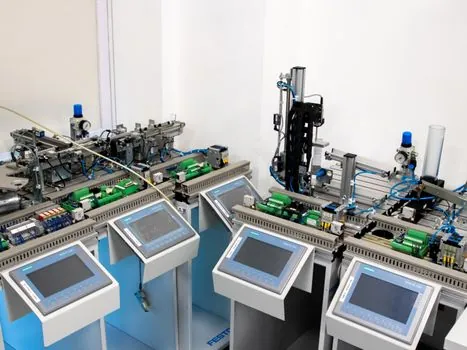
The avionics cell on a 2026 drone line is run as an ESD-controlled zone at 10^6 ohm dissipative floor resistance, with humidity held between 30-70% RH to keep static charge below 100 V on insulators. FC firmware flashing and ESC calibration together add 6-12 minutes per drone, which is why the cell carries two parallel test rigs on mid-volume lines [S3]. The flight-test cell downstream of the line is where the FAA Part 107 paperwork is closed out for sUAS and the Section 44807 exemption is filed for aircraft over 55 lb, and that gating step is what makes a heavy-lift cinema drone different from a sub-250 g consumer build [S1]. Pilots and crew working in this cell are FAA-certificated, with a documented 15-year minimum aviation background per the operator's published 2026 spec, which is a useful benchmark when qualifying in-house test pilots [S1]. The same cell houses the ground-station checks for FIZ control and video village, which cinema customers contractually require [S1].
Compliance, insurance, and the regulatory gate
Compliance and insurance weight on a 2026 drone line is heavy enough to shape the cell layout, not just the paperwork. US operators flying commercially carry up to $10 million in general liability aviation insurance and up to $5 million in unmanned aircraft insurance, with workers' comp layered on top, and those limits feed straight into the QA paperwork cell [S1]. Transport Canada approval is also part of the working set for cross-border production, so the QA cell is sized for dual-jurisdiction release stamps [S1]. The expanded 2026 spec is worth tracking alongside the industrial drone adoption under Industry 4.0 reference, which covers the broader factory-floor integration side of the same regulatory frame. Buyers comparing line builders should request a documented BOM-to-ship takt, an insurance liability schedule, and a dual-jurisdiction release flow before signing.
Who a drone production line is for, and who it is not for

Automated drone production lines are designed for builders running 20+ finished units per day across a stable BOM, including heavy-lift cinema, agriculture, inspection, and delivery UAVs where the airframe and avionics are captive. They are not a fit for sub-250 g consumer toys, one-off prototype R&D builds, or low-volume defense platforms where every drone carries a unique mission payload. The break-even against a manual cell is roughly 8-12 finished drones per day once AGV and robotic torque cells are amortized over a 5-year program [S3]. Buyers in the middle band should run a mixed cell: robotic subassembly plus manual final integration, which is the configuration most Chinese drone OEMs currently use. Studios that only operate finished aircraft, like the cinematography houses in California and Boston [S2][S4], do not run a production line at all and should not be confused with manufacturers in the spec conversation.
Limitations, failure modes, and engineering judgment
Three failure modes dominate 2026 drone line commissioning: fixture drift at the composite layup station, BMS calibration drift in the battery cell, and flight-test station over-cycling when the upstream takt is mis-set. The first is fixed by re-qualifying layup fixtures every 500-1000 cycles, the second by re-flashing BMS firmware nightly on a reference pack, and the third by adding a buffer of 2-3 drone slots between the avionics cell and the flight-test cell. A second judgment call is line length versus cell density: lines longer than 40 m lose takt visibility and force a split into two U-shaped sub-lines, each with its own pacemaker. Buyers should also weigh the cost of dual-sourcing the avionics and the battery against the risk of a single-source line stop, and that trade is covered in detail in the drone manufacturing cost breakdown reference. Next nodes to track: the 2026 EN 4709 series updates for civil UAVs, the FAA Part 108 NPRM rollout for BVLOS operations, and the China GB/T 38931 unmanned aircraft standard revision window. [S1]