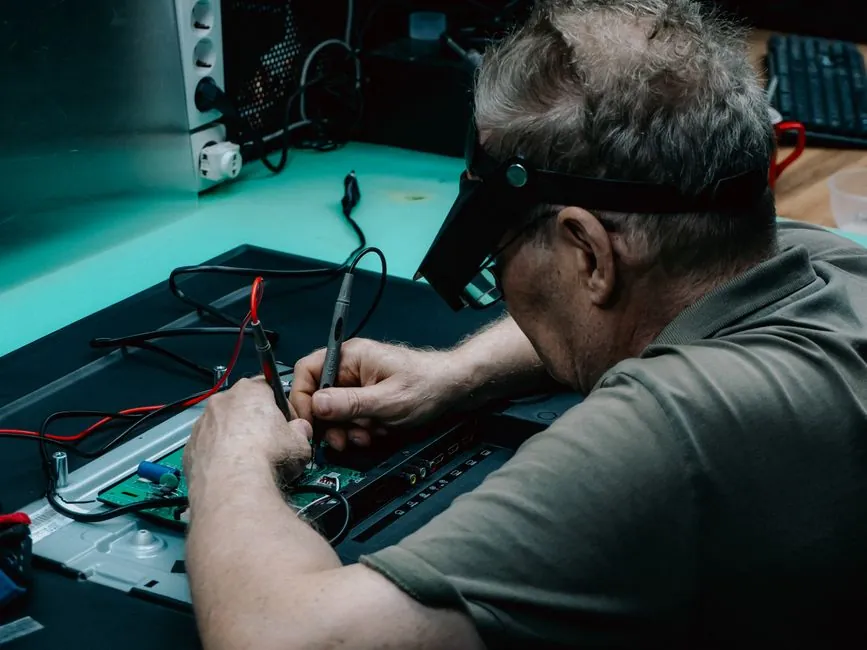
OLED module sourcing splits cleanly along two contract lines, OEM (build-to-print under the buyer's design) and ODM (build off a factory reference design the buyer re-brands), and that line decides who owns the BOM risk, the tooling amortisation, and the panel driver firmware [S2].
On Made-in-China.com, OLED-receiver and adjacent consumer-electronics suppliers almost universally list "R&D Capacity: OEM/ODM Service", with the dominant cluster sitting in Guangdong province across the TV-mainboard, wireless-DVR, and smartwatch-MP4 categories [S1][S3][S4][S5][S6]. For a spec-driven buyer, the two routes converge on the same fab floor but diverge on the engineering interface and the IP terms.
What Each Model Actually Buys You
OEM is a build-to-print contract: the buyer supplies the schematic, the panel mechanical drawing, the FPC layout, the driver-IC firmware binary, and the optical test limits, and the factory's job is to translate that into a repeatable production process, source equivalent cell batches, and hold a Cpk above whatever the buyer dictates [S2].
ODM is a reference-design contract: the factory owns a working product platform (housing, driver board, UI firmware, optical stack), and the buyer picks a SKU, applies artwork and packaging, and resells it. The factory keeps the design IP, the buyer keeps the brand surface, and tooling amortisation is spread across all the SKUs that share the platform [S2]. For OLED wearables and FPV-goggle receivers, where the optical stack and driver timing are the hard part, ODM is the common route precisely because the cell tuning is non-trivial [S1][S6].
Spec Bands and Engineering Interface
The buyer-facing engineering interface differs in a measurable way: an OEM RFQ carries a data package (Gerber, firmware binary, ICT fixture spec, optical test limits, incoming-mat'l list), while an ODM RFQ carries a marketing brief and a small set of mechanical constraints, because the factory already knows its reference design's electrical and optical envelope. On a Made-in-China supplier profile, that interface difference shows up implicitly through "Sample Service: Sample Available" tags and through revenue band filters spanning from under USD 1 million annual revenue to USD 10–50 million [S1][S3][S4][S7].
Decision Matrix: When to Pick Which
Choose OEM when the product has a differentiated optical stack (custom luminance, custom colour filter, application-specific driver timing), when you need to lock the cell supplier (LG Display, Samsung Display, BOE, Tianma, Visionox), or when regulatory ownership matters (your part number, your firmware, your EMC/CE/FCC filing under your company) [S2].
Choose ODM when time-to-market dominates (8 to 12 weeks vs 16 to 24 weeks for a clean OEM), when the reference design already meets your spec envelope, and when you accept that the cell vendor is the factory's call. Choose ODM-plus-private-mould when you need cosmetic differentiation (your bezel, your logo, your packaging) without re-engineering the optical engine. Avoid ODM when your channel requires unique firmware keys, encrypted boot, or signed driver binaries you must control, because the platform IP sits with the factory [S2][S6].
Factory-Side Reality on a Tier-2 Supplier Cluster
The Guangdong OLED-receiver supplier pool is dominated by small-to-mid factories, with annual revenue bands heavily weighted under USD 5 million on Made-in-China listings, and a mix of trading-company and audited-manufacturer profiles [S1][S3][S7].
Certification coverage is the real discriminator: ISO 9001:2015 and ISO 45001:2018 show up as the standard management-cert filter on multiple factory profiles, and CE / FCC / RoHS are the typical downstream-compliance flags the buyer will inherit via the ODM route [S3][S4][S6][S7]. For an OEM contract the buyer is usually responsible for maintaining those filings under their own brand; for an ODM contract the factory's existing filings can be transferred only with a written authorisation. For a related look at how panel capacity and evaporation lines shape the upstream fab choice, see the OLED production line design spec guide.
Cost, MOQ, and Tooling Amortisation
OEM carries a non-recurring engineering (NRE) line for fixture build, golden-sample sign-off, and pilot run, and the unit price stays higher until volume covers the amortisation, which is why a 5,000-piece MOQ is the typical OEM floor for a custom OLED module. ODM carries a much lower NRE (often just artwork and packaging tooling), and the unit price drops faster because the reference design's tooling is already paid off across other SKUs [S2].
Cell sourcing is the wildcard in either model: a single OLED cell batch from a Tier-1 panel maker is typically sold to a Tier-2 module factory in lots of 5,000 to 20,000 cells, and allocation is allocated quarterly. A buyer with a 12-month volume forecast signed in writing has materially better cell allocation than a buyer running on rolling POs, regardless of OEM or ODM status. For specifiers balancing cell allocation against flow instrumentation in adjacent process lines, the magnetic flow meter selection guide covers the parallel decision matrix on the process side.
Failure Modes and Contractual Gotchas
The classic OEM failure mode is driver-IC obsolescence: the buyer locks a firmware to a specific driver IC, the factory's second-source qualification drifts, and a year-two production run quietly switches cells with a 5% luminance shift nobody noticed until QA. Insist on a second-source driver qualification inside the OEM contract, and a luminance / chromaticity delta cap per revalidation [S2].
The classic ODM failure mode is silent reference-design change: the factory migrates the platform to a cheaper cell or a different driver to protect margin, and your re-ordered SKU no longer matches the golden sample you signed off. Lock the BOM at the SKU level in the ODM contract, require change-control notification, and reserve the right to a re-qualification sample before any production-batch switch. For adjacent sourcing-decision frameworks that share the same change-control risk profile, the AGV robot selection guide walks through a parallel second-source discipline.
Standards, Compliance, and 2026 Sourcing Signals
There is no single IEC or ISO standard that defines an OEM-versus-ODM contract; the boundary is a commercial term enforced through the supply agreement, the IP assignment clause, and the tool-of-record ownership. The standards that do bite are the product-side ones: IEC 62368-1 for AV/ICT equipment safety on the finished SKU, the EU Radio Equipment Directive (RED) 2014/53/EU for any wireless-enabled OLED product, RoHS 2011/65/EU + (EU) 2015/863 for the four phthalates, and REACH for chemical-declaration obligations on the cell [S1][S3][S6].
Trackable 2026 sourcing signals: (a) whether the factory's ISO 9001:2015 certificate has a remaining validity beyond your 12-month production window (most Guangdong factories publish a 3-year cycle that runs through 2027-2028); (b) whether the cell-vendor allocation letter names your SKU by part number or only by monthly volume; (c) whether the ODM contract names the reference-design version by drawing number or only by marketing name. The first two are verifiable today on the supplier profile, and the third is a red-flag filter that separates mature ODM partners from rebranding brokers [S1][S3][S4][S7].
For the relevant spec sheets and selection criteria, see additive manufacturing material, pressure transmitter, and flow meter.