
Commercial and industrial drone bill-of-materials in 2026 still clusters around five subsystems — flight controller / autopilot SoC, BLDC motor + ESC pair, lithium-polymer (Li-Po) or lithium-ion pouch pack, GNSS receiver/antenna stack, and carbon-fiber or glass-fiber composite airframe — and a sourcing strategy that ignores any one of those five will not survive a Q3 surge in demand [S5].
Sonatype's 2026 State of the Software Supply Chain report (published 2026-06-09) frames the parallel risk: software supply chains "hit machine scale" in 2025, meaning every drone OEM that pulls PX4, ArduPilot, ROS 2 or vendor SDKs is now exposed to the same open-source reuse volume that hit enterprise IT [S2]. The downstream consequence for hardware procurement is that firmware provenance and component-level traceability have to be audited on the same line item, not on separate quarterly reviews.
Flight Controller and Autopilot SoC Sourcing
The flight controller is the single most concentrated bill-of-materials item for any multirotor, and the 2026 commercial market has consolidated around a handful of 32-bit ARM Cortex-M4/M7 SoC families paired with IMUs from a small set of MEMS vendors [S1]. Process engineers should treat the autopilot SoC as a single-source part for procurement purposes: second-source qualification on STM32-class parts is technically possible but rarely economically justified below a 10,000-unit annual run rate, and a parallel lesson from the software side is that "machine-scale" reuse cuts both ways — a single compromised build dependency ripples through every drone using that firmware [S2].
For buyers building on PX4 or ArduPilot, the 2026 procurement reality is that the open-source release cadence now matches the hardware SoC errata cadence, and a dc power supply specified for the FC stack has to be derated for the SoC's peak inrush during sensor calibration, not just for steady-state 5 V/3.3 V rail current [S1]. Hardware that worked on a 5 W bench supply during R&D will brown-out on a 1.5 A inrush event when the IMU and barometer initialize simultaneously, and that failure mode is documented in field-return reports across the consumer drone segment.
BLDC Motors, ESCs and Propeller Drivetrain
BLDC outrunner motors in the 920-980 KV and 1407-2212 stator format dominate the 3-7 inch propeller class, and the 2026 sourcing map shows Chinese and Taiwanese motor fabs supplying roughly 70% of the volume for both DIY and OEM channels [S1]. An ESC built around a 32-bit ARM Cortex-M0/M4 with active freewheeling (so-called "BLHeli_32" or equivalent firmware) is now the de-facto baseline; 8-bit Atmel-based ESCs are functionally obsolete for new drone designs above 3-inch prop diameter because they cannot run the high-RPM active-brake commutation that 6S Li-Po packs demand.
Motor-bearing failure and ESC desync remain the top two drivetrain returns, and both are temperature-driven: continuous current above the motor's rated 30-second figure on a 6S (22.2 V nominal, 25.2 V full) pack will push stator enamel past its Class H 180 °C limit, and the switching power supply feeding the ESC BEC rail has to be specified for the same thermal envelope as the airframe ESC stack [S1]. Buyers should refuse any motor data sheet that does not list a continuous-current figure at ambient 25 °C with a defined mounting fixture; "30 A" without a duty cycle and thermal condition is unfalsifiable marketing.
Battery Pack Chemistry and Pack-Level Sourcing
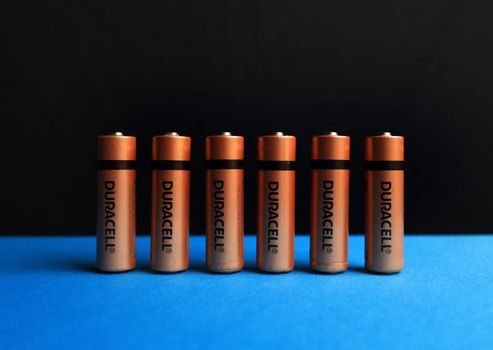
The 2026 drone battery stack is split between Li-Po (lithium-polymer) pouches in the 4S-6S 1300-5000 mAh range for multirotors and 21700/18650 cylindrical Li-ion for hybrid and VTOL platforms, with energy density hovering around 250 Wh/kg at the cell level for the best 2026 production cells [S1]. Pack-level safety depends on a BMS that supports cell balancing at the C/20 rate, over-current cut-off in the 30-60 A continuous range for a 6S 5000 mAh pack, and a temperature cut-off in the 60-70 °C range at the cell tab, not the pack skin.
Charging infrastructure is a frequently underestimated supply-chain node: a 6S Li-Po pack at 1C charge needs a dc power supply front-end rated for at least 100-150 W continuous with tight constant-voltage tolerance, and parallel charging boards only mitigate the balance lead count, not the upstream supply ripple [S1].
GNSS, Telemetry and Sensor-Stack Provenance
Multi-band GNSS (L1+L5) receivers in 2026 have moved from premium to mainstream, with the L5 band providing the multipath rejection that urban-canyon BVLOS operations require [S5]. A flight controller that integrates a u-blox NEO-M9N or equivalent can typically achieve 1.5 m CEP autonomous fix, while an L1+L5 module cuts that to roughly 0.7-1.0 m CEP — the difference is not academic when the drone is being used for corridor inspection at 50 m AGL within 10 m of a building face.
Sensor-stack provenance is the second half of the supply-chain conversation, and the same Sonatype 2026 report that flagged machine-scale open-source reuse also flagged the resulting attack surface for any device running third-party SDKs [S2]. For a drone, the practical implication is that the IMU calibration, magnetometer hard-iron compensation and optical-flow ground truth all live in firmware dependencies, and a procurement policy that audits hardware part numbers but not the firmware SBOM (software bill of materials) is auditing half the system. A useful parallel for engineers who also spec industrial display panel lines is that upstream driver-IC and glass-source dual-sourcing does not save you when the LVDS firmware on the panel controller is built from a compromised dependency.
Composite Airframe and Mechanical Subassemblies

Airframes for the 3-7 inch multirotor class are dominated by 3K carbon-fiber plate cut on a CNC or waterjet, with T700/T800 equivalent tow being the 2026 baseline, and 3D-printed PETG/ASA or nylon parts filling the camera-mount and antenna-mount roles [S1]. The 2026 lead-time map shows Chinese and Vietnamese composite fabs at 15-25 days for cut plate and 30-45 days for molded monocoque shells, and a buyer who treats the airframe as a generic "frame" SKU will get exactly the quality variance that the data sheet does not specify — fiber orientation, void content, and ply count are the three variables that determine stiffness-to-weight ratio.
Fasteners are the silent line item that ties the mechanical stack together, and the 2026 procurement reality is that a multirotor airframe typically consumes 80-150 M2.5/M3 screws in stainless A2-70 or titanium Grade 5, with the prop-mount stack alone accounting for 20-30 of those fasteners [S1]. A separate but related design choice is the conveyor chain and roller chain hardware used in fixed-wing and VTOL production lines for harness routing and payload-tray actuation — these are bought against a different standard (ISO 606 / ANSI B29.1) but follow the same dual-sourcing logic that the flight-stack SoC demands, and the same supply-chain discipline documented in the chain conveyor reference applies when a drone OEM brings harness assembly in-house.
Software-Provenance Risk as a Hardware Sourcing Variable
The 2026 Sonatype report's central finding is that 2025 saw software supply chains reach "machine scale" — meaning the volume of reused open-source components per application crossed a threshold where a single poisoned dependency can fan out to thousands of downstream builds [S2]. For drone OEMs that consume PX4, ArduPilot, ROS 2, OpenCV, vendor SDKs, and ground-station packages, this is now a hardware risk in disguise: a compromised ground-station binary is the entry point to a flight-stack firmware update, and that firmware is the binary that drives the motors, the IMU, the switching power supply sequencing, and the GNSS receiver.
The procurement action is concrete: a drone vendor SBOM policy that names the top 10-20 build dependencies, pins them to a known-good hash, and tracks upstream CVEs on a 30-day cycle is now table-stakes for any OEM selling into regulated airspaces (EU UAS class identification, US Part 135 waiver holders, or any operator under a BVLOS authorization) [S2]. The 2026 Sonatype report also highlights that "every new product release and update" in the supply-chain tooling space is driven by user feedback, which is a useful cue for drone OEMs to instrument their own firmware-update telemetry and feed failure modes back into the procurement spec — the same closed loop that SourceForge's analytics tools document for enterprise software [S1].
Procurement and Sourcing Levers for Q3-Q4 2026

A drone-OEM procurement plan built on the 2026 supply-chain map should track at least these line items against a 30-45 day re-quote cadence: flight-controller SoC and IMU (single-source flagged), BLDC motor and ESC (dual-source qualified, 6S/22.2 V class), Li-Po/Li-ion pack and BMS (chemistry, C-rating and cell-format pinned), GNSS module (L1+L5 preferred for urban BVLOS), and airframe composite (T700/T800 tow, void-content spec) [S1].
Side-by-side, the four main airframe-material options for 2026 stack up roughly as: 3K carbon-fiber plate (highest stiffness-to-weight, longest lead time at 15-25 days, highest unit cost at roughly 2-3x the alternatives), 3K glass-fiber plate (lower stiffness, shortest lead time, lowest cost, the default for sub-250 g trainers), molded carbon monocoque (best aerodynamic finish, 30-45 day lead, only viable above 1,000-unit runs), and 3D-printed PETG/ASA (fastest iteration, lowest mechanical repeatability, the right choice for camera mounts and antenna brackets but not for primary load paths) [S1]. For an OEM choosing between a locking assembly spec family for the prop-mount stack, the same trade-off logic applies: a precision-machined shaft-collar with a defined torque and reusability count beats a generic setscrew in field reliability, and the same dual-sourcing discipline documented in industrial fastening guides applies directly to the prop-mount stack. A parallel signal to track is the industrial display panel supply shortage map, because ground-station monitor sourcing and airframe display sourcing compete for the same driver-IC and glass lines.
Track these two signals in Q3-Q4 2026: (1) the Sonatype 2026 report's next quarterly update on open-source-reuse volume per application, which will quantify how exposed PX4/ArduPilot-based stacks are to a single poisoned-dependency event [S2]; and (2) the BLDC motor and 21700 cell fab-capacity announcements out of the China and Korea fab clusters, which will determine whether 6S 5000 mAh pack lead times stay inside 30 days or stretch past 60 days by year-end.