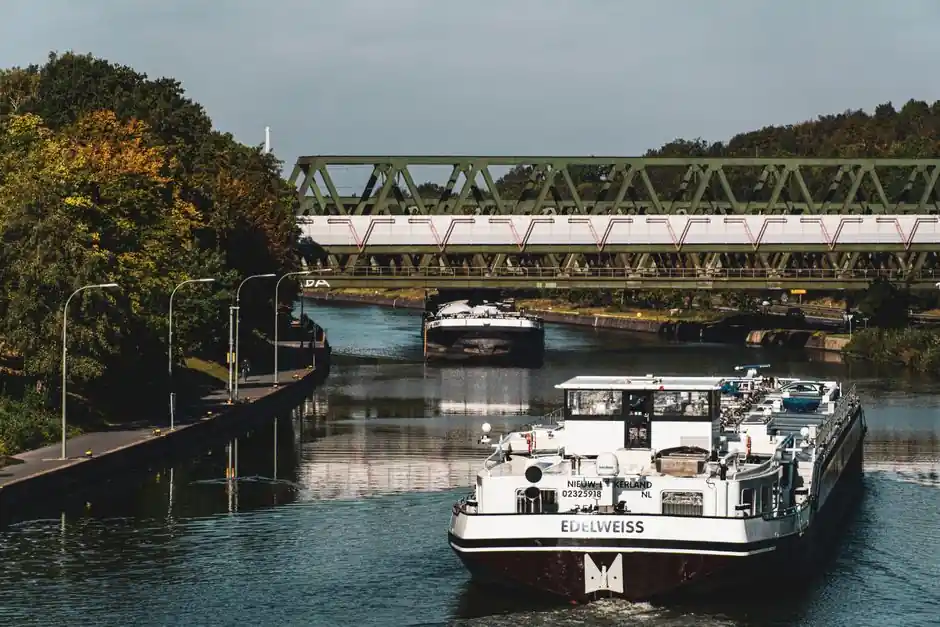
For the fourth consecutive year, historically low Mississippi River levels have forced barges to carry lighter loads and capped tow sizes, with the U.S. Army Corps of Engineers reporting the St. Louis gauge at 1.27 feet on Sept. 23, 2025, about 22 feet lower than late July and roughly 90% below the post-2019 average stage [S1].
The pattern is not confined to North America. Falling water levels on the Rhine at Kaub fell below 40 cm in mid-2022, and ITF analysis published Sep 28, 2026 confirms that drought-driven low water continues to strand cargo, congest inland ports and stall vessels on multiple trade routes [S2][S5][S6].
Draft and Tow-Size Restrictions on the Lower Mississippi
On Sept. 15, 2025, the U.S. Coast Guard imposed additional draft and tow-size restrictions on the lower Mississippi River, capping southbound barge drafts near Memphis at 10.5 feet and tows at six barges wide, with northbound drafts limited to 10 feet and tows of four to six barges across and no more than seven barges long [S1]. These caps directly translate the gauge readings at St. Louis (1.27 feet on Sept. 23) and Memphis (–5.5 feet, projected near –8 feet by month-end) into operational limits on the corridor that moves nearly 48% of U.S. corn and soybean exports [S1]. The lower Mississippi stage reading of 1.27 feet represents a drop of about 22 feet in roughly two months, equivalent to a 95% reduction against the late-July baseline and roughly 90% below the 2019-to-date average [S1].
Restricting drafts to 10–10.5 feet versus a normal operating draft closer to 12 feet means each barge carries meaningfully less tonnage, and the 4–6-barge tow-width cap versus typical 15-barge tows cuts per-trip throughput sharply. A single 15-barge tow at normal draft moves the equivalent of about two 100-car unit trains or roughly 1,000 semi-trucks, so width and draft limits on the order seen in late September 2025 can remove a large fraction of corridor capacity at exactly the moment harvest peaks [S1].
What the Numbers Say About Disruption
ITF signals published Sep 24, 2026 frame the effect precisely: falling water levels force vessels to reduce cargo, disrupt ports and supply chains, raise logistics costs and, in some cases, cut off access altogether [S2]. On the Mississippi, an average of 65 million metric tons of bulk agricultural product moves by barge each year to terminals near New Orleans, and U.S. inland waterways save shippers an estimated $7 billion to $9 billion annually versus rail or truck [S1]. When that cost advantage erodes under low water, per-ton delivered cost rises because more trips, more fuel and more labour are required to move the same tonnage.
Historical reference points anchor the macroeconomic scale: when Rhine navigation was disrupted in 2018, German industrial production fell by about 1.5% [S5]. A typical Rhine cargo vessel moves around 1,000 tonnes of grain, equivalent to about 40 truck loads, so even partial loading (mid-2022 reports described vessels sailing three-quarters empty) forces shippers to multiply trips fourfold for the same volume, quickly overwhelming limited trucking capacity [S5]. Peer-reviewed analysis of the 2022 lower Mississippi drought by Rohli et al. (2023) found drought-induced shallow water raised grounding risk and narrowed navigable channels, reducing cargo-carrying capacity and propagating economic effects through the barge, rail and truck modes [S4].
Which Cargoes and Industries Feel the Squeeze First
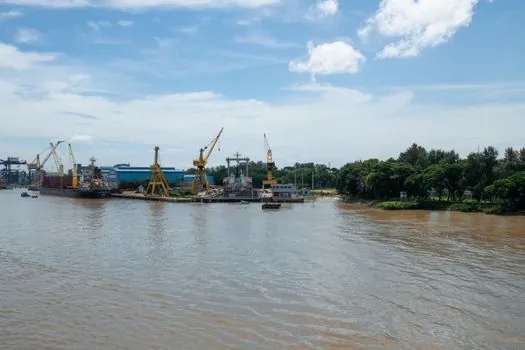
Bulk agricultural commodities dominate the exposure on inland corridors: nearly half (48%) of U.S. corn and soybean exports move first by barge down the Mississippi system, so lighter barge loads and tow caps during the September harvest window translate directly into farmgate price pressure and weaker export competitiveness versus origins with reliable waterborne access [S1]. Wheat, barley and sorghum depend more on rail, which is why they are less exposed to river-level events [S1]. On the Rhine, the exposed cargo mix shifts to chemicals, coal and cereals, and a 2018 low-water episode cut German industrial production by 1.5%, illustrating how a single shallow stretch can ripple through chemicals, steel feedstocks and power generation that depend on Rhine deliveries [S5].
Steel and metals shippers are exposed differently. Industrial buyers who planned around normal river conditions for the third or fourth quarter of 2026 are now weighing whether the DRI and HBI supply pipeline behind low-carbon steel is still arriving on schedule, because the same inland corridors that carry grain also move iron ore, scrap, and finished steel between mills and Gulf or Rhine ports. When barges carry less per trip, feedstock deliveries to integrated mills slip, and the cost of emergency rail or truck diversions stacks on top of already-elevated barge freight.
From Drought Gauge to Supply-Chain Bottleneck
The mechanism linking a river gauge to a factory input is short and concrete. Lower water levels trigger shallower navigation channels, which trigger draft and tow-size restrictions from authorities such as the U.S. Coast Guard or German federal waterway agencies, which trigger lighter barge loads, which trigger higher per-ton freight, more trips, longer dwell times at terminals, and ultimately inventory shortfalls at the receiving plant or port [S1][S2][S6]. A peer-reviewed study by Chen et al. (2025) on the Mississippi confirms that the impact of low water is compounded by lock damage and other disturbances, with cascading effects on regional supply chains rather than a single linear shock [S3].
Vinke et al. (2022) describe the system-level outcome: inland waterway transport becomes less reliable, the risk of supply-chain disruption increases, and operators face a structural rather than a transient problem, because drought recurrence is now baked into planning assumptions for European and North American corridors [S7]. ITF analysis reinforces the same conclusion for 2026: drought-driven low river levels hit shipping and trade across major routes, cargo can remain stranded or stored for longer when it cannot be moved inland, and congestion builds at the inland terminals that are supposed to feed ocean-going vessels [S2][S6].
Operating Limits and Known Failure Modes
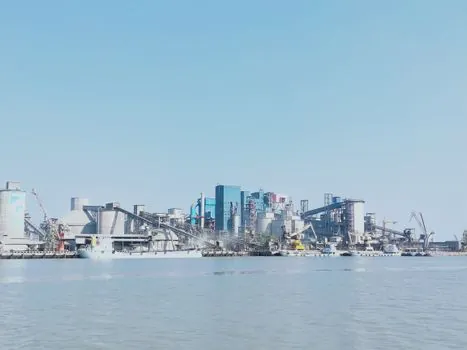
Engineers running on inland corridors already know the practical failure modes. Vessels ground when channel depth drops below their loaded draft; tows break apart when width or current exceeds safe limits at restricted bends; barges are parked mid-stream or staged at fleeting areas when tow sizes are constrained, creating queues that look like highway traffic jams; and ports lose throughput because loaded barges cannot reach the dock at the planned waterline [S1][S4][S5]. Each of these is a directly observable mode rather than a modelled risk, and each is amplified when gauges drop toward historical minima such as the St. Louis 1.27-foot reading or the Rhine at Kaub below 40 cm [S1][S5].
Drought is the principal driver, but it is not the only one. Heat waves lower river levels directly through evaporation, lock damage or scheduled maintenance reduces effective corridor capacity, and peak harvest or peak construction demand concentrates cargo onto the same constrained channel [S3]. The compounding behaviour is what makes low-water events operationally severe: a shallow channel plus a damaged lock plus a heat-driven surge in cooling demand for power-plant coal can each be absorbed individually, but their joint occurrence is what removed measurable output from the German economy in 2018 and is now pressuring U.S. grain exports four years running [S1][S3][S5].
Procurement, Routing and Sourcing Implications
For industrial buyers, three operational signals are worth tracking in late 2026: the daily Army Corps of Engineers gauge readings on the Mississippi at St. Louis and Memphis, the ITF drought-and-inland-transport indicators published periodically, and the freight spread between barge and rail quotes on the same lanes, because a widening spread is the cleanest evidence that barge capacity has actually been constrained [S1][S2]. A widening barge-versus-rail spread, or sustained negative gauge readings, is also a useful precondition for any decision to reserve capacity in advance or to switch heavy inputs from barge to rail or truck.
Equipment-side, the inland-shipping squeeze is now a meaningful input to how quickly heavy industrial equipment and breakbulk cargo can reach sites. Buyers timing transformer, turbine or mill-equipment deliveries into river-served plants should assume that barge windows can shrink for several weeks at a stretch during low-water months, and should compare the published breakbulk and heavy-lift capacity outlook against any assumption that the heaviest lifts can be moved by water at the original schedule.
Sourcing and Standards Used in This Assessment
Primary sources for this article are the Farm Bureau analysis dated Sep 24, 2025 on Mississippi River conditions and barge economics [S1], the ITF signals on drought and inland waterway transport dated Sep 24, 2026 [S2] and the ITF-aligned Down To Earth synthesis dated Sep 28, 2026 [S6], the peer-reviewed Chen et al. (2025) compound-impact study on the Mississippi [S3], the Rohli et al. (2023) AGU abstract on the 2022 lower Mississippi drought [S4], the Globalia Logistics Network analysis of the 2022 Rhine drought and the 2018 German industrial-production reference [S5], and the Vinke et al. (2022) inland-shipping reliability study in the ScienceDirect corpus [S7]. U.S. operational limits cited are the Sept. 15, 2025 U.S. Coast Guard draft and tow-size restrictions on the lower Mississippi; German operational limits cited are the mid-2022 Rhine-Kaub reference level of 40 cm and the 2018 Rhine low-water episode [S1][S5].
Watch the next gauge update: the St. Louis and Memphis readings on the Mississippi, and the Rhine Kaub reference level, are the cleanest forward indicators of whether the late-2026 shipping window opens up or stays constrained, and they move before freight indices and farmgate prices do.