Commercial-building dry-mix mortar procurement in 2026 is set by four data points: substrate exposure class, the EN 998-1 / EN 998-2 performance tier, batch throughput (3 TPH compact vs 20-100 TPH automatic), and the polymer-modifier ratio carried in the bag — every specifier should anchor the RFQ on these four before comparing brands.
Production-line builders serving this segment now span a clear size ladder: BH Mortar Industrial lists a 3 TPH BHR2000 compact line, an 8 TPH semi-automatic line, a 10-15 TPH auto line, and a 20-100 TPH full-automatic line as separate catalog SKUs [S3]; Henan DeJinYang ships automatic plants, manual ribbon-mixer lines, and thermal-insulation-mortar plants from the same Zhengzhou base [S1]. Wacker Chemie runs WACKER Academy training tracks in the Middle East, Europe and India where it teaches specifiers how to read mortar performance data sheets [S2].
Substrate Class and the EN 998-1 / EN 998-2 Performance Tier
For commercial façades and interior masonry, EN 998-1 governs rendering/plastering mortars and EN 998-2 governs masonry mortars; the specifier selects a declared compressive-strength class (e.g. CS IV at 6 N/mm²) and a capillary-water absorption category (W0, W1, W2) on the bag label, not on the bag art.
WACKER Academy's "Dry-Mix Mortar and Its Various Applications" seminar walks commercial specifiers through reading these EN 998-1/2 declared values against the substrate (concrete, AAC, clay brick, calcium-silicate) and exposure class (interior dry, exterior sheltered, exterior exposed) [S2]. For tile-adhesive specifications, EN 12004 classes C1TE and C2TE are the two commercial-building workhorses, with C2TE1 / C2TE2 reserved for façades and large-format panels.
Factory-Blended Bag vs Site-Mix Silo: Decision Tree
Factory-blended bagged mortar dominates sites under ~50 m²/day; bulk silos with mobile dry-mortar storage tanks become economical above ~5 T/day, where dosing consistency and waste reduction offset silo rental [S3].
BH Mortar Industrial's catalog shows the full transition: a 3 TPH BHR2000 small plant with a 5 m³ mobile storage tank for low-volume contractors, an 8 TPH semi-automatic line, and a 20-100 TPH automatic line with bulk cement silos and dust collectors for project plants that feed multiple commercial towers [S3]. DeJinYang's "Manually Dry Mortar Line" targets a different user — site crews that need ribbon-mixer flexibility for small EIFS patch batches and thermal-insulation-mortar mixes where production volume does not justify a tower [S1]. For specifiers, the rule of thumb is bag-and-silo blend: 25 kg paper bags for repair areas, 30 T silo for façade and large-format tile work.
Throughput Ladder and Equipment Map (3 TPH → 100 TPH)
Commercial specifiers should match the plant throughput to the project's peak daily demand: 3 TPH covers a single 4,000 m² façade block, 8-15 TPH covers a multi-tower site, and 20-100 TPH serves a regional distributor serving multiple sites [S3].
The standard plant architecture across the 3-100 TPH ladder is sand dryer → bucket elevator → vibrating screen → ribbon / twin-shaft mixer → bucket elevator → storage silo → impeller-type or air-blowing valve port packer; DeJinYang lists each of these as a separate product line on its catalog (sand drying line, bucket elevator, vibrating screen, screw conveyor, packing machine) so the specifier can build either an automatic or a manually operated line from the same vendor [S1].
BH Mortar Industrial's BHR2000 3 TPH plant is described as a "small dry mortar production line" suited to entry-level tile-adhesive and masonry-mortar batches; the 8 TPH semi-automatic line is positioned for mid-size contractors; the 10-15 TPH auto line adds PLC batching; the 20-100 TPH full-automatic plant includes a cement silo, dust collector, and automatic stretch-pallet wrapper for finished pallet delivery [S3]. Annual output at 20-100 TPH on a single shift clears 50,000-200,000 T/year, enough to supply a multi-block commercial campus.
Admixture and Polymer-Modifier Selection
Cellulose ether (HPMC/MHPC) at 0.2-0.5% by binder mass and redispersible polymer powder (VA-VEOVA, VA-EVA) at 2-6% are the two workhorse admixtures that move a C1 tile adhesive into a C2TE grade — both are covered in the WACKER Academy curriculum that runs through the Middle East, India and Southeast Asia [S2].
DeJinYang sells a dedicated Thermal Insulation Mortar Plant for EIFS and ETICS base coats, where the aggregate is shifted from quartz sand to perlite / vermiculite / EPS granulate and the binder ratio is raised to keep the dry-density below the 400 kg/m³ EIFS cap [S1]. The same vendor's Gypsum Mortar Production Line handles light gypsum plaster (λ ≤ 0.35 W/m·K) and heavy gypsum plaster where fire-rating drives the spec, with a continuous ribbon-mixer architecture rated for large batch runs [S1].
Quality Control and Lab Equipment
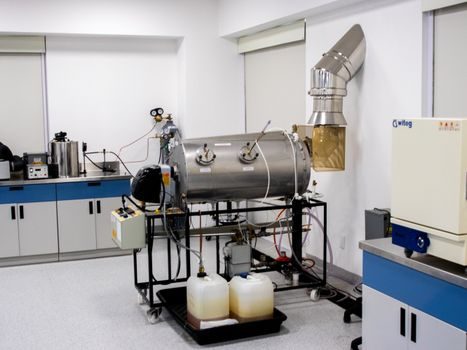
BH Mortar Industrial sells a dedicated Mortar Lab Equipment line — flow table, Vicat needle, flexural / compression testing frames, and cement Blaine apparatus — sized to QA a 20-100 TPH plant's shift output against EN 1015 sampling cadence [S3].
For commercial projects, the QA routine at receipt is: flow-test on every 25 T lot (EN 1015-3 workability 175 ± 10 mm target), Vicat set on every 50 T (initial set ≥ 2 h, final ≤ 8 h for plaster), and 28-day compressive strength on every 100 T [S2]. A 3 TPH BHR2000 plant in 24-hour continuous operation produces ~70 T, so a single lot per shift is the right QA cadence; a 20 TPH line produces ~480 T/day, so the lab workload scales 7× and dedicated lab equipment becomes mandatory [S3].
On-Site Handling: Spraying, Mixing Water, and Coverage
DeJinYang's high-pressure mortar spraying machine is rated for both cementitious plaster and lightweight EIFS base coats, with throughput scaled to the mixer's output so that one pump can drain a 3 TPH ribbon-mixer line in a single shift [S1].
Specifiers should write the water ratio into the method statement, not just the bag spec.
For Commercial Specifiers: a Quick Selection Rule

Use the same four-point checklist the dry-mortar encyclopedia page anchors: EN 998-1/2 declared class → substrate match, throughput tier (3/8/10-15/20-100 TPH) → project size, admixture package (HPMC + RDP) → performance grade, and lab-equipment scope → QA cadence. [S2]
Two further cross-references help at the procurement stage. The ready-mix concrete reference covers the adjacent plant-architecture question (tower vs horizontal mixer, silo vs truck) for buildings where in-situ concrete and dry-mix mortar are both spec'd. The adjacent residential dry-mix mortar spec map is the lower-throughput sibling — use it as a sanity check when the commercial project drops below 50 m²/day in any single trade, since residential-class bagged mortar will under-perform on a façade warranty claim. Trackable signals for the next 6 months: EN 998-1 amendment drafts around low-dust factory blends, and any shift in the 20-100 TPH full-automatic line pricing as Chinese OEMs move from semi-automatic to full-PLC standard configurations.
The underlying component specifications are covered under dry type transformer.