
Dry-mix mortar is a factory-blended mixture of binder, graded aggregate and additives delivered to site as a powder, requiring only water addition at the point of use, and the 2026 product lines from BH Mortar Industrial and Fujian Nanan H-TEC explicitly tier the technology by throughput: 3 TPH workshop units, 8 TPH semi-automatic, 10–15 TPH automatic, and 20–100 TPH full-scale automatic plants [S1][S2].
Two physical arrangements dominate the market: the workshop-type (semi-automatic, low-investment, ~200–400 m² floor area per line) and the tower-type (automatic, compact, high-rise vertical layout) [S2][S3]. H-TEC lists "Dry-Mixed Mortar Tower Type Production Line" and "Dry-Mixed Mortar Equipments" as primary categories on its 2026 product page, reflecting that the tower arrangement is the modern default for plants above ~10 TPH [S2].
Binder Basis and Cement-to-Additive Ratio as the First Classification Axis
The most common primary-axis classification for dry-mix mortar is by binder system: ordinary Portland-cement-based, modified cement-based with redispersible polymer powder (RDP) and cellulose ether, gypsum-based, and non-cement lime-metakaolin or geopolymer systems, with the cement-RDP combination being the workhorse for tile adhesive and EIFS mortars per the BH Mortar product range covering tile adhesive, cement glue, and thermal-insulation renders [S1].
For comparison guidance on cement performance trade-offs, the special cement trade-off map lays out the binder families that feed into dry-mix formulation.
Production-Line Class Comparison: Workshop, Semi-Auto, Auto, Tower
BH Mortar Industrial's 2026 product tree lists four discrete plant classes with clear throughput gaps: 3 TPH small (BHR2000), 8 TPH semi-automatic, 10–15 TPH automatic, and 20–100 TPH automatic [S1]. The Okorder-listed workshop-type line parameter sheet provides the working spec envelope for the lower three classes, with theoretical productivity of 10, 20, 40, 20 and 40 t/h across the GSW500, GSW1000, GSW2000, GDW1200 and GDW2000 models, paired installed power of 120–200 kW, and floor areas from 200 m² up to 400 m² [S3].
The tower arrangement, which H-TEC positions as its flagship, stacks aggregate drying, screening, storage, weighing, mixing and packaging vertically, cutting horizontal footprint and elevating top-bin pressure to the mixing stage for accurate dosing [S2]. For projects where the downstream packaged product must be moved at scale, the belt conveyor TCO breakdown is the natural cross-reference, since the bulk-handling interface between dry-mix plant and silo truck is identical in design pattern to aggregate conveying on a batching line.
Product-Type Sub-Classification: Tile Adhesive, Plaster, Self-Leveling, Waterproofing, Repair
BH Mortar markets a "Cement glue production line, tile glue production line" that has been shipped to Ukraine and other European customers, with a hot-sale capacity of 10–15 t/h [S1].
These sub-types demand different mixer geometries: ribbon mixers handle ordinary plaster and masonry mortar in the BH JHW1000 cylinder dry-mix mixer (supporting power ≤ 10.5 kW, batch volume ≤ 1 m³, materials fed manually) [S6], while twin-shaft paddle mixers are specified for self-leveling and tile-adhesive recipes where RDP dispersion and de-aeration are critical. The vertical-versus-horizontal layout decision also drives the choice between a gravity-fed tower (preferred for dry, free-flowing recipes) and a workshop horizontal line (preferred for damp sand or high-filler recipes).
Standards, Quality Control and the ISO/CQCA Reference Stack
BH Mortar Industrial operates as an ISO 9001:2008 certified manufacturer with its own R&D department, and the company's product range is sold into "34 provinces, cities and autonomous regions" of China with exports to "more than 30 countries and regions" per its 2026 corporate statement [S1]. H-TEC is registered as a Committee Member of the China Bulk Cement Association of Dry-mixed Mortar Specialty Council, which functions as the industry self-regulatory body for formulation, plant engineering, and QC [S2].
For formulation spec engineers, the binding standards are EN 12004 (tile adhesive C1/C2/TE/S1/S2 grades), EN 998-1 (rendering mortars), EN 13813 (screed materials and floor screeds), and ASTM C270 (mortar for unit masonry); China's GB/T 25181-2019 governs pre-mixed mortar. These standards set compressive strength, open time, slip, and adhesion thresholds that drive the binder-to-aggregate ratio decisions on the production floor, though the research material does not cite specific compressive or adhesion values for individual product grades [S1][S2].
Manufacturer Tier and Supply Chain Position
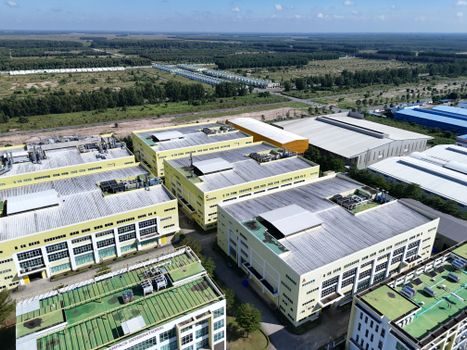
The 2026 supply base consolidates around three Chinese manufacturing hubs: Henan (BH Mortar, Zhengzhou, with installations including a BH cement tile rubber plant in Nigeria and a 10 t/h cement glue line in Ukraine), Fujian (H-TEC, Nanan, supplying tower-type production lines globally), and Shandong (the Okorder-listed workshop-type line shippers, exporting from Qingdao) [S1][S2][S3]. Xinxiang Sanyang in Henan provides the JHW1000 cylinder mixer at ≤ 10.5 kW supporting power for ≤ 1 m³ batches, illustrating the lower-capacity sub-tier [S6].
Downstream, finished-product factories such as Xiamen Zhongjingtai Building Materials Co. consume dry-mix mortar inputs to produce EPS cement sandwich panels, fireproof wall panels, and paving stones, with primary markets in North America, South America and Eastern Europe per its 2026 Made-in-China listing [S5]. This pinpoints the dominant export corridors for Chinese dry-mix plant engineering: Southeast Asia (Malaysia, Indonesia), Eastern Europe (Ukraine, Russia), the Middle East (Oman), and Africa (Nigeria) [S1].
Selection Criteria: Matching Plant Class to Market Position
A 3 TPH BHR2000 line is the right entry point for pilot or specialty runs under ~25,000 t/yr; the 8 TPH semi-automatic fits regional single-product plants; the 10–15 TPH automatic serves multi-product commercial plants with 2–4 SKUs; the 20–100 TPH tower is reserved for national-brand or export-oriented producers [S1]. The tower layout's reduced horizontal footprint and higher automation justify its capex premium at throughputs above ~15 TPH, where the per-ton labour cost on workshop lines erodes the saving on a cheaper horizontal plant [S2].
For projects that also handle ready-mix-style wet-mix outputs, the design intent of a ready-mix concrete plant overlaps with dry-mix tower design, particularly on aggregate handling, weighing accuracy, and dust collection. The same plant-builder logos appear in both categories on the 2026 H-TEC and BH Mortar catalogs, confirming the cross-discipline engineering overlap [S1][S2]. Buyers evaluating dry-mix capex should treat cement-silo, dust-collector, and automatic packing-machine auxiliary spec (all listed on the BH Mortar product tree) as the same decision matrix as for a dry mortar plant rather than re-deriving it from scratch.
Limitations and Failure Modes in the Field
The three failure patterns most often reported in 2026 dry-mix plant commissioning are: (1) inconsistent moisture in dried sand above ~0.5% by mass, causing bag set and flow problems at the packing stage; (2) RDP powder bridging in the top bin, addressed by vibrators and bin geometry changes; (3) weighing drift on the cement scale beyond the ±0.2% tolerance required for EN 12004 / GB/T 25181-grade tile adhesive, requiring re-calibration at every recipe change [S1][S2].
Workshop-type lines are particularly exposed to moisture drift because the sand dryer is sized for the lower throughput (10–40 t/h class per Okorder [S3]) and any humidity spike downstream of the cyclone can over-saturate the aggregate bin. Tower plants mitigate this by routing the hot sand directly into a top storage hopper that feeds the mixer by gravity, reducing exposure to ambient air. The 3 TPH BHR2000 line, by contrast, has been sold with semi-manual sand feeding per its product description, putting the moisture control burden on the operator [S1].
For engineering firms mapping sensor and control retrofit to upgrade an existing line, the architectural pattern of a tower dry-mix plant (weighing, dosing, mixing, packing stations) is close enough to a dry-type transformer or batch-process facility that the same control-cabinet design templates and SIL-rated instrumentation apply, with the dominant sensors being load cells on each weigh hopper, level switches on the silos, and temperature probes on the sand dryer outlet [S1][S2].
Next signal to track: the 2026 BH Mortar product page lists a 20–100 TPH "Automatic dry mortar production line" with annual output framing, suggesting the next Chinese OEM announcement window will be on a ≥ 50 TPH single-line reference plant; H-TEC's separate "Tile Adhesive Equipment, Tile Adhesive Production Line" category confirms the move from generic dry-mix to recipe-specific turnkey lines is now the standard commercial packaging [S1][S2].