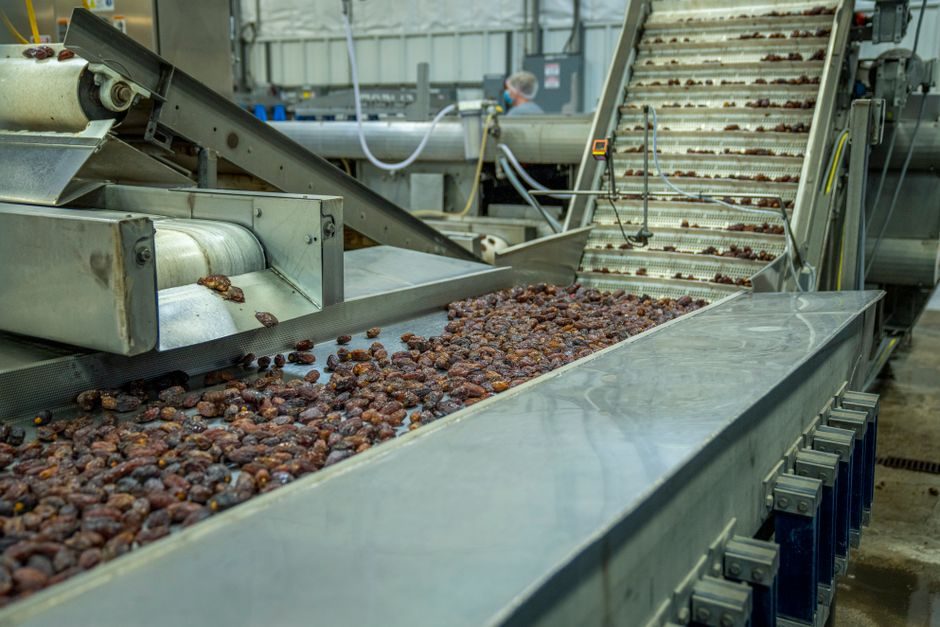
A structured TCO model on a belt conveyor line splits lifetime spend into CAPEX (structure, drive, belting, take-up), OPEX (energy, spares, labour), and unavailability cost (production loss during stops); the unavailability bucket routinely exceeds the purchase price on high-tonnage bulk lines when downtime is priced in.
The TCO concept itself — capturing purchase, use, maintenance, support and disposal over the life cycle — is documented in general supply-chain guidance [S3], and conveyor-focused wear-part vendors apply the same logic to bulk-handling plants, where minimising total ownership cost is the explicit sales argument [S2].
Five cost buckets that make up a conveyor TCO
A defensible TCO model groups spend into CAPEX (~15–25% of lifetime cost on a typical 1,000 m overland line), energy (~20–30% on motor-driven bulk lines), spares and wear parts (idlers, scrapers, liners, belt ~25–35%), maintenance labour (~10–15%), and downtime/unavailability (~10–20%, highly duty-dependent) [S3]. The exact split moves with tonnage, lift, ambient dust and abrasive ore hardness, so a single line carrying 5,000 t/h of iron ore will weight spares and energy far higher than a 200 t/h packaged goods line.
Idlers and rollers are the highest-frequency wear item by count — typically carrying 60–70% of the unit cost on a long overland conveyor — which is why component-level selection on a belt tensioner and idler spec drives more TCO than the choice of drive motor brand. Wear plate and belt cleaner choice, by contrast, is dominated by service interval, since a single missed scraper service can cut belt cover life by 30–50% on abrasive duty [S2].
CAPEX vs OPEX — where procurement gets fooled
Acquisition cost (structure, drive package, belting, head/tail pulleys) is the only line item that fits neatly into a purchase-order system; everything else leaks across departments, which is why TCO analysis "exposes the hidden costs easily overlooked during budget planning" [S3]. On capital lines the rule of thumb is that belting plus vulcanising typically consumes 25–40% of CAPEX on a 1,000–1,500 m overland conveyor, with the drive and motors another 15–25%.
Conveyor belt splices sit at the boundary: a mechanical fastener cut CAPEX by 30–50% versus a hot vulcanised splice but raises OPEX through shorter splice life and higher carcass damage risk on high-tension belts [S2]. The choice is not "cheaper vs dearer", it is "shift cost from CAPEX into OPEX and downtime" — exactly the trade-off TCO is built to expose.
Energy, drive and the motor's hidden 20-year bill

Energy cost scales with belt speed, lift and load, and is the single largest OPEX line on long, high-tonnage conveyors — typically 20–30% of TCO and rising on energy-inflated tariffs. Variable-frequency drives cut no-load draw by 20–40% on conveyors that run empty for part of the shift, which is why modern TCO models treat the drive train (gearbox, fluid coupling, VFD, motor) as a coupled package rather than a discrete purchase. [S1]
On regenerative downhill conveyors the same drive package can return 10–25% of the motor nameplate energy to the line, but only if the TCO model is allowed a 20-year horizon — payback inside a 12-month budget window looks negative and the option gets killed, which is the failure mode that TCO modelling is designed to prevent [S3].
Spares: idlers, scrapers, liners and the flat belt cover
The spares bucket is dominated by idler rolls, belt cleaners/scrapers, skirt rubber, impact bars and pulley lagging, in roughly that order of frequency. Hard-metal scraper blades routinely last 4–8× longer than polyurethane blades on abrasive iron-ore duty, but at 2–3× the unit cost — a textbook TCO decision where OPEX per tonne handled, not unit price, is the right metric [S2].
Belt cover wear on the flat belt top cover is driven by a combination of impact at the load zone, abrasion at the head pulley, and carry-back under scrapers; specifying 8 mm top cover instead of 6 mm adds ~5–8% to belt cost but can double cover life on heavy-impact applications. Skirting and load-zone support are the cheapest components on paper yet the most expensive when mis-specified, because a leaking skirt line contaminates the return idlers and accelerates every downstream wear part.
Downtime, unavailability and the cost of a stop
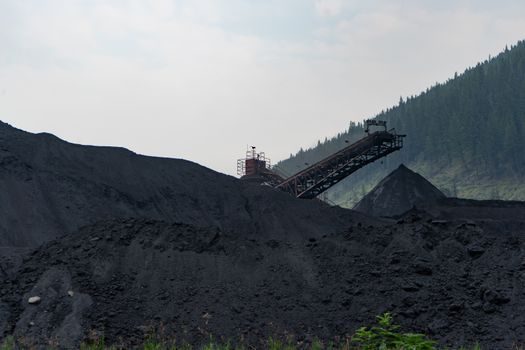
Unavailability cost is the line item most often missed, and on a continuous process it can dwarf every other bucket: a single 8-hour stop on a 5,000 t/h export coal conveyor can cost the operator more than the entire original purchase order. Converting that into $/t lost and $/h of stop gives procurement a common language with production, which is the only way to defend higher-spec spares on a belt cleaner or belt tensioner program [S2].
Who TCO modelling is for — and who it is not for
TCO modelling pays back wherever the line is duty-critical, the belt is long (>300 m), or the abrasive/impact load is high — mineral concentrates, hard-rock aggregate, iron ore, cement, MSW, biomass — because the absolute spend on spares, energy and downtime is large enough to absorb the modelling effort. For short, low-duty packaged-goods lines under 50 m running 1–2 shifts, a simple CAPEX-plus-one-year-spares comparison is usually sufficient, and a full 20-year TCO will over-engineer the decision [S3].
Buyers running a single one-off replacement on a commoditised short line should not waste time on a TCO exercise; operators holding 10–200 conveyors across a portfolio should mandate TCO on every purchase above a defined threshold (often $50,000), because the consolidated savings on idlers, scrapers and belt cover alone typically run into seven figures per year on a mid-sized mine or quarry [S2].
Side-by-side: three wear-part strategies on the same conveyor
On a 1,200 m, 1,500 t/h overland iron-ore conveyor, three cleaning/wear strategies can be compared on the same TCO frame: (a) commodity polyurethane scraper blades, (b) hard-metal tungsten-carbide blades with weekly check, (c) hard-metal blades plus a secondary belt-cleaner plumbed into the same service crew.
On the energy axis, the same conveyor can be compared with (a) a fixed-speed drive, (b) a VFD on the main motor only, (c) a VFD with regenerative braking on a downhill section. (a) is the reference baseline; (b) typically saves 15–25% of motor energy for a 10–20% CAPEX premium; (c) is only economic on net-downhill profiles but can pay back the incremental drive cost in under 24 months at 2026 industrial tariffs and shift 10–20% of TCO from energy into the residual CAPEX column [S3].
Limitations, failure modes and what TCO cannot fix
TCO modelling is sensitive to discount rate, energy-cost trajectory and assumed MTBF; running a 20-year model with a 3% real discount rate against another team using 8% will flip the same set of options.
TCO cannot compensate for mis-application: a hard-metal scraper fitted to a mechanical fastener joint, a VFD installed on a motor not rated for inverter duty, or a higher-grade belt cover on a conveyor with a mistracking problem will all return less than the model promised. The hierarchy is still design → installation → maintenance → TCO, and procurement should refuse to optimise the cost stack on a line that has not first been engineered to run at its design duty. Useful adjacent reads on the same spec-driven approach sit in our DTH drilling rig price guide and the shaft coupling selection map, which use the same CAPEX/OPEX/unavailability split.