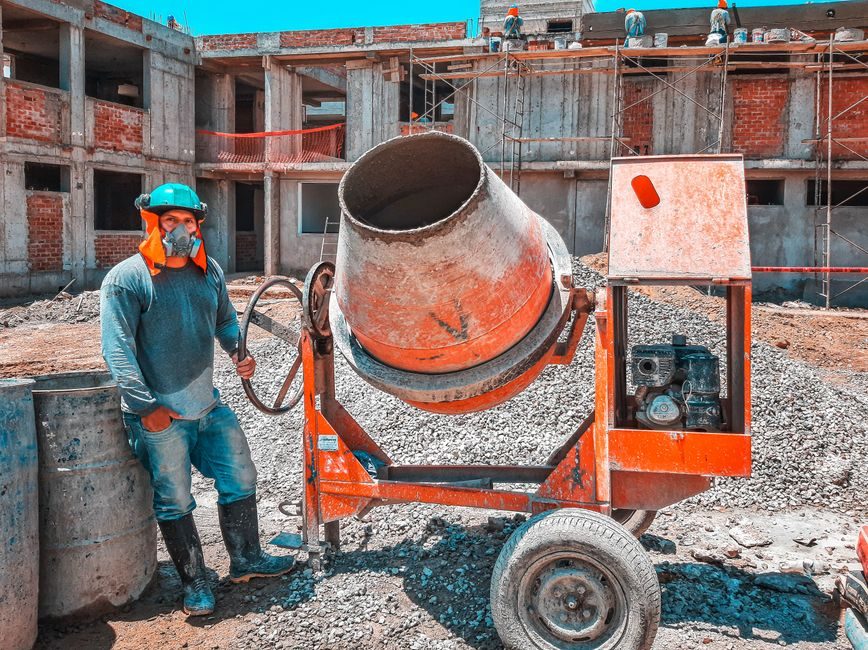
Special cements are modified Portland or calcium-aluminate binders engineered to deliver one dominant property — sulfate resistance, low heat of hydration, rapid strength gain, controlled expansion, or high-temperature stability — at the cost of another, typically set time, workability, unit price or long-term strength ceiling.
Specifying engineers select from five core families defined by ASTM C150/C595/C845, ACI 318 and API 10A: sulfate-resistant (Type V / HS), low-heat (Type IV / LH), high-alumina (CAC), expansive (Type K / Type S / Type M), and oil-well (API Class A–H). Each family is mapped against the duty the structure actually sees — soil sulfate concentration, pour mass, sulfate-rich groundwater, refractoriness, restrained expansion, or downhole temperature/pressure. For full taxonomy see the special cement types and classifications field map.
Sulfate-Resistant Cement (ASTM C150 Type V, HS / SRPC)
Sulfate-resistant Portland lowers tricalcium aluminate (C3A) content to 5% maximum by mass, the threshold at which ettringite-driven expansion in sulfate-bearing soils is held below the 0.04% expansion limit at 6 months specified in ASTM C1012 [S1]. It is also the wrong tool where chloride ingress, not sulfate, drives deterioration — for that, low w/c plus supplementary cementitious materials (slag, fly ash, silica fume) outperform HS cement alone. Reference data on these binder trade-offs is aggregated in the concrete admixture types and functional classifications spec page.
Low-Heat Cement (ASTM C150 Type IV, LH)
Low-heat Portland restricts C3S and C3A so the 7-day heat of hydration stays below 290 kJ/kg (70 kcal/kg), versus 330–375 kJ/kg for Type I, per the ASTM C150 optional heat-of-hydration limit. The advantage is unambiguous in mass pours — dam blocks, thick raft foundations, mat pours above 1.5 m thickness — where a 15–20 K temperature differential between core and surface cracks conventional concrete. ACI 207.2R recommends LH or mass-concrete mixes precisely to keep peak core temperature below 70°C and the thermal gradient below 20°C. The disadvantage is strength gain: Type IV develops 28-day strength roughly 50–65% of Type I, often requiring extended formwork stripping times of 14–21 days rather than 7, and the binder costs 20–35% above ordinary Portland because of the strict composition control. For routine structural members this family is uneconomic; for nuclear containment or dam-core pours the thermal control is the only specification that prevents through-cracks. Aggregate temperature control and pre-cooling of mixing water, covered in the concrete admixture installation spec map, work alongside LH cement to keep the heat budget inside the design envelope. [S1]
High-Alumina Cement (CAC, calcium aluminate)
Calcium-aluminate cement replaces the calcium-silicate hydrate matrix with calcium-aluminate hydrates, reaching 80% of ultimate compressive strength within 24 hours and refractoriness in service up to 1300–1400°C, which makes CAC the default for kiln linings, chimney repairs, flue ducts and emergency patches where heat or rapid return-to-service governs. The advantage is twofold: (1) early strength of 40–60 MPa at 6 hours enables formwork removal and traffic loading inside one shift, and (2) chemical resistance to weak acids and sulfate solutions exceeds that of Portland. This is why CAC is barred in structural concrete in many jurisdictions and limited to refractory, repair and rapid-hardening patch duty. Workability window is also tight — initial set within 2–4 hours — so batching and placement must be sized to a single shift, not a day's pour. [S2]
Expansive Cement (ASTM C845 Type K, S, M)
Expansive cements use calcium-sulfoaluminate (Type K), calcium-aluminate + sulfate (Type S), or tricalcium aluminate + sulfate (Type M) formulations to drive controlled ettringite formation that swells the matrix by 0.05–0.20% in restrained conditions, counteracting drying shrinkage in slabs, watertight joints, and post-tensioned anchorage zones. The advantage is crack control in large-area slab-on-grade pours where shrinkage stress otherwise produces map-cracking within 30 days. The disadvantage is sensitivity to mix water, curing temperature, and restraint — over-dosed expansive cement with rigid formwork can lift forms or spall edges, and under-restrained placements waste the expansion as free deformation with no compressive pre-stress. Mechanical anchor and pre-stress technologies, discussed in the hydraulic press selection guide, often substitute for expansive-cement design when loads are predictable. [S3]
Oil-Well Cement (API Spec 10A Class A–H)
Oil-well cements are API 10A Class A through H and G/H SR (sulfate-resistant) blends, milled finer and retarded for downhole conditions — high temperature (up to 160°C for Class G/H at depth), high pressure (above 100 MPa pore), and sulfate-rich brine. The advantage is engineered performance over the API thickening-time schedules (e.g. 90–120 min at BHCT for Class G) and predictable compressive-strength development (≥10.3 MPa at 8 h, 38°C, 21 MPa for Class G at 38°C per API 10A Schedule 5/6), which makes zonal isolation behind casing possible. The disadvantage is raw-material sensitivity: silica flour is added above 110°C BHCT to prevent strength retrogression, and any contamination by Type I/II during bin storage destroys the retardation chemistry, so storage and sequencing rules apply. Cost is 2–4× ordinary Portland, justified by the well integrity requirement, not by the per-tonne value. Admixture selection for cement-slurry rheology, summarized in the concrete admixture installation spec map, follows API 10A- and ISO 10426-1-defined test protocols rather than ASTM C494. [S4]
Comparison: Five Special-Cement Families on Four Decision Criteria
Specifying engineers should match cement family to four primary decision criteria — primary duty, dominant disadvantage, typical unit cost premium versus Type I Portland (%), and standard / code anchor: [S5]
• Sulfate-resistant (Type V) — duty: soil/seawater sulfate exposure; disadvantage: lower 28-day strength ceiling and 15–30% cost premium; anchor: ASTM C150 Type V, ACI 318 sulfate class; typical use: marine substructure, sewer pipe, foundation in sulfate-bearing fill.
• Low-heat (Type IV) — duty: mass-pour thermal control; disadvantage: 50–65% of Type I 28-day strength, 20–35% cost premium; anchor: ASTM C150 Type IV, ACI 207.2R; typical use: dam core, mat foundation, nuclear containment.
• High-alumina (CAC) — duty: refractory or rapid-strength repair; disadvantage: strength loss from "conversion," restricted to non-structural use; anchor: ISO 215:2024 (CAC refractory), EN 14647; typical use: kiln lining, flue duct, traffic restoration in 6 h.
• Expansive (Type K/S/M) — duty: shrinkage compensation in restrained pours; disadvantage: 30–60% cost premium, sensitivity to restraint and curing; anchor: ASTM C845; typical use: water-holding tanks, post-tension anchor zones, large slab-on-grade.
• Oil-well (API Class A–H) — duty: downhole zonal isolation; disadvantage: 2–4× cost premium, contamination-sensitive storage; anchor: API Spec 10A, ISO 10426-1; typical use: casing cement, geothermal wells, Class G/H SR for high-T or high-sulfate wells.
A plain-vanilla Type I/II Portland at typical ready-mix price remains the economic default for 80–90% of structural pours; special cements earn their premium only where the service condition would otherwise fail — sulfate attack, thermal crack, refractory exposure, restrained shrinkage, or downhole pressure/temperature cycle. For context on parallel specialty-material spec logic, the rubber tubing price and cost guide 2026 shows the same cost-premium-vs-duty pattern across elastomer families.
Failure Modes and Selection Pitfalls Engineers Catch at Pre-Pour Review

Three failure modes repeat on real projects and are avoidable at specification stage. First, mixing Type V (low C3A) and Type III (high C3S) cements in the same bin or silo produces a hybrid with neither property — always dedicate silos and purge between cement-family changes. Second, specifying LH cement in thin sections below 500 mm thickness over-pays for thermal control the structure does not need; the heat of hydration is dissipated by surface area, so LH cement only earns its premium above 1.0–1.5 m section thickness. Third, expansive cement under-dosed for a 200 mm slab delivers free deformation with no restrained pre-stress, so the spec must match the labelled expansion to actual restraint stiffness — expansion of 0.05% in a free slab is invisible; the same mix in a panel against hardened concrete generates measurable pre-compression. Each of these is documented in the special cement types and classifications field map under the "spec traps" table. [S6]
Hold lots that miss any of these test thresholds before the silo is filled, and the field failure modes above drop sharply. For projects mixing cement and battery-cell supply chains, the cell-level battery industry trends mid-2026 spec map shows parallel lot-level verification logic.
For component-level specifications, see pressure transmitter, and flow meter.