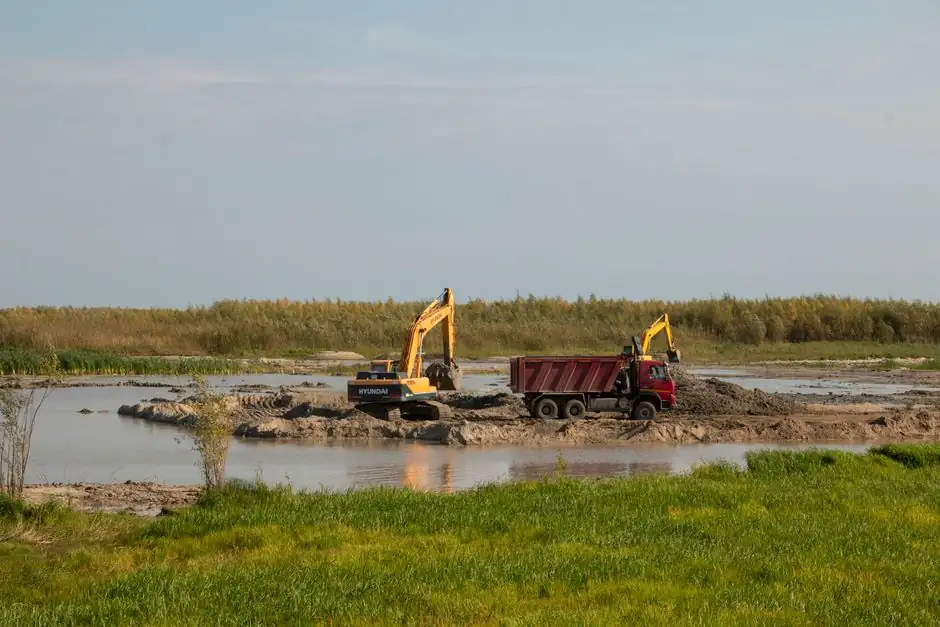
A 10-foot-long, 6-foot-wide, 4-foot-tall dump body holds about 8.9 cubic yards of struck volume, which at typical dirt density (roughly 1.4 short tons per cubic yard) works out to roughly 12.5 tons before the chassis runs out of legal weight [S4]. Box dimensions set the geometric ceiling; payload in tons is gated by something tighter, namely axle count, GVWR, and the DOT Federal Bridge Formula [S2][S5].
For road-legal rigs the envelope runs from 1 to 5 tons on a small pickup dump, 6 to 8 tons on a single-axle, 12 to 18 tons on a tandem (10-wheeler), 18 to 25 tons on a tri-axle, 20 to 25 tons on a quad-axle, and 25 to 40 tons on a semi end dump or belly dump [S5]. Off-road articulated haulers, not road-legal, move 28 to 60 tons per load inside mine and earthmoving pits [S3].
Body Volume to Tons: The Conversion Chain
Inside-bed length times width times height in feet, divided by 27, yields struck cubic yards, the standard volume unit North American dump bodies are rated in [S4]. One cubic yard is a 3 ft × 3 ft × 3 ft box. Internal features trim usable volume: a hoist well eats roughly 0.5 yd³, and a curved-radius body like the Ox Bodies Stampede loses another 0.5 yd³, details that rarely change basic sizing but matter when loads are billed to the cubic yard [S4]. For an encyclopedia view of body styles, see the dump truck reference page, which maps body geometry to chassis class.
Material density then converts volume to weight. Dry mulch runs 400 to 800 lb/yd³ (2 to 4 tons per 10 yd³), wet gravel clears 3,000 lb/yd³ (about 15 tons per 10 yd³), and asphalt millings sit between 2,800 and 3,200 lb/yd³ (14 to 16 tons per 10 yd³) [S2]. At 1 cubic yard weighing roughly 2 tons, hot-mix asphalt fills a 15 yd³ body to about 30 tons, which is exactly why paving fleets run tri-axles and semis instead of tandems [S2]. The mining dump truck entry covers how density-driven payload math scales up for ore and overburden.
Payload by Axle Configuration: A Side-by-Side Comparison
The decisive variable is axle count, not bed size, because each axle adds both payload and a Bridge Formula multiplier. A tandem (10-wheeler) with 3 axles carries about 12 yd³ or 14 tons; a 5-axle end-dump semi carries about 18 yd³ or 22 tons; a 5 to 7-axle belly dump carries about 22 yd³ or 24 tons; a 6 to 7-axle side dump carries 21 to 26 yd³ or 22 to 26 tons with fast side-tip discharge; a transfer dump pulls a powered truck plus a trailing box for a combined 26 to 40+ yd³ in two boxes; a super dump adds a liftable trailing axle to stretch spacing under load and reach 19 to 26 yd³ or 19 to 26 tons; a tri-axle or quad rigid runs 14 to 20 yd³ or 16 to 26 tons [S3].
Cruise across these six configurations and the same pattern shows up: empty chassis weight climbs from 28,000 lb on a small single-axle to 32,000 to 36,000 lb on a tri-axle, while legal payload climbs from 6 to 8 tons up to 25 tons, and a tri-axle legally hauls up to 25 tons once the Bridge Formula is satisfied [S2]. A six-axle heavy configuration in the Sany table is rated 30 to 40 tons, fitted to long-distance heavy-haul routes [S1]. For body-side geometry that drives the volume number, the Tandem-Axle Dump Body: Standard Length, Width, and Side Height reference covers the most common paving-truck size class.
Material Density Changes the Right Truck for the Job

A 14 ft steel body holding 15 yd³ of wet gravel weighs more than 22 tons, which pushes a 33,000 lb GVWR chassis past its legal limit on most states' Bridge Formula, a key reason paving and aggregate contractors move up to tri-axles rather than fill tandems to the brim [S2]. Topsoil, fill dirt, and wet clay behave similarly: weight fills the truck before the body does, and the operator has to leave cubic yards on the table to stay legal [S3].
Light materials flip the constraint. Dry mulch at 400 to 800 lb/yd³ fills a 14 to 18 yd³ quad-axle body long before the 20 to 25-ton payload limit is reached, so mulch and wood-chip hauliers size for volume, not weight, and often run the largest bed the chassis can straddle [S2][S5]. Demolition debris, scrap, and asphalt millings sit in the middle: dense enough that axle rating matters, light enough that body volume is the first spec to size. Spec the bed for the lightest commodity you will carry and the chassis for the heaviest; whichever constraint binds first is the one to spec against.
Dimensional Envelope: What Fits on the Road
Standard road dimensions run 7 to 11 m (23 to 36 ft) overall length, 2.3 to 2.55 m (7.5 to 8.5 ft) width, 3 to 3.8 m (10 to 12.5 ft) height with the bed down, and 3.2 to 4.5 m (10.5 to 14.8 ft) wheelbase [S5]. The bed itself typically measures 4.5 to 7.0 m long by 2.2 to 2.4 m wide by 1.0 to 1.6 m tall. When the dump box is raised, total height can extend 15 to 18 ft into the air, well past the 14 ft minimum that utility wires and bridge overhangs are designed to clear, so overhead checks are mandatory before tipping in tight urban yards [S5].
Overall length drives turning radius and site access: trucks under 8.5 m (about 28 ft) are safer on narrow residential or steep jobsites, while full-length 11 m (36 ft) semis need firm, level ground to lift a loaded trailer without tipping [S3][S5]. Width is tighter than most operators expect; even a 4-inch difference matters when threading a 10 to 11 ft gate, and a tandem, tri-axle, and semi all share roughly the same 2.3 to 2.55 m body width, so what separates them in the field is axle count and wheelbase, not the box itself [S5].
Selection Criteria: Matching Truck to Use Case

For short urban delivery of light materials (mulch, wood chips, yard waste) on tight residential streets, the right pick is a single-axle or small tandem with a 5 to 14 yd³ body, because maneuverability and a shorter wheelbase beat raw payload [S1][S5]. For paving and aggregate work where dense materials like asphalt millings, stone, or wet gravel dominate, a tri-axle or 10-wheeler tandem with 12 to 18 yd³ body is the workhorse, and DOT bid documents often require the tri-axle's 18 to 22-ton asphalt rating for compliance [S2].
For highway earthwork and long-distance site delivery, an end-dump semi (18 yd³, 22 tons) or belly dump (22 yd³, 24 tons) is the most efficient per-ton-mile, with the belly dump laying a windrow in a single rolling pass and the end dump dropping a full pile in one spot when the ground is level [S3]. For operations that need in-place dumping with extra tonnage, a super dump's liftable trailing axle stretches spacing under load to pull 19 to 26 tons through the Bridge Formula where a tandem cannot [S3]. Inside a mine or quarry, off-road articulated haulers in the 28 to 60 ton class are the only practical option, since they bypass public-road rules entirely and are sized to match a 30 to 60 ton hydraulic excavator's pass [S3].
Weight Compliance and Common Pitfalls
The DOT Bridge Formula, not cubic yards, sets the legal ceiling. The formula rewards widely spaced axles, so a tri-axle legally hauls up to 25 tons and a tandem is often capped near 66,000 lb depending on axle spacing, regardless of how much volume the body can swallow [S2]. Empty chassis weight matters too: a small dump at 28,000 lb empty and a 6 to 8-ton payload runs 40,000 to 44,000 lb gross, while a 32,000 to 36,000 lb empty tri-axle legally loaded to 25 tons runs 82,000 to 86,000 lb gross, all of which has to clear the Bridge Formula axle-by-axle [S2].
Three pitfalls repeat across the spec sources. First, oversizing the body to chase volume without re-checking axle rating produces overweight loads, DOT fines, and cracked frames, even when the bed is not heaped [S2][S4]. Second, ignoring internal volume losses (hoist well, body curvature, side wall thickness) leads to promised-vs-actual shortfalls of 1 yd³ or more, which matters on per-yard contracts [S4]. Third, raising the bed in tight urban overhead without checking the 14 ft wire clearance has caused tip-overs and contact events, a clearance risk that grows with taller tri-axle and semi bodies [S5]. Spec the bed for the lightest commodity and the chassis for the heaviest, then verify against the Bridge Formula state by state before the first load goes on. Watch for the next axle-spacing rule updates and any 2026 state-level GVWR amendments to the Federal Bridge Formula, which have shifted legal payload bands for super-dump and quad-axle configurations over the past year.
The underlying component specifications are covered under carton box.