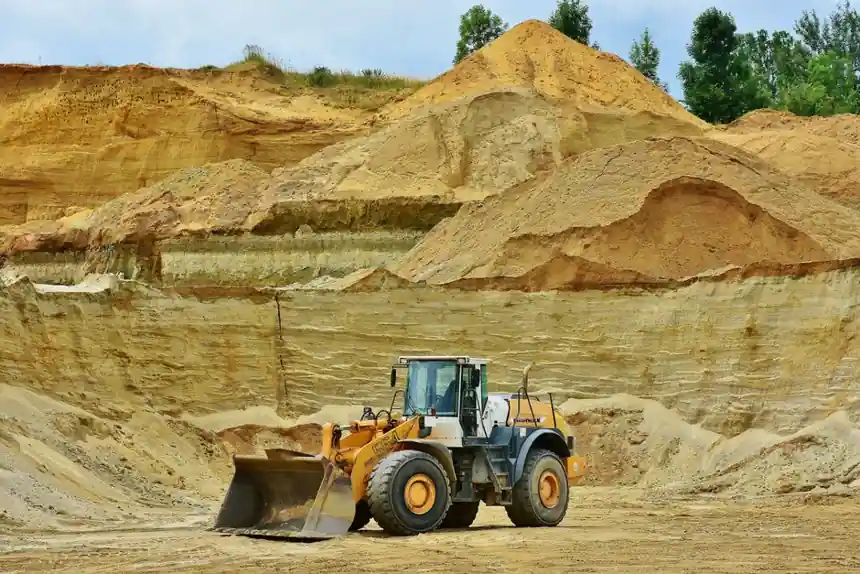
Track shoe width is the single most useful spec a buyer can change to control ground bearing pressure on a crawler excavator, and the published data proves it cleanly: on the Cat 330, swapping from 600 mm (24 in) triple grouser shoes to 800 mm (31 in) triple grouser shoes drops ground pressure from 57 kPa (8.3 psi) to 44 kPa (6.4 psi) on the same HD Reach boom + R3.2CB2 (10'6") stick + 1.80 m³ (2.35 yd³) HD bucket configuration [S3]. The machine picks up only 900 kg (1,100 lb) of operating weight, yet the contact patch grows by roughly a third, so each square centimetre carries less load.
The decision matters because ground pressure dictates whether a machine can work on finished asphalt, a landscaped yard, a soft subgrade, or rough quarry fill. For reference on the underlying undercarriage hardware and how the crawler crane track frame compares structurally, the geometric principle is identical, and the published construction machinery and equipment operating envelopes depend on it. The data below is drawn from five current Cat hydraulic-excavator spec sheets and a Cat 304 mini excavator product page, covering classes from 3 t to 50 t [S1][S2][S3][S4][S5][S8].
Track shoe width options across Cat 300-series class
The Cat 300-series product line offers four standard track shoe widths per model, and the catalogue is consistent enough to use as a reference table. The 323 lists 600 mm (24 in) standard, 700 mm (28 in) and 790 mm (31 in) optional [S4]. The 330 lists 600, 700, 800, and 900 mm (35 in) all as optional, because the line ships regional-specific [S3]. The 336 GC ships 850 mm (33 in) as standard and offers 800, 700, and 600 mm as options, the reverse of the lighter machines because the heavier operating weight needs more contact area by default [S5]. The 320 ships a single 790 mm (31 in) triple grouser shoe as the lone Long Undercarriage option [S1]. The 349, in the 50 t class, ships two options: 600 mm (24 in) and 750 mm (30 in) double grouser shoes, with operating weights from 47,700 kg (105,300 lb) on the lighter shoe [S2].
Track frame hardware also scales predictably with class. The 320 carries 49 shoes per side, 8 track rollers per side, and 2 carrier rollers per side on its long undercarriage [S1]. The 323 and 336 GC carry the same 49/8/2 count [S4][S5]. The 330 carries 50 shoes per side, 9 track rollers per side, and 2 carrier rollers per side [S3]. The 349, the largest of the set, carries 52 shoes per side, 9 track rollers per side, and 2 carrier rollers per side [S2]. All five machines are spec'd against ISO 10265:2008 (brakes), ISO 12117-2:2008 (ROPS), and ISO 6395/6396:2008 sound performance, with the 320, 330, and 336 GC also meeting ISO 10262:1998 FOGS [S1][S3][S4][S5].
How track shoe width changes ground pressure
Ground pressure on these machines is published in kPa and psi on every spec sheet, and the relationship is mechanical, not marketing. On the Cat 330, the published matrix shows 57 kPa (8.3 psi) at 600 mm, 49 kPa (7.2 psi) at 700 mm, and 44 kPa (6.4 psi) at 800 mm for the HD Reach + R3.2CB2 configuration with 1.80 m³ (2.35 yd³) HD bucket [S3]. The R2.65CB2 (8'8") stick on the same machine gives 57 kPa (8.2 psi), 49 kPa (7.1 psi), and 44 kPa (6.3 psi) at the same three shoe widths, a difference under 0.2 kPa because stick length barely changes mass distribution [S3]. The Mass boom + M2.5DB (2.5 m / 8'2") stick with the larger 2.12 m³ (2.77 yd³) HD bucket runs 58 kPa (8.4 psi) at 600 mm and 50 kPa (7.2 psi) at 700 mm, gaining roughly 1 kPa from the bigger bucket [S3].
The 336 GC table is the cleanest demonstration in the set. Reach + R3.9 m (12'10") DB stick + 1.88 m³ (2.46 yd³) HD bucket: 73.0 kPa (10.6 psi) on 600 mm shoes, 63.2 kPa (9.2 psi) on 700 mm, 56.3 kPa (8.2 psi) on 800 mm, and 56.6 kPa (8.2 psi) on 850 mm [S5]. The 850 mm standard shoe gives almost the same ground pressure as the 800 mm optional, because operating weight rises 200 kg faster than the contact area on the wider shoe. The R3.2 m (10'6") DB stick on the same machine gives 72.7 / 62.9 / 56.1 / 56.4 kPa at the same widths, a near-identical curve [S5].
Comparison table: 300-series ground pressure by shoe width
The published ground pressures at the most common shoe widths, base configuration, are: [S2]
- Cat 320 (22,700 kg / 50,100 lb) Reach boom + R2.9 (9'6") stick + 1.19 m³ (1.56 yd³) HD bucket: 35.9 kPa (5.2 psi) on 790 mm shoes [S1].
- Cat 323 (24,100 kg / 53,100 lb) HD Reach boom + R2.9 (9'6") stick + 1.30 m³ (1.70 yd³) HD bucket: published with 600 mm shoes; 700 mm and 790 mm optional [S4].
- Cat 330 (30,000-30,900 kg / 66,100-68,200 lb) HD Reach boom + R3.2CB2 (10'6") stick + 1.80 m³ (2.35 yd³) HD bucket: 57 kPa (8.3 psi) on 600 mm, 49 kPa (7.2 psi) on 700 mm, 44 kPa (6.4 psi) on 800 mm [S3].
- Cat 336 GC (35,300-36,500 kg / 77,800-80,500 lb) Reach boom + R3.9 m (12'10") DB stick + 1.88 m³ (2.46 yd³) HD bucket: 73.0 kPa (10.6 psi) on 600 mm, 63.2 kPa (9.2 psi) on 700 mm, 56.3 kPa (8.2 psi) on 800 mm, 56.6 kPa (8.2 psi) on 850 mm [S5].
- Cat 349 (47,700 kg / 105,300 lb) Reach boom + R3.35TB (11'0") stick + 1.90 m³ (2.48 yd³) HD bucket: shipped with 600 mm (24 in) double grouser shoes as standard, 750 mm (30 in) optional [S2].
Mini-class ground pressure for soft-ground comparison
Mini excavators sit in a different ground-pressure band entirely. The Cat 304 mini excavator with 1,700 mm (66.9 in) overall track width, 305 mm (12 in) ground clearance, and 66.7 in stick length publishes a ground pressure of 28.7 kPa (4.2 psi) at minimum weight [S8]. A buyer-focused explainer notes that small-machine ground pressure commonly sits in the 29-30 kPa range, with 4.3 psi (29.7 kPa) cited as a typical reading [S6]. The published ground pressure is the machine's weight divided by the total track-on-ground contact area, and the relationship is the same one a process engineer uses for foundation bearing checks, so the math translates directly [S6][S7].
Track shoe construction is also relevant. On the 320, each 790 mm (31 in) wide, 10 mm (0.39 in) thick triple grouser track shoe for the long undercarriage weighs 3,370 kg (7,400 lb) for the full set including the step extension for ISO 2867 [S1]. On the 336 GC, the 600 mm (24 in) wide, 11 mm (0.43 in) thick triple grouser set weighs 4,090 kg (9,020 lb), and the 700 mm (28 in) wide, 11 mm (0.43 in) thick set weighs 4,450 kg (9,800 lb), so wider shoes add roughly 360 kg per set on the 36 t class [S5]. That mass is already counted in the published operating weight and ground pressure tables.
Selection rules for the buyer or specifier
Three engineering rules hold across all five spec sheets. First, pick the widest shoe that still fits the transport envelope and the in-service width limit on the jobsite, because the 600→800 mm step on a 30 t class machine buys 13 kPa of pressure reduction for 200-900 kg of added steel [S3][S5]. Second, treat the published ground pressure as a calculated number, not a measured field value, because manufacturers compute it from the no-load track-on-ground length, the shoe width, and the operating weight with a 90% fuel tank and a 75 kg (165 lb) operator [S1][S3][S5]. Third, in soft-ground applications such as utility trenching on finished subgrade, a tracked machine under 30 kPa (4.4 psi) is typically the safe band, and the mini-class Cat 304 at 28.7 kPa (4.2 psi) lands at the upper end of that comfort zone [S6][S8].
Operating weight alone is not the controlling variable. The 349 weighs 47,700 kg (105,300 lb) on 600 mm (24 in) double grouser shoes, but Cat also offers a 750 mm (30 in) shoe on the same machine [S2]. A buyer working on a haul road, a hardstand, or a quarry bench can stay on 600 mm and reduce undercarriage wear cost; a buyer crossing finished pavement, working on a pipeline right-of-way, or staging on a slab should move up to 750 mm to cut contact stress. The published drawbar pull of 335 kN (75,311 lbf) and maximum travel speed of 4.8 km/h (3.0 mph) on the 349 are unchanged by shoe width, so the trade is purely between ground pressure, wear metal, and transport width [S2].
Track frame and ground-pressure engineering also govern crawler crane outrigger and track-pad design, so the same shoe-width-versus-bearing-pressure calculation applies whenever a lattice-boom crawler picks up a heavy load over soft ground. The selection logic on a crane is the same: pick the widest pad the transport envelope allows, and recheck the ground-pressure number against the soil bearing capacity at the pick point.
What the data does not solve
The published ground pressure is the static average, not the peak dynamic load when the machine slews, lifts over the side, or works on a slope. The 320 spec sheet notes the 4.2 mt (9,300 lb) counterweight, the 790 mm (31 in) triple grouser shoes, and the 22,700 kg (50,100 lb) operating weight, but does not publish a per-corner load number [S1]. Slope rating is published as 35°/70% maximum gradeability on the 320, 330, 336 GC, and 349, and 5.3-5.7 km/h maximum travel speed is consistent across the mid-size class [S1][S2][S3][S4][S5]. A buyer needing a true working-angle ground-pressure envelope should request it from the manufacturer, because the static number is a baseline, not a guarantee.
Track frame, shoe composition, and grouser height are the next decision layer once shoe width is set. Triple grouser shoes dominate the 300-series product line, while the 349 ships double grouser shoes as standard in the 47-50 t class, and the 320/323/330/336 GC sheets all show triple grouser on every shoe-width option they publish [S1][S2][S3][S4][S5]. Buyers should match shoe style to the wear environment, because a triple grouser shoe gives better traction on mixed terrain but a double grouser shoe resists bending fatigue better on pure rock.
For follow-up tracking: Cat's spec sheets on the 320, 323, 330, 336 GC, and 349 are the cleanest published source for shoe-width versus ground-pressure data, and any new option widths (a 950 mm shoe, for example, on the 330 or 336 GC) will show up first in the "Operating Weights and Ground Pressures" matrix on those PDFs. A buyer who needs a wider shoe than the current 900 mm (35 in) maximum on the 330 should ask the dealer for the next size, and check whether the undercarriage bogie geometry changes [S3]. The mini-class 304 product page is the reference point for the 28-30 kPa band that soft-ground work demands [S8].
Spec-level background on the components involved: excavator.