Specifying a dump truck is a site-fit problem first and a price problem second: chassis articulation, payload band, emission tier, and ROPS/FOPS cab certification have to clear before the first bolt is torqued, and the EMSUNTOUR ST42 — 42,000 kg payload, 450 kW (611.83 hp) Volvo diesel, CAN-bus control, ROPS/FOPS cab — is a concrete data point for the underground-mining envelope [S1].
A modern truck is delivered as a system, not a chassis: Lishun's flatbed series lists five model codes (N5, N8, N15, N20, N25) plus the K5 and K8 mining-truck pair, signalling that the install checklist is tied to a model line, not a generic dump truck silhouette [S2]. Selection scope therefore covers off-road flatbed, mining dump truck class, agricultural RHD, and on-road cabover sub-lines, each with different acceptance gates.
Payload, Power, and Emission Baseline
Underground articulated units cluster around a 15-54 t payload window, with the ST42 sitting mid-band at 42 t and a 450 kW powerpack — values that fix the haul-route gradient, ramp width, and ventilation air demand at the heading [S1]. Volvo engines are offered to Euro III standard with an optional Euro IV upgrade on the same chassis, and that single decision swings after-treatment sizing, mine-permit documentation, and fuel-sulfur handling on site [S1].
Lishun's off-road flatbeds (N5/N8/N15/N20/N25) and the K5/K8 mining dump truck line cover the 5-25 t surface band, while the EMSUNTOUR underground range (ST15, ST20, ST30, ST42, ST54) covers heavier 15-54 t headings [S1][S2]. That 5:1 payload span is the first filter: an N5 cannot be reinstalled into a heading sized for an ST54 without re-engineering the box, the trunnion, and the load-sensor calibration range.
Cab Safety, Structure, and Optional Safety Stacks
ROPS/FOPS-certified cabs are a hard requirement on any powered mobile equipment in a production heading, and the ST42 is delivered with that certification as part of the cab structure rather than as a retrofit [S1]. Optional Lincoln automatic centralized lubrication and the Ansul centralized fire extinguishing system are offered as factory-fit options, and both need commissioning lines run during installation — lube distribution blocks, nozzle counts per articulation joint, and Ansul cylinder pressure verification are acceptance items, not aftermarket add-ons [S1].
The cargo box uses high-strength wear-resistant steel with a reinforced design, and the chassis uses high-quality structural steel — pairing two different steel grades on one frame, which means the install torque table has to be referenced against the joint, not the truck [S1]. For heavier deployments, the dump truck body wear-liner package and the hoist cylinder stroke must be re-validated against the local ore density, not the OEM default.
Control, Telemetry, and the CAN-bus Hand-off
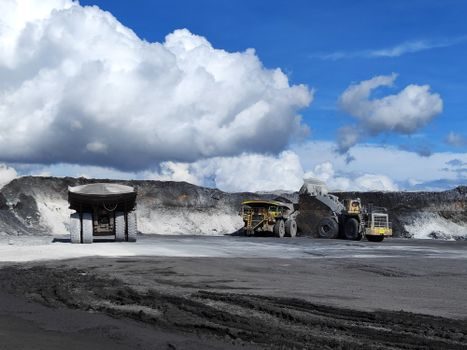
CAN-bus is the backbone on the ST42: real-time operating parameters, fault alerts, and self-diagnosis are surfaced through the on-board display, and the install sign-off must include a clean bus termination reading on both ends of the backbone and a verified node map against the OEM drawing [S1]. Five intelligent options ride on that bus — line-of-sight remote control, remote driving, intelligent collision early warning, blind-spot monitoring, and driver fatigue monitoring — each of which adds a node and a commissioning step that the supervisor has to witness, not just receive a vendor PDF for [S1].
Lishun's broader portfolio (cabover Q3/Q6/QJ7050 ranges, RHD farm models) operates on simpler electrical architectures, and retro-fitting a CAN-bus stack onto those platforms is rarely clean — the install guide therefore treats CAN-bus as native to the underground class and as an aftermarket risk on lighter lines [S2]. This is also why the mining dump truck install checklist carries more electronics sign-off lines than the surface flatbed checklist.
Installation Acceptance: Step List and Test Values
A defensible sign-off runs six gates: (1) pre-lift inspection of chassis welds, articulation pins, and tyre pressure against the OEM table; (2) lubrication system prime to specified line pressure, with Lincoln blocks bled at every nozzle; (3) Ansul cylinder pressure within the nameplate window and a discharge test on a non-production day; (4) CAN-bus scan with zero active DTCs and a verified node list; (5) ROPS/FOPS label photographed and filed; (6) a loaded brake test at 25% and 100% payload on the worst gradient on the haul route, with stopping distance logged against the OEM curve [S1]. Skip gate 6 on a heading with a 1-in-7 gradient and the truck will not pass a real mine audit.
Tools and instruments that the install crew commonly brings on site — torque wrenches calibrated to the joint table, a hydraulic pressure gauge for the hoist and brake circuits, and a bus analyser for CAN verification — overlap heavily with the toolkit used on a tapered roller bearing installation, which is why shared mobile-tooling budgets are common between truck bay and gearbox bay [S1].
Failure Modes, Limits, and When Not to Self-Install
Three failure patterns dominate field callbacks: (a) articulation-pin wear accelerated by under-greasing, usually traced to a Lincoln line blocked at install; (b) hoist-cylinder leakage from contaminated fluid during commissioning; (c) CAN-bus fault storms after a non-OEM node is added, typically a third-party fatigue camera or a payload sensor. Each of these is an install-stage error, not a wear-out issue, and each is traceable through the commissioning logbook if one is kept [S1].
Escalate, do not self-install, when: the heading is MSHA-classified and requires factory-trained commissioning; the cab ROPS/FOPS label is missing; the Volvo Euro IV option is being field-converted from a Euro III chassis (engine ECU and after-treatment do not share a calibration map); or the haul route is steeper than 1:5, in which case the brake curve must be re-validated against site gradient rather than the OEM flat-grade data [S1]. The TCO picture for the on-road cabover class is a separate calculation, and operators sizing it should treat the install as a one-time capex event against a 10-year lifecycle model rather than a sunk line item, similar to how a concrete pump truck TCO is built.
Track two signals over the next quarter: (1) the next EMSUNTOUR ST-series catalog revision, which historically lists ST15/ST20/ST30/ST42/ST54 on a single spec sheet and reveals whether the Euro IV default has shifted from optional to standard; (2) Lishun's N-series updates, which use the same five-code ladder (N5/N8/N15/N20/N25) and indicate whether the 4WD variants are absorbing the CAN-bus option or staying purely hydraulic [S1][S2]. Either change will move the install checklist for new deliveries.
Spec-level background on the components involved: linear guide.