
Single-row tapered roller bearings in the 7.9–1,270 mm bore range are installed cold with a mechanical or hydraulic press, then set against a second bearing to lock the spindle in opposite directions [S1]. Cold mounting is mandatory for small-bore units; for bores above ~100 mm, hot-oil heating to 80–120 °C remains the established shop practice to expand the inner ring before sliding it onto the shaft.
Heavy-duty mill and industrial variants from the same product family span 50.8–1,499.87 mm bore and 83.34–2,032 mm OD, with axial single-row carbon-steel executions up to 2,000 mm OD and 480 mm width for steel-plant and gearbox duty [S3][S4].
Pre-Install Inspection: Symptoms of a Defective Bearing
A bearing that fails within the first 100 operating hours almost always shows one of three pre-install conditions: brinelled raceways, contamination, or dimensional mismatch with the housing. New tapered roller bearings shipped in factory wrap must be inspected for flat spots on the rollers before mounting — any dent deeper than 0.01 mm on a raceway surface is a reject, because that point will become a fatigue initiator under the Hertzian contact stress of the first loading cycle. [S1]
Confirm bore and OD against the supplier datasheet: a TSF flanged-cup unit for automotive and gear-reducer duty is typically ordered between 7.9 mm and 1,270 mm bore and 31.9 mm to 1,435 mm OD, while a TSRB automotive series clamps a much narrower 22.23–117.48 mm bore and 57.15–? mm OD window [S1][S6]. Order the matching cup and cone as a set; mixing part numbers from different production lots is the leading root cause of premature spalling. Verify the bearing number stamped on the cone and cup against the works order before opening the foil pack.
Cleaning, Handout, and Tool Readiness
Bearing seats must be solvent-cleaned to a residue-free, lint-free condition, and the shaft fillet radius must be checked against the bearing's minimum chamfer dimension. A fillet larger than the bearing's abutment dimension forces the inner ring to sit high, which distorts the contact ellipse and concentrates load on the lip of the raceway. Solvent residue or shop rags with loose fibres raise the contamination floor and shorten grease life. [S1]
Handout preparation: press-fit sleeves, induction heaters calibrated to 80–120 °C, torque wrenches calibrated within ±4% of indicated value, feeler gauges covering 0.02–0.20 mm, and a dial indicator with 0.01 mm resolution.
Cold Mount Versus Hot Mount: Bore-Based Decision
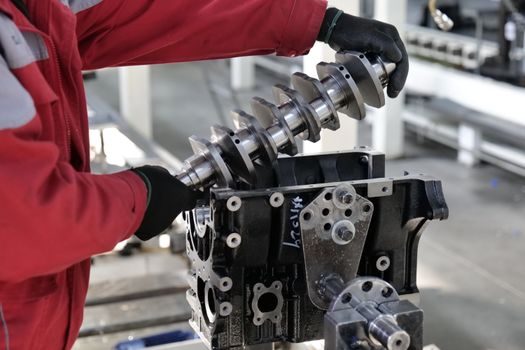
The cold-mount versus hot-mount decision is governed by interference fit magnitude, not technician preference. For bores up to ~80 mm, where the press-fit interference is typically below 0.03 mm per diameter, an arbor press and a mounting sleeve are adequate. For bores above ~100 mm — including the heavy mill bearings at 50.8–1,499.87 mm bore — induction heating to 80–120 °C expands the inner ring by enough to slide on without mechanical force. [S1]
Standard single-row thin-section variants in steel, used where space is constrained inside automatic transmissions, can also be press-fit cold, but the long-life thin-section series requires a controlled axial load to avoid brinelling the delicate raceway lip [S2]. A mechanical sleeve of the same diameter as the inner ring, with a flange to contact the cone backface, transmits press force through the ring and never through the rollers.
Setting the Endplay: The 0.05–0.13 mm Acceptance Window
After the cone is seated, the cup is drifted in and the assembly is locked against a second bearing to constrain the shaft axially. The acceptance criterion for endplay on a single-row arrangement is 0.05–0.13 mm of measured axial float at room temperature. Endplay below 0.05 mm forces the rollers to ride against the rib under thermal growth, which trips overheating within hours; endplay above 0.13 mm allows the rollers to skid during start-up under load, brinelling the contact band. [S1]
Use a dial indicator mounted to a rigid stand with the plunger on the shaft end. Push the shaft in one direction, then pull it the other; the indicator reading is the total axial float. On a flange-mounted cup, a flanged-cup TSF type simplifies this step because the flange face gives a fixed reference against the housing bore, allowing the through-bored housing to be machined once and the cup flange to control axial location directly [S1].
Lubrication and Run-In: From Grease Pack to Steady-State
Grease filling should occupy 30–50% of the free internal volume — over-greasing is a more common cause of early failure than under-greasing, because the churning action forces lubricant past the seal and into the housing cavity. For high-speed or corrosive-environment service, NSK's stainless moulded-oil bearings integrate a lubricant-impregnated polymer that releases oil continuously and removes the periodic re-lubrication step [S5].
Run-in at 10–25% of rated speed for 30–60 minutes lets the contact patches conform and the grease distribute, after which a full-load test for a further two hours verifies temperature rise stays under 10 °C above ambient at the outer ring. If the housing exceeds 80 °C on a standard grease-packed unit running at 75 °C ambient, the bearing is over-greased, under-lubricated, or running with negative endplay — all three are field-recoverable, but only the first two.
When Not to Repair: Replace or Escalate
A tapered roller bearing that has run to failure should not be re-installed, even after ultrasonic cleaning. Heat tint, micro-spalling on the rollers, and brinelled raceways are all subsurface damage markers that re-emerge within a few thousand hours under load. Escalate to engineering review when the failure repeats within 30 days on the same duty cycle, when the housing bore shows measurable ovality above 0.05 mm, or when lubricant analysis flags wear particles above 50 ppm iron. [S1]
For 168-set batches of excavator and transmission variants — including 22×56×17 mm R22-class units and 225 mm QJ-series transmission bearings — sourcing from suppliers that publish bore/OD tolerances and lot traceability reduces incoming-inspection rejection rates on heavy-equipment rebuilds [S7]. Tapered roller bearing rebuilds on rolling-mill gearboxes and automotive gear-reducer shafts see the most consistent service life when the matched cup-cone pair and a flanged-cup reference like the TSF design are kept together as a single replaceable assembly [S1][S4].
Field reference for adjacent categories: self-aligning bearing selection logic clarifies when a spherical roller is the better fit than a tapered pair, while the 10-year TCO stack on angular contact bearings provides a comparable cost model for high-precision shafts. For process equipment where the bearing is a sub-assembly of a larger machine, the concrete-mixer-truck five-gate field map shows how acceptance gates are layered for rotating components in mobile plants. The reference bearing spec in our tapered roller bearing encyclopedia entry cross-references the ABEC/ISO tolerance classes used to size the cold-mount press fit.
For component-level specifications, see crossed roller guide, and roller bearing.