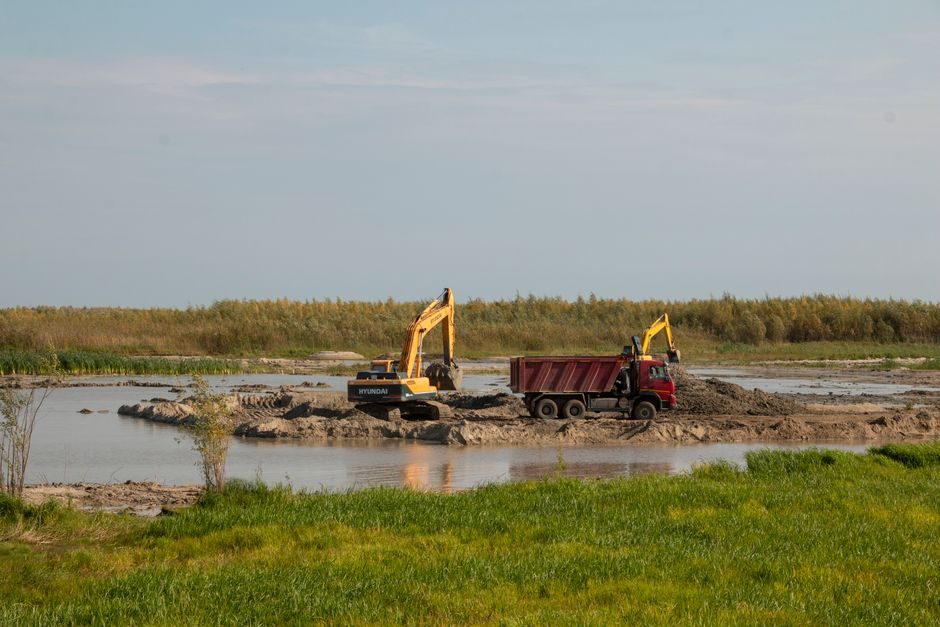
A dump truck — abbreviated DPTRK in dispatch and telematics systems [S1] — is a self-unloading vehicle that tips its body via hydraulic or mechanical lift to discharge bulk material without external handling [S2]. The defining advantage is single-cycle payload: one truck replaces several loader-and-conveyor steps and turns a haul loop in minutes rather than hours.
The same tipping mechanism that creates that productivity also defines its limits: grade stability during lift, ground-bearing pressure from each tire print, axle-load limits under road regulations, and structural fatigue at the pivot and frame [S2]. On-road, off-road, and mining subclasses exist because no one geometry satisfies all three duty profiles — a fact the dump truck types and classifications guide maps in detail.
Core Advantages: Payload, Cycle Time, Versatility
Payload density is the headline metric. Standard on-road rigid dump trucks in the 6×4 and 8×4 configurations typically operate in the 18–40 t GVW band per cycle, with articulated dump trucks (ADT) [S3] extending that envelope to 25–45 t payload over rougher haul roads. Mining-class electric-wheel rigid haulers — the SF32601, SGA 3550, and 108 t motorwheel examples documented in engineering literature [S2] — push single-load payload past 100 t, with 108 t and 154 t class frames analysed in finite-element studies of drive-axle housings and lift mechanisms [S2].
Cycle time is the second lever. The hydraulic lift-to-dump action normally completes inside 30–45 seconds, so a truck running a 10-minute loaded haul and 5-minute return can sustain 4–6 cycles per shift-hour. Body geometry variants — rear-tipping, side-tipping, bottom-dump, and rotary-skip designs [S2] — let the same chassis serve aggregates, grain, refuse, or concrete without retooling, which is why the concrete-mixer-truck and dump-truck body family shares so many structural components.
Versatility in loading method is the third advantage: a dump truck accepts wheel-loader, excavator, conveyor, or gravity-fed loading, and the body can be sheeted, lined, or heated for specific bulk products. An ECU-controlled un-lowered-body alarm system is one documented safety retrofit aimed at the lift-cycle failure mode [S2].
Core Disadvantages: Stability, Road Limits, Operating Cost
Tip-over during lift is the dominant safety failure mode. Roll-over analyses of dump-truck unloading, based on virtual-prototype simulation [S2], show that centre-of-gravity shift at full lift angle is the critical parameter, and uneven ground or off-camber haul roads reduce the safe lift envelope well below the chassis rating. A mining-class 42 t-class dumper's pivot-shaft rupture failure has been formally analysed, indicating that pivot fatigue is a documented wear mode, not a theoretical one [S2].
Road-legal axle load caps make on-road dump trucks payload-limited even when the body and chassis can carry more. Gross vehicle weight, per-axle limits, and bridge-formula rules under national transport codes typically cap productive on-road payload in the 18–30 t band, forcing longer-haul jobs to use bottom-dump or semi-trailer ejector configurations instead. This is the structural reason the encyclopedia dump-truck entry separates road, off-road, and mining duty cycles.
Operating cost is concentrated in tires, brakes, and structural maintenance. Off-road and mining dump-truck braking performance has been the subject of dedicated test and simulation work [S2], and steering heaviness in heavy dumpers is a documented reliability complaint with formal root-cause studies behind it [S2]. Fuel burn scales with GVW, so a 100 t mining hauler is not a viable substitute for ten on-road tippers on a 5 km loop — the cycle-cost crossover is well below that payload.
Selection Criteria: Haul Distance, Road Type, Payload Band

Haul distance is the first decision filter. Below roughly 5 km of one-way haul on prepared roads, on-road rigid 6×4 or 8×4 dump trucks dominate on cost-per-tonne. Between 5 km and 20 km on unpaved or soft-ground haul roads, articulated dump trucks (ADT) earn their premium because their oscillating hitch keeps all wheels on the ground over ruts, preserving tractive effort and reducing tire wear [S3]. Beyond 20 km, conveyor or rail usually beats truck haul on energy-per-tonne, regardless of truck class.
Road type and regulatory regime decide the chassis configuration. On public roads, single- and tandem-axle rigid dumpers with conventional steering and braking satisfy homologation. Off-road and mining sites tolerate wider, higher, and heavier machines — up to the 108 t-class electric-wheel dumpers documented in pump-damage and frame-finite-element studies [S2]. The mining dump-truck reference covers the higher end of this envelope.
Payload band and material density set the body volume. Aggregate, coal, ore, grain, and refuse each have different bulk densities, and matching body volume to density avoids both under-utilised payload and over-height instability. Side-tip and rotary-skip body geometries are documented solutions for low-density or sticky materials [S2].
Comparison: On-Road Rigid vs. Articulated vs. Mining Rigid
On a 10 km mixed loop with a 25 t target payload, the three classes line up as follows. On-road rigid (6×4/8×4): lowest acquisition cost, road-legal, payload capped by axle-load law, vulnerable to soft-ground rutting. Articulated (ADT): higher acquisition cost, off-road capable, oscillating hitch preserves traction, payload 25–45 t, slower top speed on road. Mining rigid (≥100 t class): highest acquisition and operating cost, restricted to dedicated haul roads, single-load payload past 100 t, requires matching loading shovels [S2][S3].
"Selection therefore is a triangle of haul distance, ground condition, and payload band, not a simple 'bigger is better' decision." The crossover between articulated and mining-rigid typically falls in the 45–60 t payload range; below that, ADTs win on flexibility; above that, mining rigids win on cost-per-tonne at high annual hours. The same logic informs the encyclopedia reach-truck entry on the materials-handling side — duty cycle, not peak spec, drives the buy.
Operational Constraints and Failure Modes
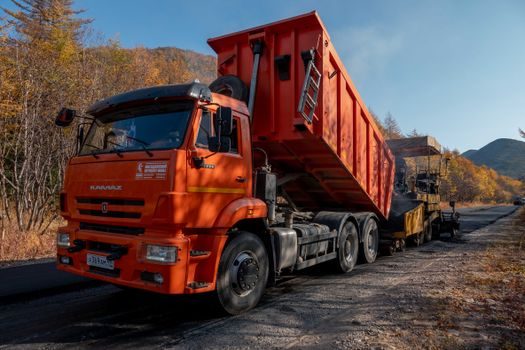
The lift mechanism is the leading maintenance cost centre. Finite-element and ADAMS-based virtual-prototype studies of heavy tipper lift mechanisms, LT3242 frames, and SF32601 mining-dumper performance [S2] all show that stress concentrations at the pivot, first-stage cylinder mount, and rear hinge govern service life. A formal pivot-shaft rupture analysis on a 42-class dumper confirms this is a documented in-service failure mode, not a hypothetical one [S2].
Brake and steering systems carry the second-highest failure load. Mining-dumper braking performance test and simulation, plus heavy-dumper steering-heaviness root-cause analyses, both appear in the engineering record [S2]. Together they imply that brake and steering maintenance intervals should be set against GVW-tonne-kilometres, not against simple service hours, on any aerial-work or dump-truck site vehicle that shares duty with loaded haul loops.
On-board weighing accuracy, where fitted, is the simplest guard against both overloading and under-utilisation. A truck-mounted self-measuring device for dump trucks has been formally developed and field-applied [S2], and on regulated sites the same load data feeds compliance reporting, payload-utilisation dashboards, and shift-cost analytics. Specifiers should confirm weighing tolerance, calibration interval, and CAN-bus or telematics output before purchase.
Where Dump Trucks Fit — and Where They Don't
Dump trucks fit jobs with discrete, high-tonnage bulk moves on a defined loop: quarry-to-crusher, mine-to-stockpile, port-to-yard, construction-cut-to-fill. They don't fit long-distance bulk haul, where rail or pipeline wins on energy per tonne, nor low-volume urban distribution, where a flatbed with a loader is more flexible. They also don't fit confined or steep sites, where a truck scale-based stationary weigh-and-tipping station plus smaller shuttles may be safer and cheaper. [S2]
Trackable signals to watch in the second half of 2026: the next revision of national GVW and bridge-formula rules in several jurisdictions, telematics integration of on-board weighing data into fleet fuel and tire-wear models, and continued ADT-class cab random-vibration studies aimed at operator fatigue limits on rough haul roads [S2]. Each of these will shift the cost-per-tonne crossover lines between rigid, articulated, and mining classes.