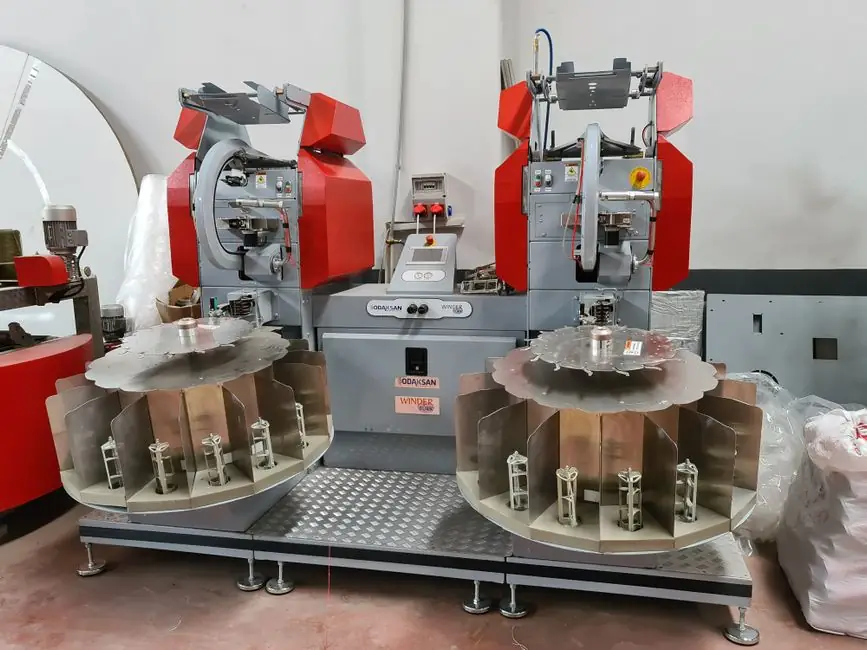
Dynamic balancing machines are sold in tiered weight classes that together span a 1 kg to 50 t rotor weight envelope, with rotational speed windows between 50 rpm and 100,000 rpm depending on the build [S1][S6]. The same vendor portfolio typically splits into sub-50 kg precision units, 150 kg to 6 t soft-bearing workhorses, and 20 t to 80 t heavy rotor rigs used for paper-mill rollers, turbine rotors, and crusher shafts [S2][S7].
The selection question is not which machine is "best" but which weight class, suspension type, and ISO 1940-1 grade actually match the rotor, its service speed, and the available floor loading at the balancing location [S3].
Weight classes and what each tier is built for
Hard-bearing and soft-bearing balancing machines are sold in three practical weight tiers that map to the 1 kg to 50 t envelope, and the tier dictates the drive system, bed stiffness, and foundation requirement [S2]. Sub-50 kg belt-drive units such as the SCHENCK Pasio 15 (15 kg), Pasio 50 (50 kg, 180 to 2,700 rpm), and Balance Systems BMK8 (3 kg) are designed for armatures, small motor rotors, and turbocharger wheels in high-volume production lines [S1]. High-precision vertical machines with 1 to 16 kg capacity and 50 to 100,000 rpm speed windows are used for small turbojet engine rotors and dental or micro-turbine components [S6].
Mid-range soft-bearing units from 150 kg to 6 t cover the bulk of industrial fans, pumps, electric motor armatures above 50 kg, and small turbine shafts, with optional overhung-rotor cradles for disc-style parts [S2]. The 30 to 3,000 kg pre-resonance universal balancer 9D718 is a typical mid-tier example built for workshop duty without a special concrete block [S4]. Heavy rotor rigs in 20 t, 30 t, 50 t, 70 t, and 80 t capacities are used for paper-mill rollers, large motor rotors, generator armatures, and marine turbine shafts, and they are commonly supplied with digital control cabinets and on-site installation crews rather than as portable units [S7].
Soft-bearing vs hard-bearing suspension: which fits the floor you have
Soft-bearing balancers let the supports move with rotor vibration, so the residual unbalance reading reflects the rotor response rather than a coupled bed-frame system, and the supports do not need mechanical calibration when you change rotor type [S2]. ERBESSD positions its soft-bearing line for 50 g to 50 t rotors with 2 mg to 200 mg residual unbalance, and advertises that a stable, level floor is enough, no rigid concrete foundation needed [S2]. The 800 kg balancer against a 20 t rotor is the vendor's flagship example of bringing the workshop to the rotor instead of shipping the rotor to a balancing hall [S2].
Hard-bearing and pre-resonance universal balancers such as the 9D718 couple the rotor to a stiff bed, which is more tolerant of nearby vibration sources and gives repeatable influence coefficients for production runs, but the foundation and bed mass scaling become the limiting factor as rotor weight climbs past a few tonnes [S4]. For high-volume armature lines below 5 kg, fully automatic two-plane units like the Balance Systems DMK6-AE remove material by milling rather than adding weights, which is why automotive motor plants run them in cells rather than on a stand-alone balancer [S1]. The encyclopedia entry on dynamic balancing machines covers the difference between static and dynamic unbalance measurement planes in more detail.
Selection criteria mapped to rotor mass and service speed
Rotor mass alone does not size a balancer; the combination of mass, service speed, and the target ISO 1940-1 balance quality grade (G0.4 to G4000 depending on rotor type) sets the permissible residual unbalance in gram-millimetres, which then drives the machine's measurement resolution [S3]. The Texas A&M rotor balancing reference frames the basic relationship as residual unbalance U_per = T, with the tolerance T in kg·mm derived from the rotor weight W in kg, the service speed n in rpm, and the chosen G-grade, while a separate calculation gives the centrifugal force F = m_u · r · ω², where ω = 2πn/60 [S3][S5].
A practical comparison across the three weight tiers, using only spec values confirmed in the research:
Sub-50 kg tier (SCHENCK Pasio 15, Pasio 50, Balance Systems BMK8, DMK6-AE): rotor capacity 3 to 50 kg, speed windows 180 to 2,700 rpm, two-plane dynamic measurement, automatic milling correction, designed for cells and line-side mounting [S1]. Mid-range tier (ERBESSD soft-bearing, VTM 9D718): rotor capacity 30 kg to 6 t, soft-bearing suspension or pre-resonance hard-bearing, trial-weight or influence-coefficient method, 2 mg to 200 mg residual unbalance on the soft-bearing line, workshop floor installation without a special foundation [S2][S4]. Heavy rotor tier (JP 20T to 80T, SCHENCK HL series up to 5,000 kg, ERBESSD to 50 t): rotor capacity 20 t to 80 t, low service speeds, digital control, on-site rigging, used for paper-mill rollers, generator rotors, and large motor armatures [S1][S2][S7].
Service speed also matters: high-precision units reach 100,000 rpm for turbojet rotors, while heavy roller balancers rarely run above 1,500 rpm because the rotor diameter, not just the mass, sets the bearing reaction force and the required drive power [S1][S6][S7].
Use cases, failure modes, and on-site balancing
Two-plane dynamic balancing in the rotor's own bearings is the dominant field method for crusher, mill, fan, and mixer rotors that cannot be removed easily, and the Vibromera case study reports that a 100 g unbalance on a crusher rotor at 1,500 rpm acts like 50 hammer strikes per second on the bearings, with bearing life dropping from 30,000 to 50,000 hours when balanced to under 5,000 to 10,000 hours when left unaddressed [S5]. The same source targets ISO 1940 G6.3 balance quality and under 4.5 mm/s RMS vibration per ISO 10816 for crusher rotors [S5].
Common failure modes tied to poor balancing are bearing overheating, labyrinth seal wear from rotor axial wander, coupling bolt loosening from 1× runout, and shaft cracks initiated at keyway stress raisers, and the Texas A&M summary specifically calls out half-key, full-key, and no-key conventions as a recurring source of assembly unbalance that pushes rotors above ISO 1940-1 limits [S3]. For shop testing the Brüel & Kjær reference notes that a rotor can be statically balanced end-for-end at rest yet still show large dynamic unbalance once spun, which is why single-plane static checks are not accepted for any rotor that will run above its first critical speed [S8].
Standards, tolerances, and what to ask the vendor
The governing documents are ISO 1940-1 for permissible residual unbalance and balance quality grades, ISO 11342 for flexible rotor balancing procedures, ISO 10876 and ISO 7919 as alternative derivation paths from vibration limits, and ISO 8821 for shaft and keyway conventions that the Texas A&M summary flags as a frequent root cause of out-of-tolerance assembly [S3]. For high-speed turbomachinery, SAE ARP 4048 is the cited industry standard for horizontal balancing machines for turbines and compressors, and SCHENCK's HL series is built to comply with it [S1].
Engineers specifying a new balancer should ask for: the rotor weight range with a 10% margin, the maximum service speed and the minimum trial weight, the achievable residual unbalance in g·mm at the heaviest rotor, the foundation requirement (concrete block vs level floor), the calibration certificate traceable to ISO 1940-1, and whether the machine accepts overhung rotor cradles or only between-bearing rotors [S2][S3][S4]. For plants running high-volume armature production, the next node worth tracking is the migration from milling-based two-plane correction to additive weight or laser-ablation heads, which several European OEMs have shown in cell layouts; the next signal to watch is wider adoption of soft-bearing portable balancers for on-site turbine and crusher work, which ERBESSD's 800 kg / 20 t example captures [S2][S5]. Related coverage of self-lubricating spherical plain bearings is useful for plants pairing balanced rotor retrofits with bearing upgrades, and the sand reclamation process line walks through how crusher rotor condition feeds downstream aggregate quality.
The underlying component specifications are covered under dynamic compactor, and coding machine.