
An electric axle (e-axle) integrates the motor, inverter, and reduction gearbox into a single housing, so its production line must verify electrical, mechanical, and acoustic performance in one test cell rather than as three separate subassemblies [S1][S2].
Quality standards converge on three measurable gates: NVH at full operational speed, efficiency and torque mapping across the working map, and high-voltage isolation resistance before the unit ships to the vehicle assembler [S1]. The same gate logic applies whether the e-axle targets a passenger car, light commercial vehicle, bus, or heavy truck; only the test envelope changes.
What the E-Axle Test Cell Has to Prove
End-of-Line (EoL) cells must run continuously on a conveyor or AGV-fed takt, with the EoL and Conformity of Production (COP) test loops designed to be modular so the same hardware handles manual loading through fully automated flow [S1].
Standard testbeds cover power ranges up to 440 kW per wheel for passenger cars, light-, mid-, and heavy-duty vehicles; configurations above 440 kW per wheel are built on request rather than taken off the shelf [S1]. Power density at this level means a 24/7 uptime requirement, so the test cell layout, dyno coupling, and cooling loop are sized for sustained load, not just peak rating.
Acoustic screening is treated as a release gate, not a sampling check, because NVH defects found after vehicle integration drive the costliest recalls in the EV drivetrain category [S1].
Core Structural Components Driving Tolerance Stacks
The e-axle has shifted from a passive structural member into a propulsion-critical subsystem, with axle housing, half-shafts, and wheel-end assemblies now directly governing torque delivery, NVH, safety, and load capacity [S2].
For truck and bus applications, the dominant architectures are centralized drive, distributed drive, electric portal axle, and coaxial e-axle, each with a different tolerance stack on the gear mesh, bearing preload, and sealing interface [S2]. Truck e-axles in particular are pushed by higher continuous torque and longer service life targets than passenger units, which is why the housing machining, gear grinding class, and bearing selection drive the bulk of the quality plan.
Designers also leverage the integration itself: combining motor, power electronics, and transmission in one unit reduces the part count, trims interfaces that would otherwise need torque audits, and removes cabling that previously needed separate Hi-Pot testing [S4]. Fewer interfaces mean fewer leak paths, fewer connector mismatch failures, and a shorter BOM to control under IATF-style traceability.
Selection Criteria for a Production Test System
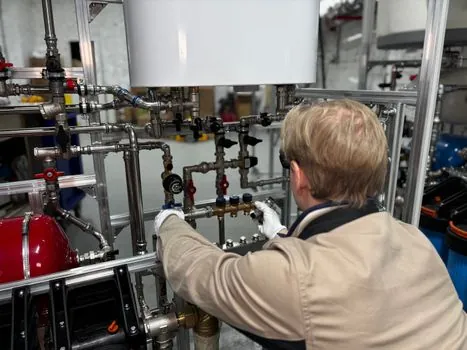
A spec-first e-axle test purchase should be filtered on four criteria: power envelope per wheel, footprint and building interface, handling interface (trolley, conveyor, robot, or AGV), and the level of automation from manual preparation through match-plate or fully automatic connection [S1].
Comparing the three main test-cell tiers used in 2025-2026 production: EoL cells focus on go/no-go gates for every unit, QA cells perform deeper diagnostics on sampled units to catch drifts before they become field failures, and COP cells replicate regulatory audit conditions for batch release. AVL's published portfolio names these three exactly: E-Axle TS End of Line, Quality Assurance, and Conformity of Production [S1].
Risk reduction in this spec is about hitting Start of Production (SOP) on time: late testbed delivery is one of the most common causes of slipped EV launches, which is why on-time delivery and VR-based planning sign-off are written into vendor commitments [S1].
Adaptive Assembly Lines and the Variety Problem
E-mobility batch sizes are low and vehicle variety is high, which breaks the economics of a Dedicated Manufacturing System (DMS) and forces a Flexible Manufacturing System (FMS) approach, but a pure FMS loses productivity because process steps stop running in parallel [S5].
The 2022 roadmap work by Abdul Hadi proposes a hybrid adaptive line that uses a Level of Practical Application matrix to decide which adaptive technologies (vision-guided torque, inline NVH, autonomous material flow) earn their complexity cost on an e-axle line [S5]. For a process engineer, the practical takeaway is that not every station should be made flexible, and a static gear-mesh station next to a vision-inspected wheel-end station is often the lower-risk configuration.
This matters for quality planning because an FMS that cannot hold its process capability index (Cpk) on a critical characteristic is worse than a DMS that holds it cleanly. On an e-axle line, the critical characteristics to protect with rigid stations are rotor balance, gear-mesh pattern, and bolt torque-angle on the housing split line.
Vendor and Integrator Landscape
American Axle & Manufacturing (AAM) markets highly integrated, high-speed e-drive units positioned for multiple segments including passenger and commercial, using deep integration as the differentiator versus standalone motor or gearbox suppliers [S3].
On the test-system side, AVL offers the AVL E-Axle TS family covering EoL, QA, and COP, with claimed 24/7 operation and VR/AR-based project planning for cell layout sign-off [S1]. Tier-1 system integrators like Bosch and Aisin are repeatedly cited as the volume leaders on the e-axle product itself rather than the test equipment [S4].
For a sourcing decision, the practical split is: specify the e-axle product (motor power, peak torque, gear ratio, weight, cooling interface) from the drivetiner, and specify the test cell (power range, layout, handling interface, automation level) from a test-systems house such as AVL or an equivalent automation integrator. Conflating those two purchases is the most common spec error on new EV programs.
Standards and Sourcing Discipline
High-voltage safety on the test cell follows IEC 61851 for conductive charging interfaces and IEC 60664 for insulation coordination, while functional safety on the integrated drive falls under ISO 26262 with the appropriate ASIL target on the inverter and torque-path functions [S1]. Production conformity for road-vehicle type approval in major markets is the driver behind the COP test tier, not an internal QA choice [S1].
For process engineers writing a factory-acceptance test (FAT) protocol, the minimum data set per unit is: insulation resistance (Mohm at the test voltage), no-load current map, back-EMF constant (Ke), efficiency map at defined torque/speed points, NVH pass/fail against an acoustic reference, and Hi-Pot pass on the HV bus. The same data set is also what feeds the COP audit trail.
For a related perspective on how material-handling and sub-tier components feed the same EV ramp, see the analysis on silicone rubber demand 2026-2030.
For the relevant spec sheets and selection criteria, see additive manufacturing material, air quality monitor, and power quality analyzer.