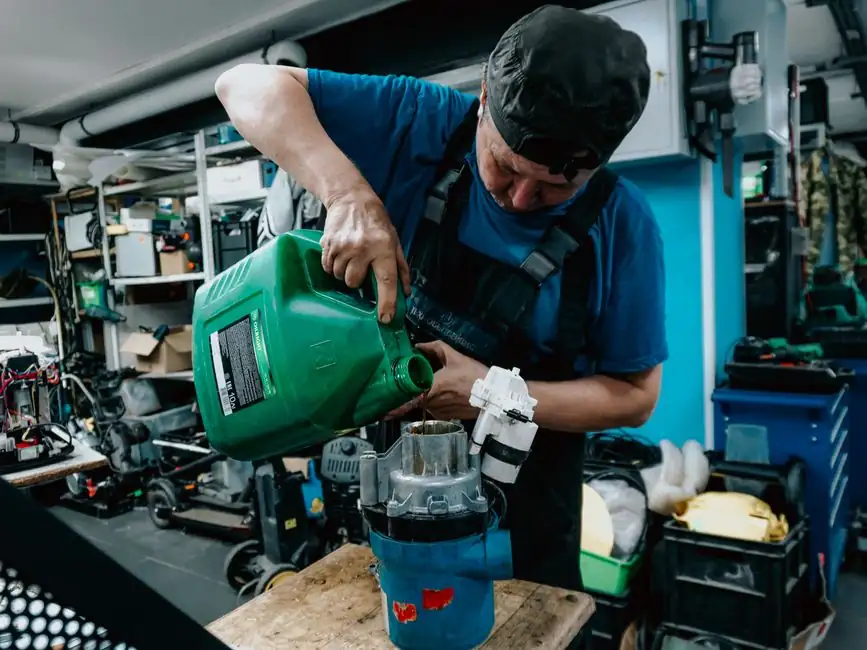
An immersion (poker) vibrator head is, mechanically, a steel tube containing a shaft, an eccentric mass, and two ball bearings; once the bearings lose preload or lubrication, head temperature rises, vibration amplitude drops, and abrasive wear escalates fast [S2][S3].
Wacker Neuson, Multiquip, Conmec, Beton Trowel, and Tomahawk operator manuals converge on the same diagnosis tree: low oil, oil-seal leakage, and dry running are the three named root causes of bearing failure in 25-65 mm diameter internal-vibrator heads [S3][S4][S5][S6].
How the head works, and why the bearing is the wear part
Inside a sealed poker head, the flex-shaft drives a short rotor whose offset eccentric mass produces the orbital vibration that consolidates concrete; ball bearings at each end of the rotor locate it and carry the dynamic load [S2]. A portable 45 mm (1.75 in) gasoline-driven unit such as the Beton Trowel BT-45H spins the head at engine-coupled speed through a flexible shaft, and the head itself is normally oil-bath-lubricated to dissipate heat from the bearings and eccentric [S2].
Because the housing is sealed for life, the operator can only see bearing condition indirectly: through head temperature, vibration feel, RPM at the casing, and any grease or oil weeping past the seal. A 38-65 mm Wacker Neuson IE-series internal vibrator is explicitly documented to "heat up if it is turned on and not immersed in the fresh concrete," and the same warning labels hot surfaces as a burn risk plus an indication of "excessive wear" to internal components [S6].
The three failure paths every operator manual lists
Conmec's CPV-Series operator manual lists bearing failure causes in plain order: "(1) Not enough oil in the head," followed by degraded seals and worn hex drives [S3]. The Tomahawk TVIBH manual adds the field check that if grease has penetrated the head, the oil seals must be replaced because leaked grease is evidence the rotating seal lip has already failed [S5]. The same document tells technicians to "examine the bearings, seals and hex driver" at every scheduled service interval [S5].
Multiquip's parts and operation documentation for the 900HD through 2600HD head range and the 314V/382V flex-shafts repeats the same instruction set, tying bearing service life to seal integrity, oil level, and avoidance of dry running [S4]. Across these four sources, the diagnostic shape is consistent: the bearings are not the only wear item, but they are the one whose failure takes the whole poker head out of service. For context on how the head's vibration amplitude and frequency relate to its diameter and consolidation performance, see poker vibrator vibration velocity ranges and head diameter selection.
Selection criteria when replacement is the right call
Replacement is justified, not rebuild, when one or more of the following is true: the head runs hot to the touch within seconds of immersion; RPM at the casing falls below the rated 9,000-10,000 RPM band seen on Conmec's CPV petrol backpack; oil level reads low on the dipstick and the seals are weeping; or the eccentric makes audible rumbling distinct from the normal orbital hum [S3]. The Conmec manual is explicit: "When notice wear parts, replace it" rather than continuing to run a head with suspect bearings [S3].
For OEM service parts, the right bearing is matched to the rotor journal diameter and the housing bore, not to the head's outer diameter; the 25-35 mm "pencil" heads, 38-45 mm mid-range, and 55-65 mm high-amplitude heads each use different bearing references, and the Multiquip and Wacker Neuson parts books should be cross-checked against the head serial plate [S4][S6]. Seals are always replaced with the bearings; pressing a new bearing into a housing with the old seal lip is the most common reason a rebuild fails within 50 hours [S5].
Who this is for, and where it does not apply
Ball-bearing-supported eccentric heads are universal in gasoline-driven backpack and portable electric immersible vibrators; they also dominate small ride-on and form-vibrator pokers. The guidance above does not apply to high-frequency external form vibrators, which use eccentric weights on the motor shaft with a different bearing arrangement, nor to hydraulic vibrators that mount the eccentric inside a hydraulic motor and rely on the motor's own bearing system rather than head-mounted ball bearing cartridges. [S3]
For crews running only external or formwork-type vibration, the failure-mode discussion in this article is informational only; the dominant wear part in those systems is the motor mount or the form clamp, not the head bearing [S2][S4].
Prevention: oil, seals, and avoiding dry running

Three preventive actions dominate the manuals. First, hold the head in the fresh concrete before pulling the throttle; running an immersion vibrator in air is the fastest path to overheating the bearings and is flagged as a burn and wear hazard by Wacker Neuson [S6]. Second, check oil level at the prescribed interval and refill with the manufacturer-specified viscosity; Conmec ties bearing life directly to oil quantity, and the implication in [S3] is that running low on oil is failure cause #1. Third, replace seals at the first sign of grease ingress or oil weep; Tomahawk's inspection step converts any grease contamination into a mandatory seal replacement [S5].
A second-best preventive practice is to spin the head briefly with the head up and the handle (or variable control) in the open position before the shift, to discharge any impurities or contaminants that have settled inside the casing, as documented for Minnich-style drill and vibrator tools [S1]. This 10-15 second purge step is not a substitute for scheduled service but is the cheapest way to catch a failing seal before it pulls abrasive slurry past the bearing [S1][S4].
Comparison: rebuild vs. replace the head
Field economics point to replacing the head assembly rather than rebuilding the bearing cartridge once the eccentric or the housing bore is scored. The cost of a new 38-45 mm head is comparable to two bearing sets, two seal sets, and the labour hours for a clean-room-style teardown, and the new head arrives with a fresh factory oil fill and a known seal history. Rebuild is the right call only when the operator has the OEM bearing and seal kit, a press, a clean bench, and a way to verify rotor endplay against the spec listed in the parts book [S3][S4].
A useful internal anchor for bearing selection is the ball bearing encyclopedia page, which describes load ratings, seal choices, and the difference between shielded (2Z) and sealed (2RS) variants commonly used in vibrator heads. For application context on the host machine category, see the concrete vibrator and broader construction machinery and equipment reference pages.
Limitations and what the manuals do not cover

None of the cited operator manuals publish a quantitative bearing-life figure in hours; the published service intervals are condition-based ("inspect seals and bearings," "check oil") rather than time-based. None specify a vibration-amplitude threshold at which the head should be pulled from service, so operators must rely on temperature, sound, and seal-condition cues [S3][S4][S5][S6].
Standards coverage is also thin: the manuals reference general operator safety but do not name ISO 1940 balance grades, ISO 15 bearing designations, or DIN 3760 radial-shaft-seal standards for the rebuild parts. Anyone specifying a replacement bearing for a critical pour should therefore cross-check the OEM part number against the bearing-maker catalogue rather than against a generic ISO code, and should follow the seal-and-bearing replacement as a paired operation rather than as independent items [S4][S5].
Track two signals going forward: the public release of revised Wacker Neuson IE-series service literature with explicit hour-based bearing intervals, and any ISO or EN update that names a balance grade for immersion-vibrator eccentrics. Either would let crews move from condition-based to time-based bearing replacement on 38-65 mm heads.