For slabs in the dual-46 inch class, the headline decision is mechanical-belt-and-gearbox drive versus hydrostatic twin-motor drive, and that choice drives purchase price, maintenance load, and finishing feel across roughly 8,500 to 12,000 ft²/hr of float-phase output [S3].
Ride-on trowels with hydrostatic drivelines such as the Whiteman HTXD6i and STX6H pair independent hydraulic motors to each rotor, eliminate the clutch and most belt service, and reach a 160 rpm top rotor speed on a 4 cylinder turbo diesel, according to OEM cut sheets [S4]. Mechanical lines from the same OEM family, including the MQ Whiteman mechanical line with CVT (Continuously Variable Transmission), TwinPitch control, and constant-velocity joints, sit in the lighter and lower-cost segment of the catalog [S1].
How the Two Drivelines Actually Differ at the Component Level
A mechanical ride-on routes engine torque through belts, a primary clutch, a jackshaft, and a bevel or worm-style gearbox per rotor, with steering actuated by mechanical levers tied through linkages to the spider assemblies [S3]. The arrangement keeps the parts count short, the empty mass low, and the upfront price down; in a contractor comparison, mechanical riders were described as "thousands of dollars" cheaper than equivalent hydraulic units, with simpler repair economics [S2].
A hydrostatic ride-on replaces that mechanical path with an engine-driven hydraulic hydraulic power unit feeding a dedicated variable-displacement motor on each rotor, plus a proportional hydraulic actuator network for steering, pitch, and retardant spray. According to OEM literature, this configuration "reduces service costs by eliminating maintenance items such as belts, clutches and gearboxes" on the rotor drive path [S4]. The trade is added fluid-side complexity: a tubular steel hydraulic reservoir, filtration, cooling, and hose runs that did not exist on the mechanical platform [S4].
Steering Feedback vs Operator Workload on the Slab
Mechanical steering ties the operator's hands directly to the spider via levers, so feedback through the controls reflects what the rotor meets in the concrete. Veteran finishers consistently cite this tactile channel as a productivity asset, because set-time, bleed, and aggregate behaviour can be read through the bars rather than only by sight [S2]. On a hydrostatic machine the same inputs run through a joystick commanding a proportional hydraulic valve, so hand effort drops but the direct mechanical read is filtered out [S2][S4].
The hydrostatic side answers that loss of feedback with features a mechanical rig cannot easily offer: SmartPitch that synchronises blade pitch on both rotors from a single button, electronic cruise control that locks in a chosen rotor speed, and Power Management that trims pump stroke to keep the engine at peak efficiency under load [S4]. Combined with the proportional hydraulic steering upgrade on current production units, the operator workload per shift is materially lower, which is the practical counterweight to the lost slab feel [S4].
Productivity, Flatness, and Rotor-Speed Envelope
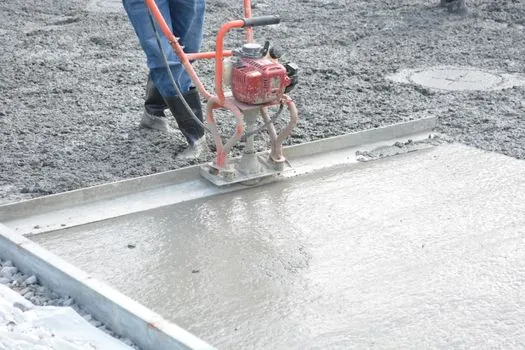
Published production-rate bands for open-floor pours put dual-46 inch mechanical or hydrostatic riders at 8,500 to 12,000 ft²/hr (790 to 1,115 m²/hr) during the float phase and 5,500 to 8,000 ft²/hr (510 to 740 m²/hr) during finishing, with a coverage rule of thumb near one dual-46 plus one 36 inch support machine per 20,000 to 30,000 ft² pour [S3]. Rotor-speed envelope is broadly 60 to 165 rpm across the ride-on class, with the hydrostatic HTXD6i specifically rated to 160 rpm and quoted at 20% more horsepower than the prior generation [S4][S3].
Spider geometry also differs by driveline. The six-blade spider on the Whiteman STX and HTXD6i hydrostatic range is rated to deliver 33% more blade contact than the prior four-blade pattern, improving contact patch for both pan and finish passes [S4]. On the mechanical side, MQ Whiteman literature highlights TwinPitch control as the differentiator for repeatable finish quality, paired with CVT input and constant-velocity joints to keep rotor speeds stable under load [S1].
Power, Emissions, and Engine Match-Up
Engine options on current MQ Whiteman hydrostatic machines span a 23 HP Vanguard V-Twin on the LD6SL, 70 HP Hatz Tier 4 Final turbo diesel on the HTX6H and STX6H, an 84 HP Ford Power Products gas/LPG unit on the STXDF, plus the 40 HP EFI Vanguard MD80, 57 HP Kubota dual-fuel MD82, and 25 HP twin Honda EFI MD105 [S1]. The MD-Series, launched as the next-generation mechanical and hydrostatic line, ships in overlapping rotor spans of 8 ft and 10 ft non-overlap, with twin six-blade rotors across the diesel and EFI variants [S1].
Entry-level mechanical units are commonly specced with 20 to 24 HP Honda electric-start engines in compact twin-rotor formats such as the VS836H, which targets smaller slabs and rental fleets where low empty weight and easy transport matter more than absolute flatness ceiling [S8]. Larger diesel hydrostatic rigs, in contrast, target indoor emissions with Tier 4 Final aftertreatment on the Hatz turbo diesel, accepting the heavier chassis to keep torque available across long shifts [S1][S4].
Maintenance Load, Wear Items, and Hydraulic-Leak Risk
The mechanical platform's maintenance story is simple but recurring: belts, clutches, CV joints, and gearbox oil are the periodic items, and they sit in accessible locations under hinged panels on current production machines [S1][S4]. The hydrostatic platform trades those consumables for hydraulic-side items: reservoir level, filter changes, hose and fitting inspection, and oil-temperature monitoring, with the OEM citing the tubular steel tank design as a flow and cooling improvement over prior generations [S4].
Contractor commentary puts the leak-risk asymmetry on the record: "the one potential issue with hydraulic riders is the potential of leaking hydraulic fluid. If this happens, it can ruin the whole slab you are working on" [S2]. Mechanical riders carry no comparable slab-contamination risk because the driveline is dry, which is a non-trivial point on architectural slabs where a hydraulic-oil stain is a tear-out and re-pour event [S2].
Decision Matrix: Mechanical vs Hydrostatic by Selection Criterion
Upfront cost: mechanical wins, with hydraulic units carrying a premium in the "thousands of dollars" range for comparable rotor class [S2]. Operator feedback and slab feel: mechanical wins through direct lever linkage [S2]. Long-shift ergonomics, cruise control, and load-managed power: hydrostatic wins via SmartPitch, Power Management, and proportional hydraulic steering [S4]. Service simplicity and leak risk on finished slabs: mechanical wins; hydrostatic reduces belt, clutch, and gearbox service but introduces fluid-side inspection [S2][S4]. Maximum rotor speed and finishing precision at the top end: hydrostatic wins, with the HTXD6i rated to 160 rpm and a six-blade spider delivering 33% more blade contact [S4].
Use the mechanical driveline for mixed small-to-medium pours, rental fleets, owner-operator finishers who prioritise tactile feedback, and any slab where a hydraulic leak would be unacceptable; use the hydrostatic driveline for large open pours above the 20,000 ft² class, high FF/FL targets, indoor work with Tier 4 Final emissions requirements, and long shifts where cruise control and Power Management reduce operator fatigue [S1][S2][S3][S4]. For broader concrete-placement planning around trowel passes, the same spec-by-spec logic that drives front versus rear discharge concrete mixer truck selection applies, since pour rate and truck cycle time set the trowel fleet size before the driveline choice is even made [S3].
Trackable Signals and Watch-Items Through 2026
Two near-term data points will tell whether the hydrostatic share keeps expanding into the mid-size class: the take-up of the MD80 and MD82 EFI and dual-fuel hydrostatic models with 40 to 57 HP ratings, and any Tier 4 Final filter or hydraulic-fluid interval extensions published for the Hatz-powered HTX6H and STX6H [S1]. On the mechanical side, watch the MD-Series mechanical variants and any next-generation CVT or TwinPitch revisions that would close the rotor-speed gap with hydrostatic units [S1].
For the spec-driven buyer comparing a power trowel purchase today, the disciplined next step is to map slab size, FF/FL target, shift length, and leak-risk tolerance onto the decision matrix above, then verify engine emission tier, rotor-speed rating, and spider-blade count on the OEM cut sheet before signing the order [S1][S3][S4].