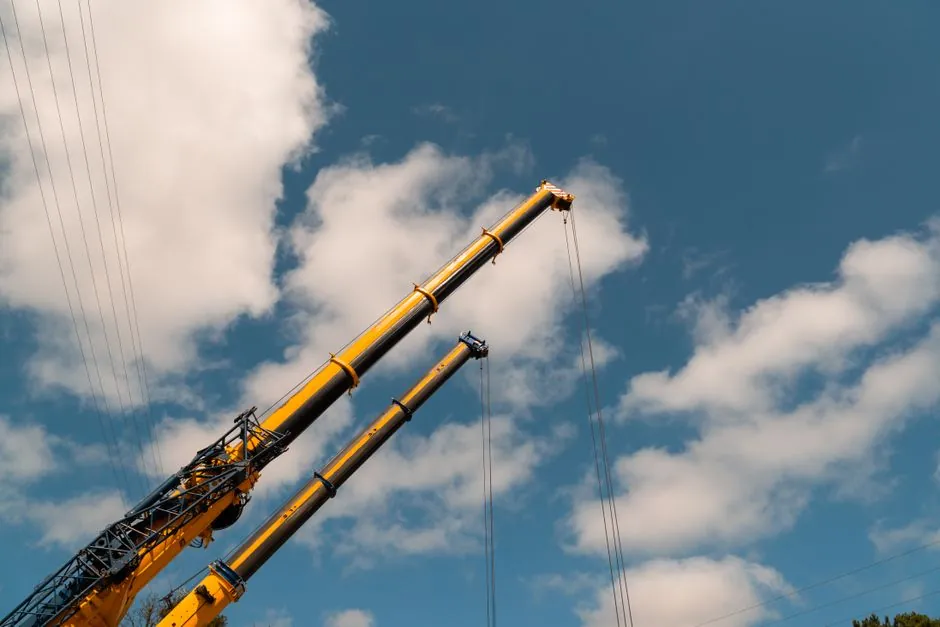
Self-climbing formwork is a crane-independent system lifted by hydraulic rams anchored to the previous pour, while crane-climbing (jumpform) systems are repositioned by an external tower crane at every cycle [S1][S3].
Both systems are wall-mounted, rail-guided assemblies designed for vertical concrete cores, piers, and shear walls, but they differ fundamentally in lifting energy source, cycle time, and tolerance to weather and crane logistics [S1][S2].
How Each System Lifts: Hydraulic Rams vs Crane Pick
A self-climbing formwork climbs by hydraulic cylinders that push the entire platform upward along brackets anchored in the cured concrete of the previous lift, with no external lifting equipment required [S1][S3].
In a crane-climbing (jumpform) arrangement, the formwork is stripped, hung from the tower crane, and flown to the next suspension point, so every cycle consumes crane time and a rigging crew on the hook [S1][S3]. For a typical 3-4 m pour cycle, the hydraulic lift is sequenced by centralized manifolds, while the crane pick is sequenced by crane availability and weather windows, which is the operational divide that drives the rest of the trade-off [S3].
Core Comparison: Cost, Speed, Wind, and Crane Dependency
Self-climbing systems are typically specified when the structure exceeds roughly 15-20 stories, where crane-climbing hook-time becomes a bottleneck, and when wind exposure at altitude would ground a crane [S3][S4].
On per-cycle labour and crane-cost, crane-climbing formwork carries lower capital outlay and lighter components, making it the default for mid-rise shear walls, cooling towers, and non-slab dams where crane time is plentiful [S1][S3]. Self-climbing systems carry higher upfront cost in hydraulic power units, climbing brackets, and anchorage hardware, but recover that cost by freeing the tower crane for rebar hoists, slab tables, and other trades [S1][S3]. Wind tolerance is a hard differentiator: self-climbs continue vertical progress in conditions that frequently ground tower cranes, which is why they dominate core-wall work above 100 m [S3]. Cycle time per lift on a self-climb is typically 1-2 hours of active jacking plus repositioning, whereas a crane-climb is bounded by crane queue position and rigging, often running 3-6 hours per cycle on a busy site [S3].
Selection Criteria: Height, Crane Hours, Geometry, Site Logistics
Building height is the primary selector: below roughly 8-12 stories, crane-climbing is usually more economical; above 15-20 stories, self-climbing's crane-hour savings dominate [S1][S3].
Geometry matters: self-climbing platforms integrate full-height safety screens and working decks as one rigid unit, which is valuable for closed elevator and stair cores with repetitive pours, and less valuable for open shear walls or one-sided dam faces where a single-sided climbing formwork braced against the previous pour is enough [S1]. Crane availability is decisive: sites with a single shared tower crane covering rebar, slab, and formwork moves often cannot allocate enough hook time for daily jumpform cycles, and that bottleneck is the single most common reason a project converts to self-climbing mid-contract [S1][S3]. Wind exposure above 100-150 m routinely forces crane stand-downs, while a self-climb anchored to the cured structure is largely unaffected, giving self-climbing a measurable schedule advantage in exposed locations [S3].
Engineering Constraints and Failure Modes
Both systems depend on the cured concrete reaching adequate compressive strength before the next lift, since the climbing brackets transfer wind load, dead load, and live load into the previous pour through preset anchors [S1][S3].
For self-climbing systems, hydraulic power-unit redundancy, hose-burst protection, and synchronized jacking are critical: an out-of-sync ram can rack the platform and damage the rail or the cured wall [S3]. The hydraulic actuators in these platforms are heavy-duty versions of the same principle used in hydraulic actuators across heavy industry, scaled for sustained vertical load rather than stroke speed. For crane-climbing systems, the dominant failure mode is rigging error during the pick, including soft-sling failures and wind-induced sway at altitude, which is why lift-height picks are usually restricted below the crane's free-standing chart plus slewing radius margin [S1]. Both systems share a common risk in anchorage pull-out if the prior lift's concrete is under-strength, which is why spec-level cycle planning ties the strip-and-lift sequence to cylinder-test results on representative cubes, not the calendar [S3].
Standards, Sourcing, and Spec Documentation
There is no single global standard that prescribes "self-climbing" vs "crane-climbing" selection; instead, designers rely on manufacturer load charts, site-specific wind analyses, and project-specific method statements tied to the climbing system's rated working load [S1][S3].
Spec documents typically include rated hydraulic pressure, allowable wind speed during jacking (often specified up to around 70-80 km/h for self-climbs in calm-rest conditions), platform live load, and anchor proof-load values derived from the system supplier's design guide [S1][S3]. Sourcing decision usually pits established OEM platforms, such as the PERI ACS-400 referenced in industry write-ups, against regional systems that follow the same rail-guided, hydraulic-jack architecture but vary in panel face material, screen height, and bracket spacing [S5][S6]. Lead times for self-climbing packages are typically 8-14 weeks for engineering plus 4-8 weeks for fabrication, longer than standard jumpform because of the hydraulic power units, climbing brackets, and integrated screen system [S1][S3].
Decision Matrix: When to Specify Each System
Use the matrix below as a quick selector: self-climbing wins on three or more of the listed criteria, crane-climbing wins when only one or two apply. [S1]
Building height above 15-20 stories: self-climb [S1][S3]. Crane hours constrained (single shared tower crane): self-climb [S1][S3]. Wind exposure above 100-150 m: self-climb [S3]. Closed core geometry with repetitive pours: self-climb [S3]. Mid-rise shear walls (8-12 stories) with crane capacity to spare: crane-climb [S1]. Open one-sided dam face or thick retaining wall with access from one side only: single-sided climbing formwork (a third category that does not require either a crane pick or a self-climb platform) [S1]. For projects where the schedule risk is steel tonnage rather than core cycle, a parallel read on Hot-Rolled vs Welded Built-Up Steel Section for Long Spans: Decision Matrix shows the same logic, namely capital cost vs cycle-time risk on tall frames.
Track these signals before locking the spec: the structure's final height and core count, the tower-crane count and free-standing capacity at final lift, the design wind speed at platform height, and the cycle-time target per pour; the system that wins on three of those four is the right one. A rebar splice detail in the core wall, if it drives crane time for rebar cages more than it drives formwork time, may push the decision back toward crane-climbing to keep one trade flow, and that interaction is covered in Couplers vs Lap Splices: Real Rebar Savings and Where They Show Up.
For component-level specifications, see self aligning bearing.