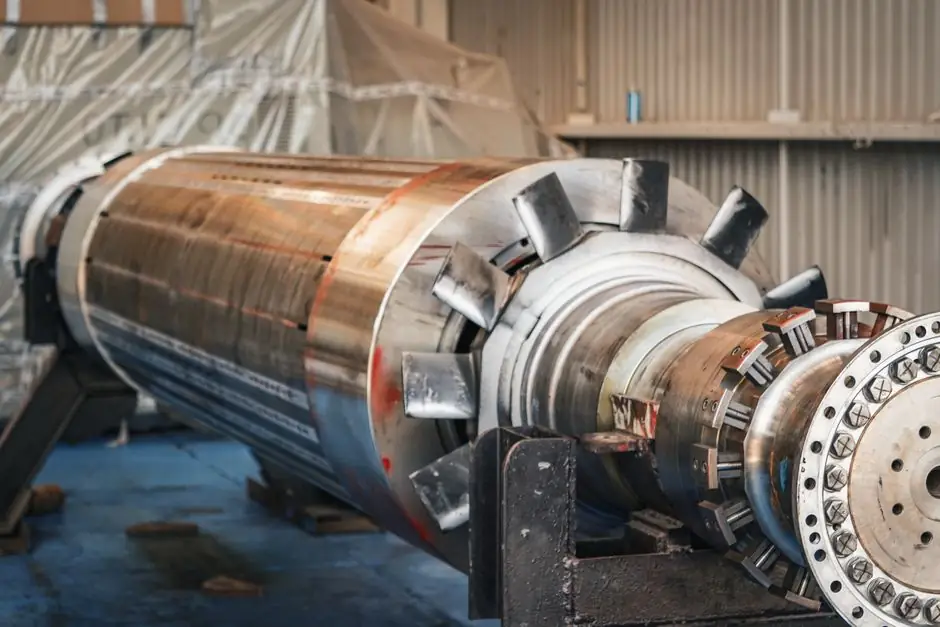
Four material streams carry ~99% of an electric motor's mass and cost: electrical steel for stator/rotor cores, copper for windings, aluminum for housings and squirrel cages, and permanent magnets (NdFeB or ferrite) for PM machines [S3][S5].
Steel typically constitutes around 50% of a motor's weight, with overall iron and steel content reaching approximately 90% once housings and end shields are included; copper makes up 7-18% depending on motor type, and aluminum fills the balance in frames, end caps, and induction rotors [S5]. Specifying the wrong grade in any of these four streams cascades directly into efficiency, temperature rise, and supply risk.
Electrical Steel Laminations: Grade, Thickness, and Coating Selection
Non-oriented electrical steel (NOES) in grades such as M19, M22, M36, and M47 is the default for rotating machines, while grain-oriented electrical steel (GOES) is reserved for transformer-grade stators and some high-efficiency designs [S3]. Lamination thickness has trended down to 0.20-0.35 mm to cut eddy-current losses, with 0.25 mm and 0.35 mm now standard for premium EV traction motors.
Core-loss numbers are the deciding metric: M19-29G at 0.35 mm typically lands around 2.10 W/kg at 1.5 T/50 Hz, while M22-29G runs near 2.40 W/kg, and 0.20 mm NOES can drop below 1.5 W/kg at the same induction [S3]. The lamination stack is bonded and insulated with coatings (C3, C4, C5, or C6 per ASTM A976) to control interlaminar resistance; high-speed blanking presses (e.g., Schuler Smartline EV 3.8) feed coil stock through fine-levelling and strip-thickness gauging before stamping [S3].
Copper Windings: Purity, Wire Class, and Insulation System
Recycled copper saves up to 85% of the energy needed for primary refined copper, which is why motor-grade wire is routinely sourced from recycled feedstock meeting C11000 or C10200 purity (≥99.9% Cu) [S5]. Round magnet wire dominates the fractional-horsepower segment, while rectangular / flat wire (hairpin) has become the EV-traction default for slot-fill above 60%.
Insulation class is the binding spec: Class A (105 °C), B (130 °C), F (155 °C), and H (180 °C) define the thermal envelope, with Class F the most common industrial default and Class H reserved for inverter-fed traction or hermetic motors. Common enamel chemistries include polyester-imide (PEI) for Class F and polyamide-imide (PAI) overcoat for Class H, with the dual-coat system resisting the voltage spikes of IGBT switching at dV/dt above 5 kV/µs. For an adjacent view on how copper, aluminum, CRGO, and amorphous feedstocks compare in adjacent rotating equipment, see the transformer raw material spec map.
Aluminum: Die-Cast Frames, Squirrel Cages, and End Shields
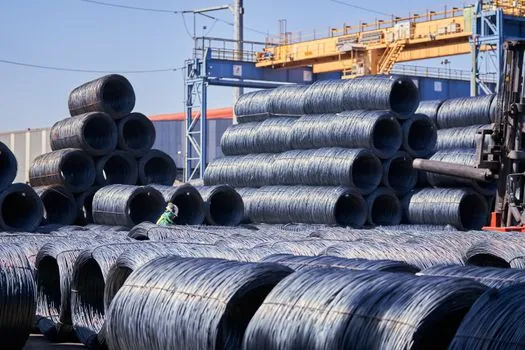
Aluminum appears in three roles: die-cast frames and end shields (A383, A384, or A390 per ASTM B85), pressure die-cast squirrel cages for induction rotors (A356 or A360), and extruded or sheet cases for small motors. The die-cast route consolidates housings, cooling fins, and mounting feet in one shot, replacing fabricated steel in many IEC-frame sizes from 63 to 160. [S5]
Weight savings versus cast iron run 40-55% on the housing alone, a meaningful lever for linear-guide systems and electric-pallet-truck drivetrains where unsprung mass is unwanted. Recycled aluminum cuts CO2 by roughly 58% versus primary aluminum, so most OEM datasheets already quote 50-75% recycled content in frame alloys [S5]. Specify the alloy temper (F, T5, T6, T7) explicitly; T6 is the common default for pressure-tightness on housings, while T7 is preferred where dimensional stability under thermal cycling matters.
Permanent Magnets: NdFeB vs Ferrite Trade-off
Permanent-magnet motors (PM) use either sintered NdFeB (typically N35-N52 grades, with N42SH and N48SH common for traction) or hard ferrite (Y30, Y35) where temperature stability and cost dominate. NdFeB delivers energy products of 250-400 kJ/m³, an order of magnitude above ferrite, but heavy-rare-earth additions (Dy, Tb) are needed to hold coercivity above 150 °C for traction duty. [S5]
Ferrite magnets run to ~120 °C continuous and cost roughly 5-10% of equivalent NdFeB, making them the default for appliances, HVAC, and small electric-actuator systems. Magnet supply risk is real: Dy/Tb pricing is volatile and concentrated in a few processors, so a growing number of traction designs specify ferrite-assisted synchronous reluctance or externally-excited synchronous topologies to remove the heavy-rare-earth dependency. For stator winding manufacturing trade-offs and magnet-bonding processes (e.g., Loctite EA 9536 tolerance-compensating bonding tape), see the motor materials deep-dive coverage.
Shaft, Bearings, and Secondary Materials
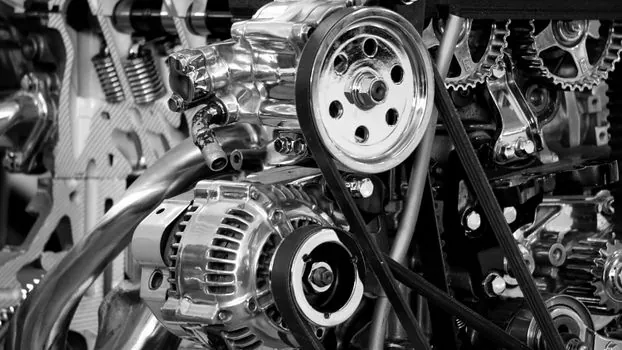
Motor shafts are typically medium-carbon steel (AISI 1045, 4140) or alloy steel (AISI 4340) for high-speed or high-torque builds, with surface hardness reaching 45-55 HRC after induction or through-hardening. Bearing selection follows speed and load: deep-groove 6200-6300 series for general industrial, hybrid ceramic (Si3N4 balls, steel races) for high-rpm and inverter-duty, and sealed-for-life 2RS variants where relubrication is impractical. [S5]
Stator and rotor laminations are bonded with backlack weld, interlocking cleats, or anaerobic adhesives, while the slot liners and wedges use Class F or H nomex/polyester film. Encapsulation and potting compounds (epoxy, silicone, or polyurethane) fill the air gap between windings and housing to pull heat into the case; thermal-conductivity ranges of 1.0-3.5 W/m·K are typical, with lighting-equipment-and-electric-lamps and traction applications pushing higher-load fillers. Inverter switching above 5 kV/µs demands a corona-resistant magnet-wire enamel system, typically a PAI overcoat; legacy PEI systems usually fail PDIV (partial-discharge inception voltage) testing in this regime.
Sourcing Workflow: Spec, Supplier Audit, Sample, and Order
A workable electric-motor sourcing flow runs: define mechanical envelope, duty cycle, efficiency class (IE3/IE4/IE5 per IEC 60034-30-1), insulation class, IP rating, and ambient; shortlist suppliers with ISO 9001 and (for hazardous-area builds) IECEx or ATEX scope [S2]. Request samples, demand mill certificates for steel (coil-to-coil chemistry), copper (resistivity, purity), and aluminum (alloy, temper), and run at least a 72-hour no-load heat test plus locked-rotor current check.
For factory audits, weigh manufacturing-process depth, in-house winding and balancing, and quality-control metrics (Cp/Cpk on critical dimensions) above headline unit price [S1]. Negotiate Incoterms (EXW vs FOB vs DDP), deposit / balance terms, warranty (12-24 months is standard), and after-sales service including spare windings and bearing kits; forklift failure-mode data shows bearing and winding faults are the top two failure drivers across industrial fleets, which is a useful way to anchor the warranty conversation. Hold the supplier to documented electrical steel grade (M19, M22), copper purity (C11000), and aluminum alloy (A383 / A356) on every datasheet, because substitutions on these specs are where efficiency silently erodes over a multi-year production run.