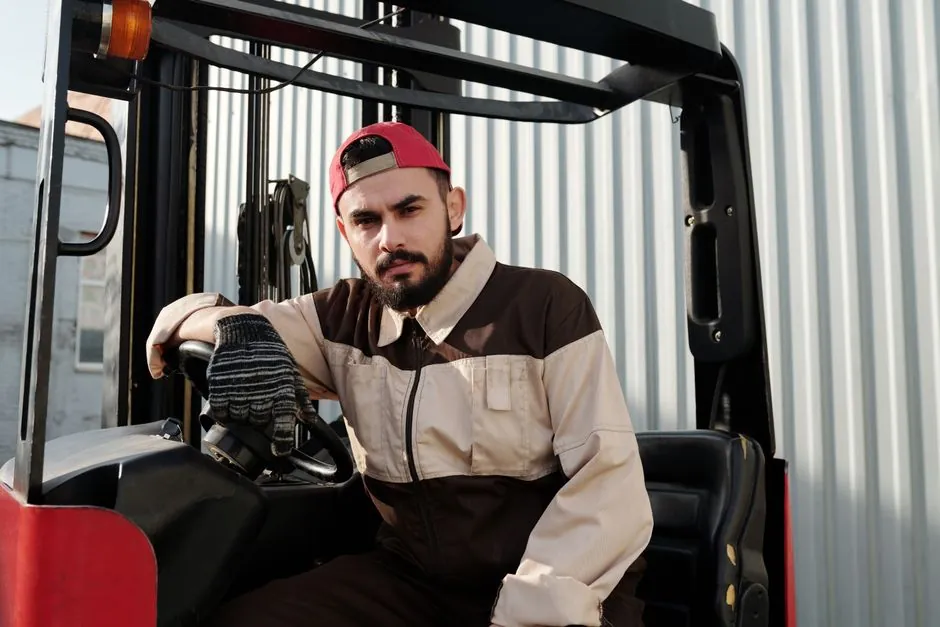
US workplace data records 67 forklift-related deaths in 2023 and 24,960 DART (days away, restricted, or transfer) cases during 2021–2022, with annual injury estimates between 35,000 and 62,000 across all sectors [S4].
Industry analysis attributes about 24% of forklift accidents to rollovers and roughly 70% of incidents overall to preventable causes, making the failure pattern as much a behavioural and maintenance problem as a mechanical one [S2][S3].
Front-end structural failure: the off-centre load problem
Front-end degradation is the dominant mechanical failure path for forklift masts, forks, and lift cylinders, and it is driven by off-centre loading rather than absolute weight alone [S1]. A 2023 PHM (prognostics and health management) study extracted acceleration features over 1 s windows, then used AWGN (additive white Gaussian noise) and LSTM (long short-term memory) autoencoder augmentation to train a random forest and a lightGBM classifier for load centre-of-gravity position, reaching 0.9563 and 0.9566 accuracy respectively [S1].
When the load centre is skewed to the right, asymmetric mast bending accelerates, and the same research group built a 20 s window logistic regression model that classified failure stages with a macro F1 (the harmonic mean of precision and recall, averaged across classes) of 0.9790, versus 0.9220 for random forest, and used a least-squares exponential fit on the resulting degradation curve to project a remaining useful life (RUL) point [S1]. Engineers specifying a forklift for repetitive side-loading duty should treat the OEM load centre chart, not just the rated capacity, as the binding constraint.
Rollovers, tip-overs, and the load centre of gravity
Rollovers and tip-overs together make up the single largest accident class, at roughly 24% of recorded forklift incidents, and they are mechanically a centre-of-gravity problem: a combined truck-plus-load mass shifted past the stability triangle by an overextended load, a sharp turn, a slope, or uneven substrate [S2].
Designs built for uneven ground, such as a rough terrain forklift, widen that stability base and lift the operator enclosure, but they do not eliminate the rule that the load centre must stay inside the wheelbase; OSHA penalties for serious violations are quoted at around $13,500 per citation, and aggregate damages from improper forklift handling have been estimated near $86M per year [S2]. Speed policy on corners and slopes, combined with the OEM's specific load-moment diagram, is the cheapest available control.
Struck-by and pedestrian collision failures

Pedestrian strikes account for nearly 20% of all forklift accidents and 36% of forklift fatalities, driven by blind spots around the mast and the rear chassis, mixed-traffic aisles, and breakdowns in operator-spotter communication [S2][S4].
Engineering countermeasures documented by an expert-witness practice include ultrasonic, radar, and LiDAR (light detection and ranging) proximity sensors, rear-view cameras, and mast geometry redesigned for sightlines, paired with segregated pedestrian walkways and standardised hand-signal protocols [S4]. A daily forklift pre-use inspection checklist forces the operator to confirm horn, lights, mirrors, and any fitted proximity alarm before a shift, which is the lowest-friction way to keep the sensing chain alive.
Mechanical failure of brakes, hydraulics, and steering
Mechanical failure is one of the five most-cited accident classes and almost always traces to four subsystems: service brakes, parking brake, hydraulic lift and tilt cylinders, and steering linkages, with mast chains and forks as recurring wear items [S2][S3][S4].
The expert-witness record over 30 years of US investigations converges on the same point: properly documented routine maintenance of those four subsystems prevents the majority of mechanical-failure incidents, while absent records turn every subsequent event into a liability claim [S4]. Field acceptance limits worth pinning into a PM (preventive maintenance) procedure include brake pedal travel within OEM spec, hydraulic droop less than a defined mm per minute with the load held, steering free-play inside the manufacturer's lash budget, and fork heel wear below the scissor-engagement cut-out [S3][S4].
Falling loads and mast-system failures
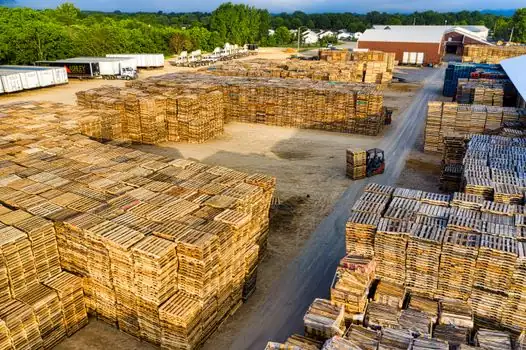
Falling-load incidents are triggered by overloading, off-centre loading, sudden braking, or a back-tilt that lets a pallet slide, and they are the failure mode most directly tied to load-centre prediction rather than to operator skill alone [S1][S5].
The PHM study derived its contextual diagnosis by applying an exponentially weighted moving average to the load-position classifier probabilities, then used SHAP (SHapley Additive exPlanations) feature attribution to identify the most predictive vibration features inside the normal operating band, and finally set a fault threshold from those features so an alarm fires before the load is lost [S1]. In practical terms, the cheapest equivalent for sites that do not run ML pipelines is a tilt sensor interlock that blocks lift travel above a set mast angle and a load moment indicator that warns the operator before the back-tilt envelope is exceeded.
Emissions, fuel, and indoor-air failures
Internal-combustion forklifts operating indoors add a carbon-monoxide and particulate hazard that overlays the mechanical failure picture, and 24/7 warehouse operations have amplified exposure risk by running engines in tighter shift patterns [S2][S3].
The fix path is well known: switch to electric forklifts where duty cycles allow, install fixed CO (carbon monoxide) and NO2 (nitrogen dioxide) detectors at breathing-zone height in charging and operating aisles, and pair them with a documented toxic gas detector sizing and selection guide so sensor range, response time, and cross-sensitivity match the actual fuel mix in use.
Comparison of leading failure-control measures
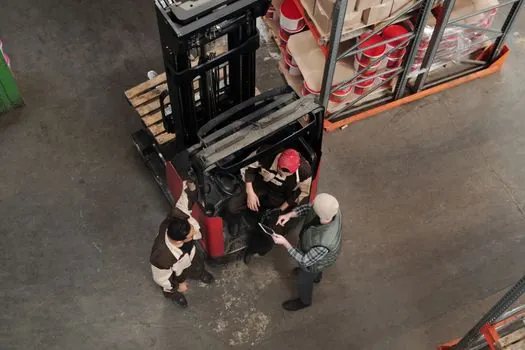
Four control families compete for budget on a typical site: documented operator training, preventive maintenance of the four safety-critical subsystems, engineering retrofits (proximity sensors, cameras, tilt interlocks), and workplace redesign (aisles, crossings, segregation). The table below lines them up against the failure modes they actually move. [S4]
Operator training and certification addresses rollovers, struck-by, and falling loads but does little for hydraulic fatigue; preventive maintenance is the only lever that reliably catches brake, steering, and hydraulic wear before it becomes an event; engineering retrofits cut pedestrian-strike and tip-over rates but require disciplined sensor calibration; workplace redesign changes the probability of every class but is capital-intensive and slow [S2][S3][S4]. A defensible programme stacks all four, with documented maintenance records as the legal floor, because the expert-witness record is consistent that missing logs convert otherwise preventable incidents into findings against the employer [S4].
Trackable signals worth watching through the rest of 2026: wider PHM-style load-centre classification pilots on lithium-ion electric fleets, and the gradual convergence of telematics data with OSHA 300 (injury and illness) logs so that near-miss sensor events can be correlated with maintenance intervals. As fleet electrification progresses, expect the emissions failure class to shrink while the struck-by class grows in relative share, which will push proximity-sensor and aisle-redesign spend higher than operator-training spend over the next planning cycle.
For component-level specifications, see construction machinery and equipment.