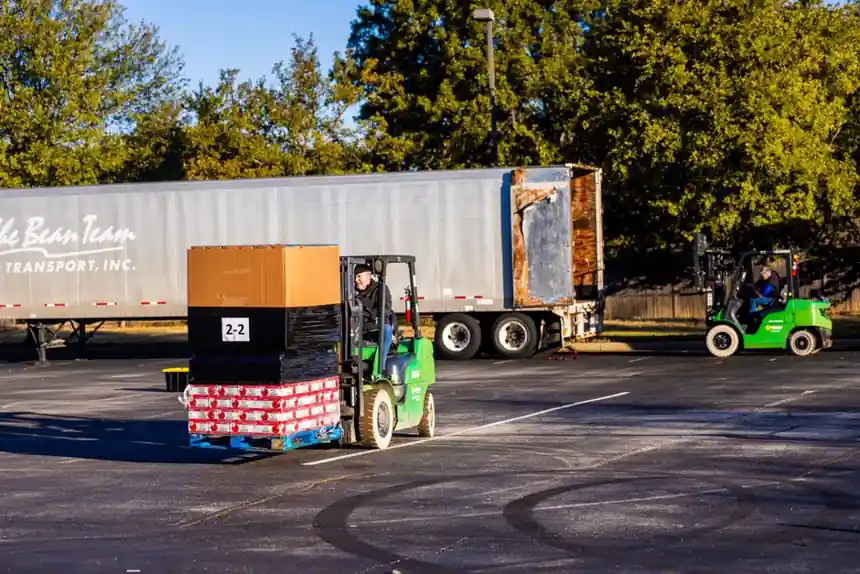
Walkie-type electric pallet trucks in the 1.5–2.0 ton (1,500–2,000 kg) capacity class are the volume sweet spot for e-commerce fulfillment in 2026, driven by a balance of versatility and cost performance that heavier 2.5–3.0 ton models cannot match at typical pick-module loads [S4].
Procurement decisions now hinge on five variables: load class, average travel distance per pick, aisle width, multi-shift duty cycle, and battery chemistry (lead-acid vs. lithium-ion). A lithium-ion pack with opportunity charging typically outperforms flooded lead-acid on shift utilization, but only when the duty cycle and charging bay layout justify the capex delta.
Defining the Equipment: Walkie Pallet Truck vs. Pallet Jack vs. End Rider
An electric pallet truck (EPT) is a battery-powered, walkie-operated material handling machine with a tiller head, designed to move palletized loads with minimal operator effort; many models also provide powered lift and lower functions [S1]. A manual pallet jack requires the operator to pump the handle to raise the load and physically push or pull the pallet, with no powered drive.
Inside the EPT family, three sub-types matter for fulfillment: (a) walkie pallet trucks, the most common SKU for first- and mid-mile pallet moves; (b) walkie straddle stackers for low-level pallet put-away; and (c) end-rider stand-on pallet trucks for high-throughput, longer travel runs between receiving and shipping. Walkie straddle stackers are a separate equipment class covered in the pallet stacker reference; the procurement logic overlaps with EPTs but the mast geometry changes the aisle requirement.
When an EPT Earns Its Premium Over a Manual Pallet Jack
Productivity data published in mid-2026 shows a manual pallet jack indexed at 100% baseline, with electric pallet trucks delivering 140–180% relative throughput on the same pick path; the gap widens as travel distance increases [S1]. Operator fatigue drops accordingly, because every manually moved load demands physical effort that an EPT removes.
For e-commerce operations the rule of thumb is straightforward: short travel, light load, low shift count (single-shift under ~4 hours of active use) keeps a manual jack economical; anything beyond that tilts the lifecycle math toward an EPT, even before factoring ergonomic injury cost. The U.S. pallet jack market as a whole shows strong demand for both manual and electric segments, with electric concentrated in high-throughput distribution and e-commerce environments [S2].
Capacity Class Selection: Why 1.5–2.0 Ton Dominates
Across 2026 model-year offerings, 1.5 ton and 2 ton electric pallet trucks remain the best-selling capacity classes for warehouse and fulfillment use, because they cover the load distribution of a standard GMA pallet (≈1,000–1,500 kg loaded) without forcing buyers into a heavier chassis and longer wheelbase [S4].
Stepping up to a 2.5 or 3.0 ton EPT increases truck mass, turning radius, and battery size, and only pays back when the operation regularly handles dense product (beverage, bagged grain, steel drums). For SKU profiles dominated by poly-bagged apparel, boxed consumer goods, and parcel-ready cartons, the 1.5–2.0 t class hits the spec envelope at the lowest total cost of ownership.
Selection Criteria: Load, Travel, Aisle, Battery, Duty Cycle
Five decision criteria separate a workable EPT purchase from a chronic bottleneck. Capacity must clear peak loaded pallet mass with margin; travel distance and average pick-path length set the productivity delta against manual equipment; aisle width constrains chassis footprint; battery chemistry governs shift strategy; and duty cycle (hours per shift, shifts per day) sets the maintenance interval and battery sizing. [S1]
Comparative scoring across these criteria is the most reliable way to shortlist two or three SKUs. Load rating is a hard gate; travel distance favours electric over manual by an increasing margin; aisle width dictates whether a standard 800–850 mm chassis fits or a narrow-aisle derivative is required; lithium-ion enables opportunity charging and eliminates battery swap, but only when opportunity-charge bays can be sited near rest points; lead-acid flooded remains cheaper upfront and is acceptable on single-shift duty with a dedicated change-out area.
Where EPTs Fit vs. Where Reach Trucks and Order Pickers Win

Electric pallet trucks own the ground-level horizontal pallet move: dock to staging, staging to pick module, pick module to outbound staging. Reach trucks are narrow-aisle lift trucks designed to move pallets into and out of pallet rack systems or shelving, with a reach mechanism that extends the forks forward and retracts them to keep the load over the wheelbase [S3]. Reach trucks also see heavy use in distribution centers, e-commerce fulfillment facilities, and manufacturing warehouses for high-density storage applications [S5].
Order pickers serve a different job: they lift the operator so workers can pick cases or eaches directly from rack bays at height, which is the inverse of pallet put-away [S3]. A typical e-commerce site runs a layered fleet, with EPTs doing horizontal pallet flow, reach trucks handling pallet put-away in narrow-aisle rack, and order pickers handling piece-pick in the pick module. The pallet rack geometry of the storage system ultimately sets which lift-truck class can be deployed.
Total Cost of Ownership Anchors
Capex for a 1.5–2.0 ton walkie EPT in 2026 commonly lands in a 1.5–3.0 kW drive-motor class with a 24 V or 48 V battery; lithium-ion upgrades the battery budget by 2–3x over equivalent lead-acid but eliminates dedicated charging rooms. Maintenance is moderate vs. low for manual jacks: drive motor, controller, hydraulic lift cylinder, and battery service dominate the scheduled service line items [S1].
The economic case for electrification is strongest where labor cost per pick is high and shift counts are at least two. For a U.S. e-commerce DC running two shifts with average pick-path travel above ~40 m, the productivity delta plus reduced injury frequency typically pays back the capex premium inside 18–30 months; below those thresholds, the manual jack remains defensible.
Common Failure Modes and Selection Pitfalls

The three most common spec errors in 2026 EPT procurement are: (1) undersizing battery capacity for the actual amp-hour draw of the duty cycle, which forces mid-shift swaps and burns the productivity gain; (2) choosing a chassis too wide for the actual aisle, forcing operators to lift and re-position pallets, which defeats the EPT's purpose; and (3) specifying lead-acid flooded when the facility has no ventilated charging room, creating a hydrogen and acid-mist hazard that fails the safety review. [S5]
A fourth, less obvious pitfall is ignoring the tiller-handle ergonomics and speed-reduction behaviour at the head of the aisle. Operators consistently rate creep-speed modulation and tiller-arm length as the top two comfort factors, and a truck that forces full throttle to inch through staging creates the same fatigue profile the EPT was meant to eliminate.
Applicable Standards and Sourcing Discipline
Safety and performance references for EPTs typically trace back to ANSI/ITSDF B56.1 (safety standard for powered industrial trucks) and the relevant EN ISO 3691-1 series for European operations, with electromagnetic compatibility falling under FCC Part 15 in the U.S. and the EMC Directive in the EU; battery handling for industrial trucks generally follows IEEE/UL listings for the charger and OSHA 1910.178(g) for industrial truck operator training. Sourcing should confirm the OEM's documented compliance against the specific revision in force at the time of order, rather than relying on catalogue claims. [S1]
For battery selection specifically, lithium-ion pack certification to UL 2580 or UN 38.3 transport testing is the baseline expectation in 2026; opportunity-charge-rated chargers should carry an IP rating consistent with the dust and wash-down environment of the DC. Buyers should request the OEM's published duty cycle, energy consumption per shift, and mean-time-between-failure data on the drive motor and controller, not just the headline capacity number.
Track three signals over the next procurement cycle: lithium-iron-phosphate (LFP) pack pricing versus NMC for the 24 V and 48 V EPT voltage class, the share of opportunity-charge-capable SKUs at the 1.5–2.0 t class, and whether major OEMs extend B56.1-compliant telematics APIs to expose battery state-of-health and fault codes to WMS/WCS layers. The lighting equipment and electric lamps category is unrelated to EPTs, but warehouse specifiers who already manage LED retrofit cycles tend to have the electrical-infrastructure baseline needed to plan EPT opportunity-charge bays at the same time. For an adjacent spec-first walkthrough on selecting equipment against measured duty-cycle and safety constraints, the safety light curtain selection guide for work-at-height applications demonstrates the same criteria-first methodology applied to a different equipment family.